

HPE6-A48 Online Practice Questions and Answers
Questions 4
Refer to the exhibit.

A 7008 Branch Office Controller (BOC) is deployed in a remote office behind a core router. This core router does not support 802.1q encapsulation. The Mobility Controller (MC) is the gateway for two tunneling mode SSIDs, as shown in the exhibit.
Which two different configuration options ensure that wireless users are able to reach the branch network through the router? (Select two.)
A. Configure all ports of the BOC as access ports on the controller VLAN, and change the gateway of clients to the core router IP.
B. Configure the uplink of the BOC as an access port on the controller VLAN, and enable NAT for the SSID VLANs.
C. Configure the uplink of the BOC as a trunk port, tagging the controller and the SSID VLANs, and enable NAT for the SSID VLANs.
D. Configure the uplink of the BOC as an access port on the controller VLAN, and add static router in the router for the SSID VLAN subnets.
E. Configure the uplink of the BOC as a trunk port that permits the controller and the SSID VLANs. The controller VLAN must be native.
Questions 5
Refer to the exhibit.
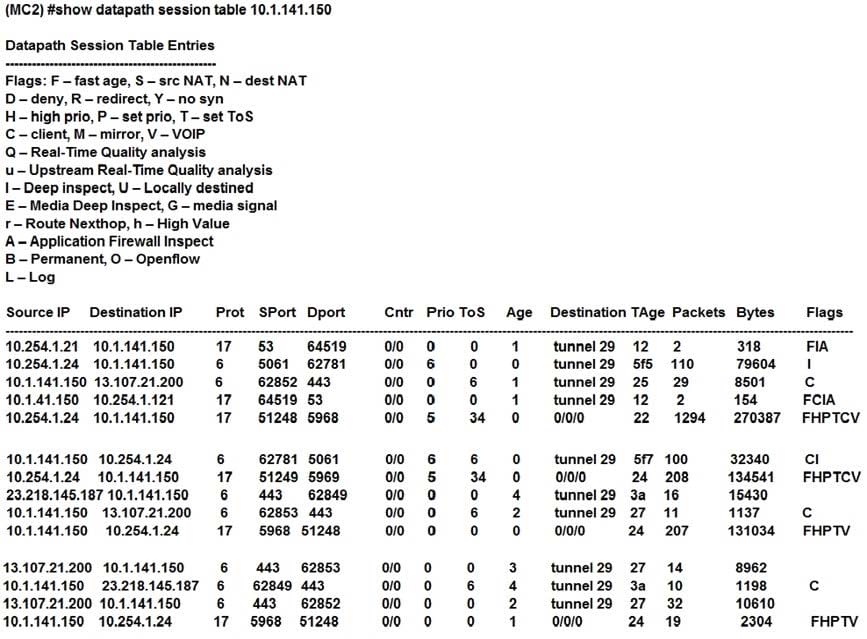
A network administrator deploys DSCP based prioritization in the entire wired network to improve voice quality for a SIP-based IP telephony system used by the company. However, users report that calls they make from the WLAN have poor audio quality, while desktop phones do not experience the same problem. The network administrator makes a test call and looks in the datapath session table.
Based on the output shown in the exhibit, what is one area that the network administrator should focus on?
A. wireless network congestion
B. WMM support on the WLAN
C. UCC based DSCP correction
D. wired network congestion
Questions 6
Company 1 and Company 2 are medium-sized companies that collaborate in a joint venture. Each
company owns a building, and each has their own ArubaOS 8 Mobility Master (MM)-Mobility Controller
(MC) deployment. The buildings are located in front of one another. For the initial stage of the project, the
companies want to interconnect their networks with fiber, and broadcast each other's SSIDs.
These are the requirements:
Do not unify the company's network management responsibilities.
Allow each company to take care of their own SSID setups when broadcasted in the other building.
Terminate Company 1 user traffic on Company 1 MCs when they connect to Company 2 APs.
Terminate Company 2 user traffic on Company 2 MCs when they connect to Company 1 APs.
What is needed to meet the solution requirements?
A. Multizone APs
B. Inter MC S2S Ipsec tunnels
C. Multi MC Clusters
D. Inter MC GRE tunnels
Questions 7
A software development company has 700 employees who work from home. The company also has small offices located in different cities throughout the world. During working hours, they use RAPs to connect to a datacenter to upload software code as well as interact with databases.
In the past two months, brief failures have occurred in the 7240XM Mobility Controller (MC) that runs ArubaOS 8.3 and terminates the RAPs. These RAPs disconnect, affecting the users connected to the RAPs. This also causes problems with code uploads and database synchronizations. Therefore, the company decides to add a second 7240XM controller for redundancy.
How should the network administrator deploy both controllers in order to provide redundancy while preventing failover events from disconnecting users?
A. Connect both controllers with common VLANs, and create an L2-connected cluster using public addresses in the internet VLAN.
B. Connect both controllers with common VLANs, and create an HA fast failover group with public addresses in the internet VLAN.
C. Connect both controllers with different VLANs, and create an L2-connected cluster using private addresses in the internet VLAN.
D. Connect both controllers with common VLANs, and configure LMS/BLMS values equal to public addresses in the internet VLAN.
Questions 8
Refer to the exhibit.
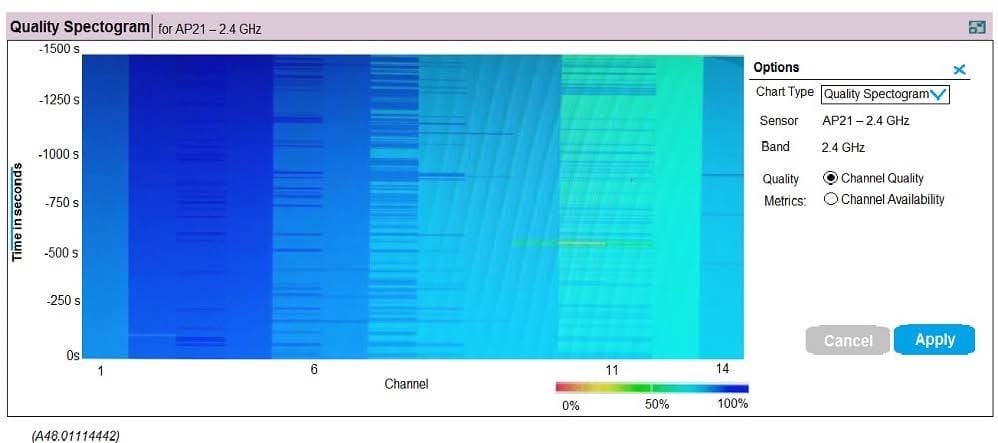
Based on the output shown in the exhibit, which channel offers the highest quality?
A. Channel 1
B. Channel 6
C. Channel 11
D. Channel 14
Questions 9
A financial institution contacts an Aruba partner to deploy an advanced and secure Mobility Master (MM)Mobility Controller (MC) WLAN solution in its main campus and 14 small offices/home offices (SOHOs). Key requirements are that users at all locations, including telecommuters with VIA, should be assigned roles with policies that filter undesired traffic. Also, advanced WIPs should be enforced at the campus only.
These are additional requirements for this deployment:
RAPs should ship directly to their final destinations without any pre-setup and should come up with the right configuration as soon as they get Internet access. Activate should be configured with devices MACs, serial numbers, and provisioning rules that redirect them to the standalone VMC at the DMZ Users should be able to reach DNS, FTP, Web and telephone servers in the campus as well as send and receive IP telephone calls to and from the voice 10.1.50.0/24 segment. Local Internet access should be granted.
Refer to the exhibit.
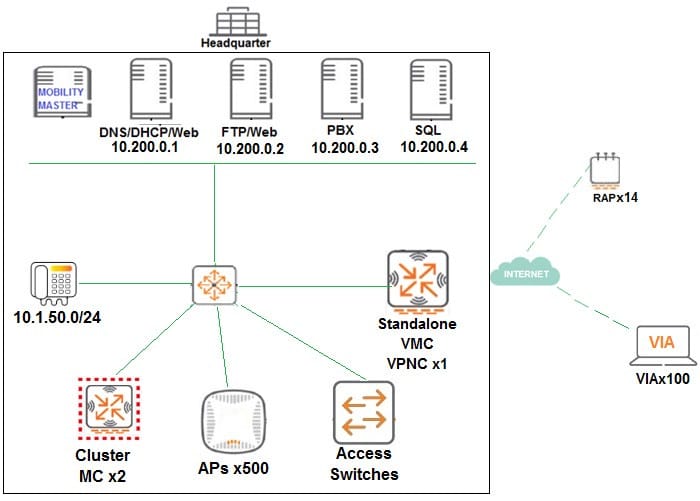
Refer to the scenario and the exhibit.
What is the minimal license capacity in use to support this proposal?
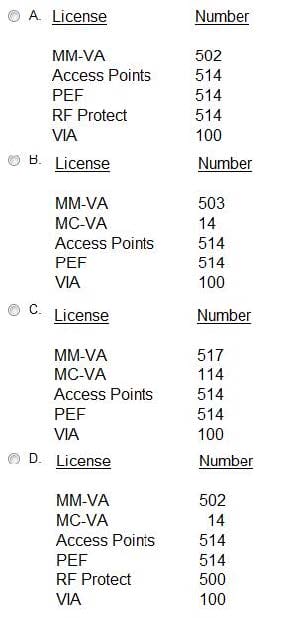
A. Option A
B. Option B
C. Option C
D. Option D
Questions 10
A network administrator assists with the migration of a WLAN from a third-party vendor to Aruba in different locations throughout the country. In order to manage the solution from a central point, the network administrator decides to deploy redundant Mobility Masters (MMs) in a datacenter that are reachable through the Internet.
Since not all locations own public IP addresses, the security team is not able to configure strict firewall policies at the datacenter without disrupting some MM to Mobility Controller (MC) communications. They are also concerned about exposing the MMs to unauthorized inbound connection attempts.
What should the network administrator do to ensure the solution is functional and secure?
A. Deploy an MC at the datacenter as a VPN concentrator.
B. Block all ports to the MMs except UDP 500 and 4500.
C. Install a PEFV license, and configure firewall policies that protect the MM.
D. Block all inbound connections, and instruct the MM to initiate the connection to the MCs.
Questions 11
An airline wants to invest in an Aruba Mobility (MM)-Mobility Controller (MC) solution for the three hubs it has throughout the country. A single MM is located in the datacenter at one of the hubs. The MCs in the other two hubs reach the MM through a site-to-site IPSec VPN.
The operations team does not want to lose monitoring and configuration control of the MCs if something happens to the datacenter where the MM resides.
Which solution ensures that there is management access to the MCs in case of an MM failure due to a datacenter outage?
A. Deploy another MM in a different location, and enable L2 redundancy.
B. Install AirWave Management Platform, and enable Read and Write Management access on devices.
C. Deploy another MM in a different location, and enable L3 redundancy.
D. Deploy a local MM on each hub, and synchronize the configuration between all MMs.
Questions 12
A network administrator needs to deploy L2 Mobility Master (MM) redundancy. MM1 uses IP address
10.201.0.10 and MAC address 1c:98:ec:25:48:50, and MM2 uses IP address 10.201.0.20 and MAC 1c:98:ec:99:8a:80. Both run VRRP process with VRID 201.
Which configuration should the network administrator use to accomplish this task?
A. /mm (MM1): database synchronize period 30 /mm/mynode (MM1): master-redundancy master-vrrp 201 peer-ip-address 10.201.0.20 ipsec key123 /mm/mynode (MM2): master-redundancy master-vrrp 201 peer-ip-address 10.201.0.10 ipsec key123
B. /mm (MM1): master-redundancy master-vrrp 10 peer-ip-address 10.201.0.20 ipsec key123 database synchronize period 30 /mm/mynode (MM2): master-redundancy master-vrrp 201 peer-ip-address 10.201.0.10 ipsec key123
C. /mm/mynode (MM1): master-redundancy master-vrrp 201 peer-ip-address 10.201.0.20 ipsec key123 database synchronize period 30 /mm/mynode (MM2): master-redundancy master-vrrp 201 peer-ip-address 10.201.0.20 ipsec key123 database synchronize period 30
D. /mm (MM1): database synchronize period 30 /mm/mynode (MM1): master-redundancy master-vrrp 201 peer-ip-address 10.201.0.10 ipsec key123 /mm/mynode (MM2): master-redundancy master-vrrp 201 peer-ip-address 10.201.0.20 ipsec key123
Questions 13
Refer to the exhibit.
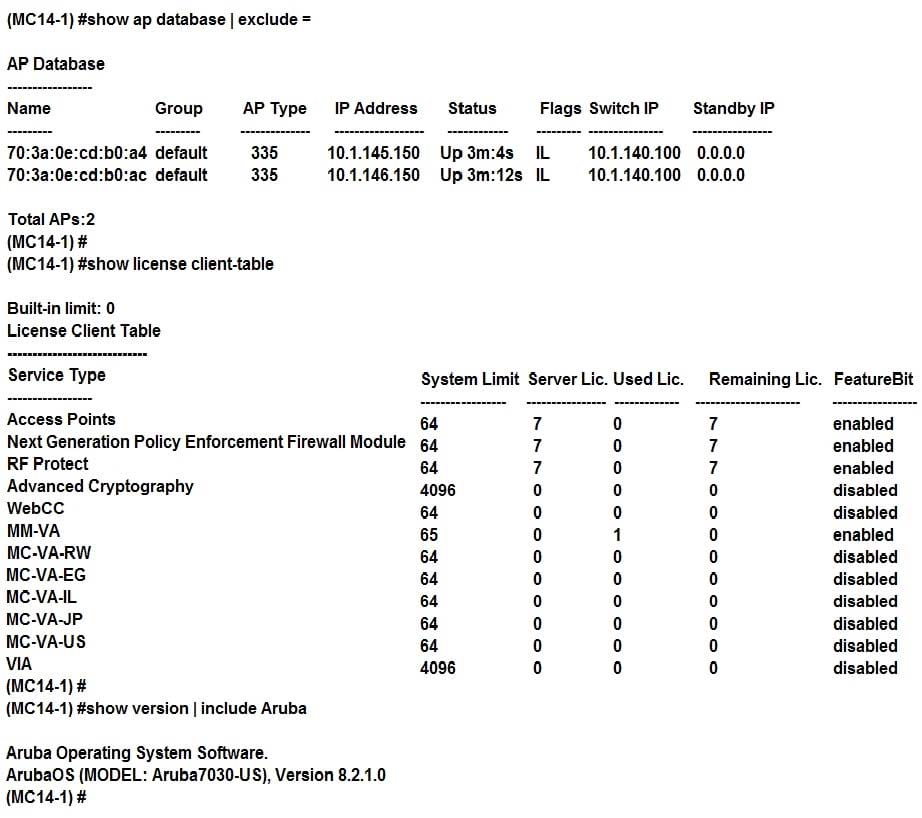
A network engineer configures some VAPs in customer groups and creates a pool of licenses with enough units for seven APs. The network engineer deploys the first two APs, looks at the ap database, and notices the APs are inactive and experience licensing-related issues.
Based on the show command outputs shown in the exhibit, what must the engineer do to solve the problem?
A. Allocate two more MM-VA licenses to the pool.
B. Allocate two more MC-VA-US licenses to the pool.
C. Allocate seven more MM-VA licenses to the pool.
D. Allocate seven more MC-VA-US licenses to the pool.


Home | About Us | Contact Us | FAQ | Guarantee Policy | Privacy Policy
Any charges made through this site will appear as Global Simulators Limited. All trademarks are the property of their respective owners.
Copyright © 2004-2026 pass2lead.com, All Rights Reserved.