

HPE6-A79 Online Practice Questions and Answers
Questions 4
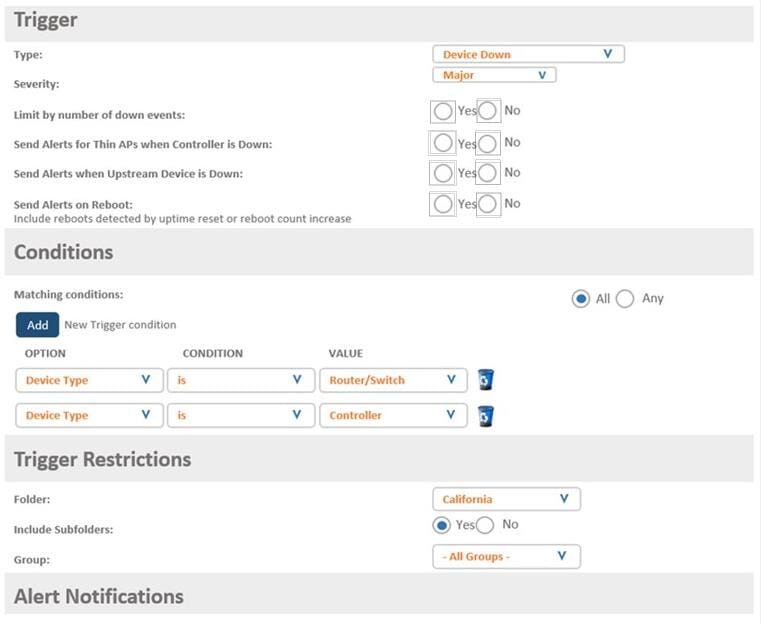
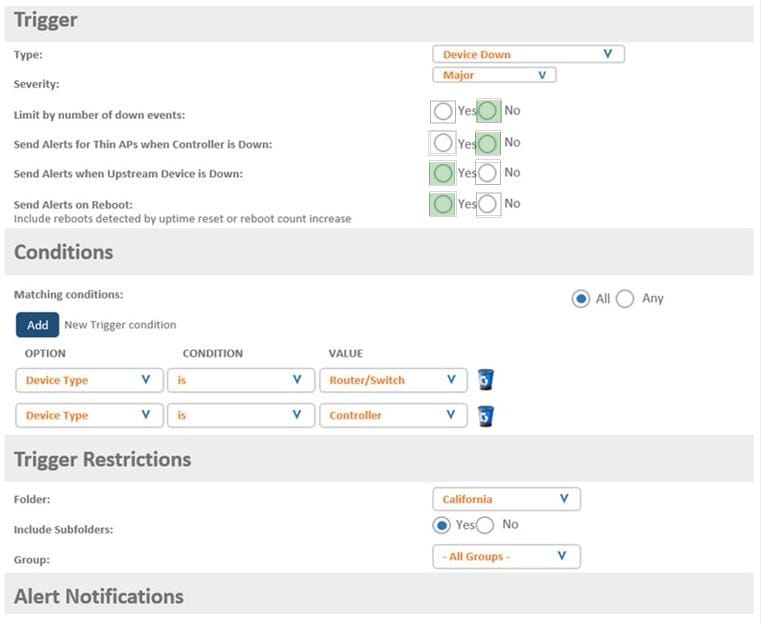
HOTSPOT
A network administrator wants to receive a major alarm every time a controller or an Aruba switch goes down for either a local or an upstream device failure. Which alarm definition must the network administrator create to accomplish this?
Hot Area:
Questions 5
A network administrator is in charge of a Mobility Master (MM) ?Mobility Controller (MC) based WLAN. The administrator has deployed an Airwave Management Platform (AMP) server in order to improve the monitoring capabilities and
generate reports and alerts.
The administrator has configured SNMPv3 and Admin credentials on both the MMs and MCs and has created Groups and Folders in the AMP server.
What two additional steps must the administrator do in order to let Airwave monitor the network devices? (Choose two.)
A. Manually add the Active MM and wait for automatic Discovery.
B. Map the AMP's IP address with a mgmt-config profile in the MM.
C. Set the AMP's IP address and Org string as DHCP option 43.
D. Manually add each MM, MC and Access Point in the AMP server.
E. Move "New" devices into a group and folder in Airwave.
Questions 6
Refer to the exhibit.
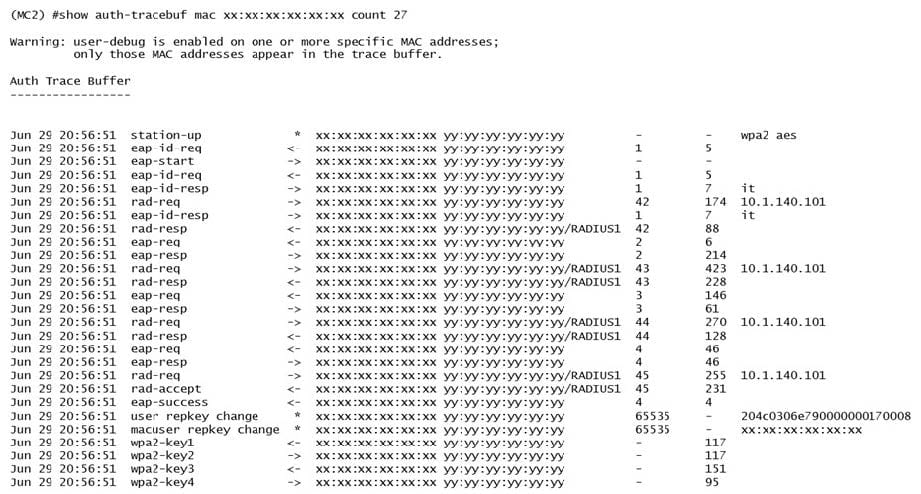
Based on the output shown in the exhibit, which wireless connection phase has just completed?
A. L3 authentication and encryption
B. MAC Authentication and 4-way handshake
C. 802.11 enhanced open association
D. L2 authentication and encryption
Questions 7
Refer to the exhibit.
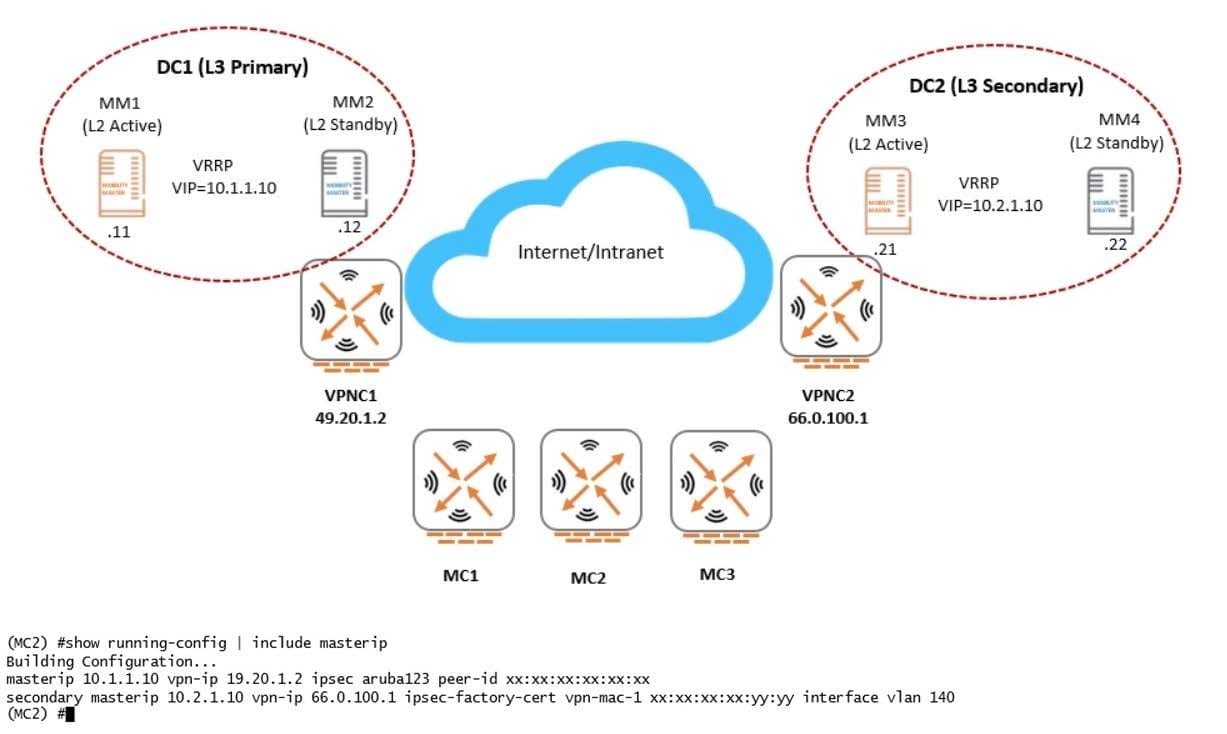
An Aruba network is deployed with L2 and L3 Mobility Master (MM) redundancy across two datacenters, as shown in the exhibit. The network administrator confirms that all Mobility Controllers (MC) are currently communicating with MM1, which is the L2 Active and, L3 Primary.
Which MM IP will MCs communicate with if MM1 fails?
A. 10.1.1.10
B. 10.1.1.12
C. 10.2.1.10
D. 10.2.1.21
Questions 8
An organization wants to deploy a WLAN infrastructure that provides connectivity to these client categories:
Employees Contractors Guest users Corporate IoT legacy devices that support no authentication or encryption Employees and contractors must authenticate with company credentials and get network access based on AD group membership. Guest users are required to authenticate with captive portal using predefined credentials. Only employees will run L2 encryption.
Which implementation plan fulfills the requirements while maximizing the channel usage?
A. Create VAP1 to run WPA2-AES and 802.1x authentication, VAP2 to run opensystem encryption with MAC authentication, and VAP3 to run opensystem with captive portal and L2 fail through.
B. Create a single VAP to run WPA2-AES and 802.1x authentication, MAC authentication L2 fail through, captive portal, and VIA support.
C. Create VAP1 to run WPA2-AES and 802.1x authentication, VAP2 to run opensystem encryption with MAC authentication, and VAP3 to run opensystem with captive portal.
D. Create VAP1 to run WPA2-AES and 802.1x authentication, and VAP2 to run opensystem encryption with MAC authentication and captive portal.
Questions 9
Refer to the exhibits. Exhibit 1

Exhibit 2
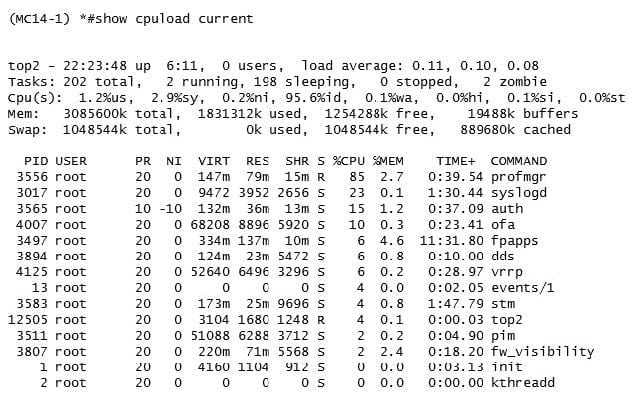
A network administrator adds a new Mobility Controller (MC) to the production Mobility Master (MM) and deploys APs that start broadcasting the employee SSID in the West wing of the building. Suddenly, the employees report client
disconnects. When accessing the MM the network administrator notices that the MC is unreachable, then proceeds to access the MC's console and obtains the outputs shown in the exhibits.
What should the network administrator do next to solve the current problem?
A. Open a TAC case and send the output of tar crash.
B. Kill two zombie processes then reboot the MC.
C. Verify the license pools in the MM.
D. Decommission the MC from the MM, and add it again.
Questions 10
Users run Skype for Business on wireless clients with no WMM support over an Aruba Mobility Master (MM) - Mobility Controller (MC) based network. When traffic arrives at the wired network, it does not include either L2 or L3 markings.
Which configuration steps should the network administrator take to classify and mark voice and video traffic with UCC heuristics mode?
A. Enable WMM in a VAP profile, and explicitly permit voice and video UDP ports in a firewall policy.
B. Confirm OpenFlow is enabled in the user role and VAP profile. Then enable WMM in a SSID profile, and explicitly permit voice and video UDP ports in a firewall policy.
C. Confirm the MC is the Openflow controller of the MMs and Openflow is enabled in VAP and firewall roles. Enable Skype4Business ALG in UCC profiles.
D. Confirm MM is the Openflow controller of MCs and Openflow is enabled in VAP and firewall roles. Enable Skype4Business ALG in UCC profiles.
Questions 11
Refer to the exhibit.

A network administrator completes the initial configuration dialog of the Mobility Controllers (MCs) and they join the Mobility Master (MM) for the first time. After the MM-MC association process, network administrator only creates AP groups, VAPs, and roles. Next, the network administrator proceeds with the configuration of the policies and creates the policy shown in the exhibit.
Which additional steps must be done to make sure this configuration takes effect over the contractor users?
A. Apply the policy in the contractors user role. Enable deep packet inspection. Reload the MCs.
B. Enable firewall visibility. Enable web-content classification. Reload the MCs.
C. Apply the policy in the contractors user role. Enable deep packet inspection.
D. Enable firewall visibility. Enable web-content classification. Reload the MMs.
Questions 12
Refer to the exhibits.

A network administrator deploys User Based Tunneling (UBT) in a corporate network to unify the security policies enforcement. When users authenticate with 802.1X, ClearPass shows Accept results, and sends the Aruba-User-Role attribute as expected. However, the AOS-CX based switch does not seem to build the tunnel to the Mobility Controller (MC) for this user.
Why does the switch fail to run UBT for the user?
A. The switch has not fully associated to the MC.
B. ClearPass is sending the wrong Vendor ID.
C. The switch is not configured with the gateway-role.
D. ClearPass is sending the wrong VSA type.
E. The switch is not configured with the port-access role.
Questions 13
Refer to the exhibit.

After deploying several cluster pairs, the network administrator notices that all APs assigned to Cluster1 communicate with MC1 instead of being distributed between members of the cluster. Also, no IP addresses are shown under the Standby IP column.
What should the network administrator do to fix this situation?
A. Apply the same cluster profile to both members.
B. Enable Cluster AP load balancing.
C. Rename the cluster profile as "CLUSTER1".
D. Place MCs at the same hierarchical group level.


Home | About Us | Contact Us | FAQ | Guarantee Policy | Privacy Policy
Any charges made through this site will appear as Global Simulators Limited. All trademarks are the property of their respective owners.
Copyright © 2004-2026 pass2lead.com, All Rights Reserved.