

JN0-347 Online Practice Questions and Answers
Questions 4
Which protocol prevents loops and calculates the best path through a switched network that contains redundant paths?
A. VRRP
B. STP
C. DHCP
D. IS-IS
Questions 5
What are three types of port designation specific to Private VLANs? (Choose three.)
A. Promiscuous ports
B. Transparent ports
C. PVLAN trunk ports
D. Designated ports
E. Isolated ports
Questions 6
Which two OSPF LSA types will you see in a stub area? (Choose two.)
A. network (Type 2)
B. summary (Type 3)
C. ASBR summary (Type 4)
D. external (Type 5)
Questions 7
Click the Exhibit button.
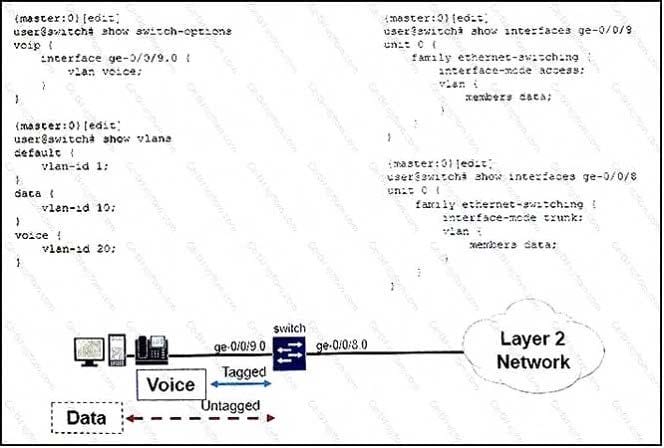
The configuration shown in the exhibit was committed on an EX Series switch. You are notified that the
phone using the voice VLAN does not work. You determine that voice traffic is not passing through the
local switch.
What should be done to solve the problem?
A. You should add the voice VLAN as a member on the ge-0/0/8.0 interface.
B. You should change the port mode on ge-0/0/9.0 to trunk.
C. You should add the voice VLAN as a member on the ge-0/0/9.0 interface.
D. You should change the voice VLAN ID to match the data VLAN ID.
Questions 8
You configured a GRE tunnel that traverses a path using default MTU settings. You want t o ensure that packets are not dropped or fragmented. In this scenario, what is the maximum packet size that would traverse the GRE tunnel?
A. 1476
B. 1500
C. 1400
D. 1524
Questions 9
Which two statements are true about Virtual Chassis? (Choose two.)
A. It is possible to automatically update the Junos OS on newly added members to participate in the Virtual Chassis
B. A software version mismatch on a newly added member must be placed in linecard mode.
C. Virtual Chassis members use VCCP to create a loop-free topology.
D. The member ID is not preserved through reboots.
Questions 10
Depending on the link type, OSPF sends link state update packets to which two addresses? (Choose two.)
A. 224.0.0.8
B. 224.0.0.6
C. 224.0.0.9
D. 224.0.0.5
Questions 11
Click the Exhibit button.
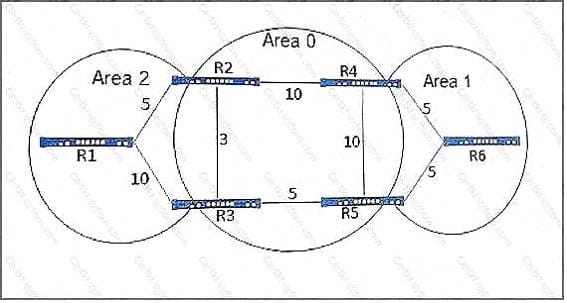
Referring to the exhibit, which path will traffic from R6 take to reach R1?
A. R6 > R4 > R2 > R1
B. R6 > R4 > R2 > R3 > R1
C. R6 > R5 > R3 > R1
D. R6 > R5 > R3 > R2 > R1
Questions 12
Click the Exhibit button. Referring to the exhibit, what does the asterisk (*) indicate?

A. The router received this entry.
B. This entry is stale.
C. This entry is new.
D. The router originated this entry.
Questions 13
Click the Exhibit button.
There are dynamically and statically routed networks attached to the ge-0/0/1 interface on R1. You only
want the dynamically learned routes to show up in routing tables for R2 and R3, but the statically routed
networks are also appearing. Those networks should only be seen by the R1 device.
Which actions would solve the problem?
A. Remove the IP address from interface ge-0/0/1.
B. Add the no-readvertise parameter to the static routes.
C. Create a routing policy for all routing protocols to drop routes learned from interface ge-0/0/1.
D. Place interface ge-0/0/1 into its own routing instance.


Home | About Us | Contact Us | FAQ | Guarantee Policy | Privacy Policy
Any charges made through this site will appear as Global Simulators Limited. All trademarks are the property of their respective owners.
Copyright © 2004-2026 pass2lead.com, All Rights Reserved.