

JN0-363 Online Practice Questions and Answers
Questions 4
Which statement is correct about IS-IS?
A. IS-IS is a distance vector routing protocol.
B. IS-IS is a path vector routing protocol.
C. IS-IS is a link-state routing protocol.
D. IS-IS is a classful routing protocol.
Questions 5
Exhibit
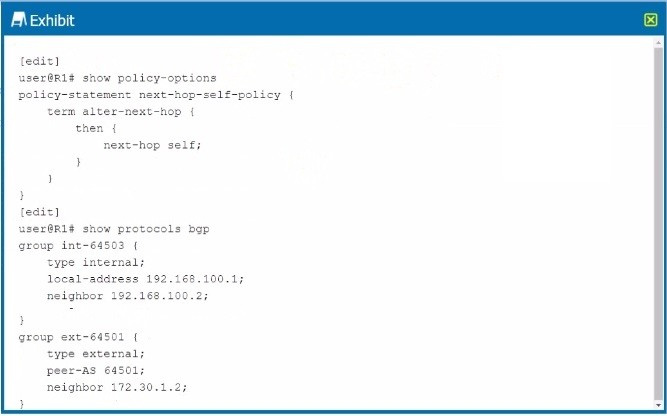
Referring to the exhibit, where should next-hop-self-policy be applied to alter the next-hop value?
A. The policy is applied as an export policy for the group int-64503.
B. The policy is applied as an export policy for the group ext-64501.
C. The policy is applied as an import policy for the group int- 64 503.
D. The policy is applied as an Import policy for the group ext-64501.
Questions 6
What is the correct order of BGP attributes for active route selection?
A. next hop -> local preference -> AS path -> MED -> origin
B. next hop -> AS path -> local preference -> origin -> MED
C. next hop -> local preference -> AS path -> origin -> MED
D. next hop -> origin -> local preference -> AS path -> MED
Questions 7
Click the Exhibit button.
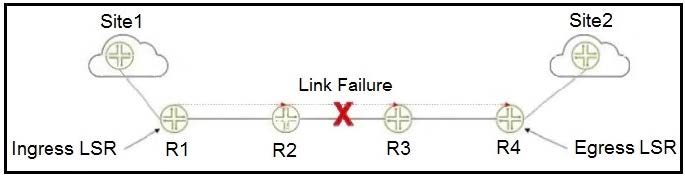
Referring to the exhibit, you have an established RSVP LSP between R1 and R4 when you experience a link failure between R2 and R3. Which two statements are correct? (Choose two.)
A. R2 sends a ResvTear message upstream to R1 signaling the link failure.
B. R3 sends a PathTear message downstream to R4 signaling the link failure.
C. R2 sends a PathTear message upstream to R1 signaling the link failure.
D. R3 sends a ResvTear message downstream to R4 signaling the link failure.
Questions 8
Exhibit You are advertising a summary route that represents your local network (172.20.0.0716) to both ISP A and ISPB. You want to influence all traffic sent to you from ISP C to go through R2. How would you accomplish this task?

A. On R1, prepend your AS number three times on the 172.20.0.0/16 route when advertising It to ISP 1.
B. On R1, change the local preference value to 250.
C. On R2. prepend your AS number three times on the 172.20.0.0/16 route when advertising it to ISP 2.
D. On R2, change the local preference value to 50.
Questions 9
Interface ge-0/0/0.0 connecls yout network to your ISP. You want to advertise this interface address as an Internal route In OSPF without creating a neighbor with your ISP. In this scenario, how is this task accomplished?
A. Remove interface ge-0/0/0.0 from OSPF.
B. Create a generated route for Interface ge-0/0/0.0.
C. Add ge-0/0/0.0 as a passive interface In OSPF.
D. Configure a static route for Interface ge-0/0/0.0.
Questions 10
Exhibit
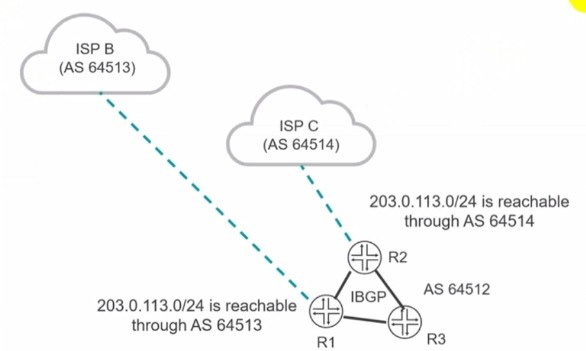
You want the R1 and R3 routers to forward traffic destined to the 203.0.113.0/24 network through R2. Which BGP attribute would you modify to satisfy this requirement?
A. community
B. origin
C. MED
D. local preference
Questions 11
Exhibit
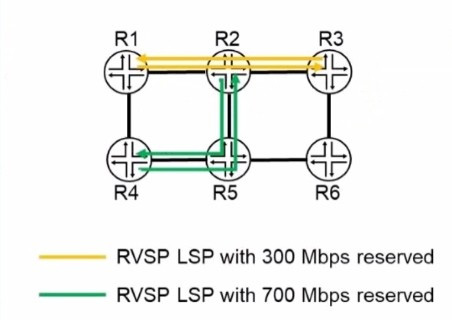
The exhibit shows a topology with 1 Gbps interfaces between routers, and four RSVP LSPs operating with the respective bandwidth reservations.
Which path will be selected for a new LSP from R4 to R6 with a bandwidth reservation of 400 Mbps?
A. R4 -> R1 -> R2 -> R5 -> R6
B. R4 -> R5 -> R6
C. R4 -> R5 -> R2 -> R3 -> R6
D. R4 -> R1 -> R2 -> R3 -> R6
Questions 12
Which two statements ate correct about the community BGP attribute on a Junos device? (Choose two.)
A. The community attribute is a mandatory BGP attribute.
B. If the community attribute is present, it is ignored and deleted in the BGP updates.
C. If the community attribute is present, it should be passed unchanged in the BGP updates.
D. The community attribute is an optional BGP attribute.
Questions 13
When would you use the qualified-next-hop statement with a static route?
A. You can use it to install the static route into different routing tables.
B. You can use it to send unwanted traffic to a null route.
C. You can use it to specify multiple next hops with different preferences.
D. You can use it to resolve the next hop if the next hop is not directly connected.


Home | About Us | Contact Us | FAQ | Guarantee Policy | Privacy Policy
Any charges made through this site will appear as Global Simulators Limited. All trademarks are the property of their respective owners.
Copyright © 2004-2026 pass2lead.com, All Rights Reserved.