

JN0-647 Online Practice Questions and Answers
Questions 4
Click the Exhibit.
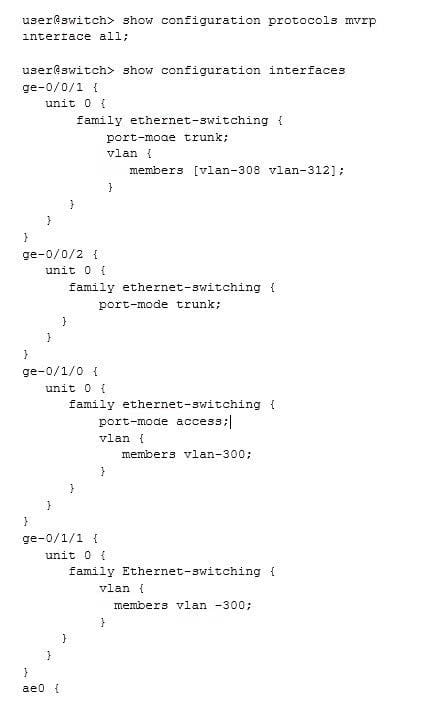
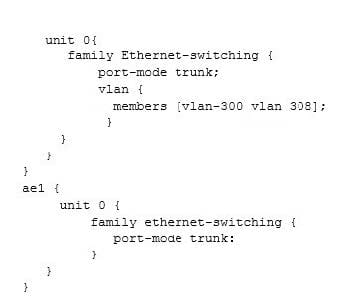
Referring to the exhibit, which set of interfaces will be registered by MVRP?
A. ge-0/1/0, ge-0/1/1, ae0, ae1
B. ge-0/1/0, ge-0/0/2, ae0, ae1
C. ge-0/0/1, ge-0/1/1, ae0, ae1
D. ge-0/0/1, ge-0/0/2, ae0, ae1
Questions 5
When configuring class of service, what would you use to allocate bandwidth to a forwarding class?
A. Buffer depth
B. Transmit rate
C. Bandwidth
D. Speed
Questions 6
Click the Exhibit button.
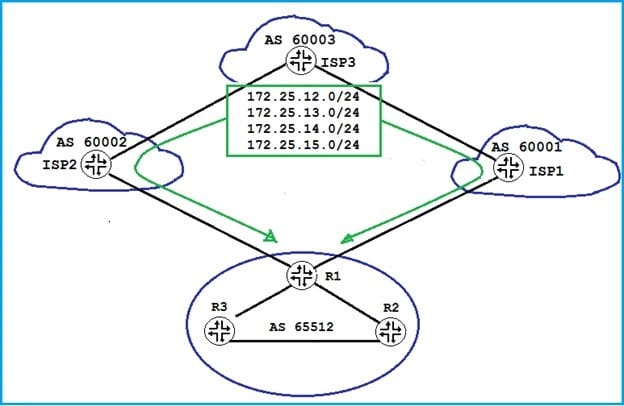
Referring to the exhibit, you have EBGP peerings with both ISP1 and ISP2. You are receiving the 172.25.12.0/24, 172.25.13.0/24, 172.25.14.0/24, and 172.25.15.0/24 routes through both neighbors. You must ensure that traffic to these prefixes are load balanced through both service providers. You have configured a load-balancing policy and have applied it to the forwarding table, but the prefixes are not being load balanced.
What is required to accomplish this task?
A. The multihop feature should be enabled between both neighbors.
B. The multipath multiple-as feature should be used between both neighbors.
C. The as-override feature should be used between both neighbors.
D. The include-mp-next-hop feature should be used between both neighbors.
Questions 7
Click the Exhibit button.
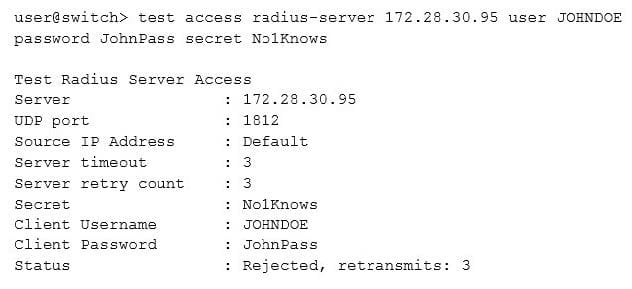
All of the clients attached to your EX4300 report that authentication to the network is abnormally slow. While troubleshooting, you individually test the RADIUS servers used for authentication and receive the information shown in the exhibit.
What happened to the RADIUS server 172.28.30.95?
A. The server is no longer reachable.
B. The RADIUS daemon went offline.
C. There is a RADIUS version mismatch.
D. Someone changed the RADIUS secret.
Questions 8
Which two statements are true about OSPFv3? (Choose two.)
A. OSPFv3 packets are sent using local subnet addressing.
B. OSPFv3 packets are sent using link local addressing.
C. The authentication mechanisms in OSPFv3 are the same mechanisms used in OSPFv2.
D. The authentication mechanisms from OSPFv2 are not present in OSPFv3.
Questions 9
Click the Exhibit button.
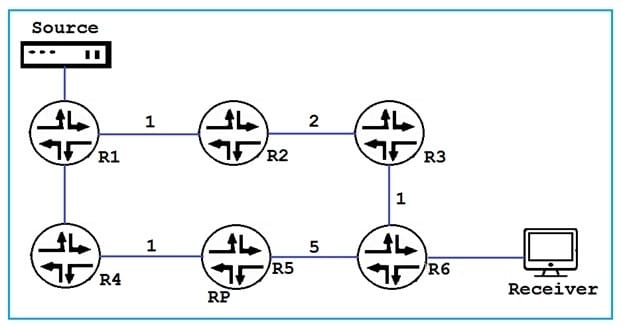
You have deployed Sparse Mode multicast in your network using the IGP metrics shown in the exhibit.
Which path will (*, G) traffic follow form the source to the receiver before the (S, G) state is registered?
A. Source, R1, R4, R5, R6, Receiver
B. Source, R1, R2, R5, R2, R3, R6 Receiver
C. Source, R1, R2, R3, R6, Receiver
D. Source, R1, R2, R5, R6, Receiver
Questions 10
Click the Exhibit button.
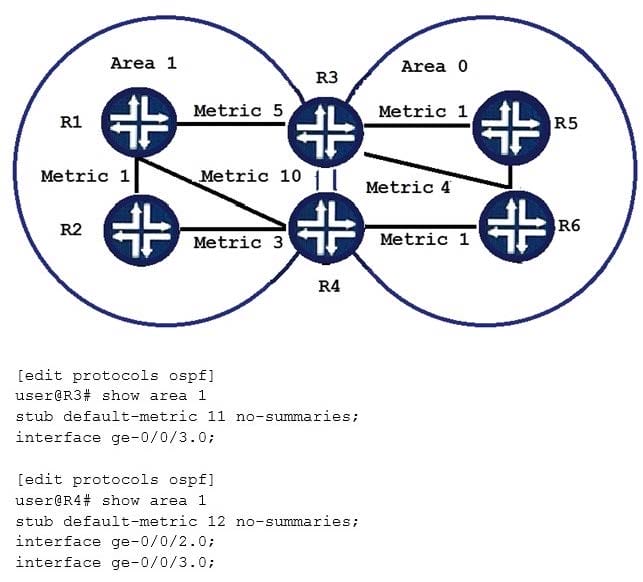
Referring to the exhibit, Area 1 is a stub area.
Which two statements are correct in this scenario? (Choose two.)
A. R2 will send traffic to unknown destinations using R1 or R4.
B. R1 will send traffic to unknown destinations using R3 or R4.
C. R1 will send traffic to unknown destinations using only R3.
D. R2 will send traffic to unknown destinations using only R4.
Questions 11
What information must you gather from the satellite device to provision a Junos Fusion Enterprise deployment on the aggregation device? (Choose two.)
A. MAC address
B. Serial number
C. Software version
D. Model number
Questions 12
In a Layer 2 environment where 802.1X is deployed with its default parameters on EX Series switches, which two statements are correct? (Choose two.)
A. RADIUS authentication requests are sent from the authenticator to the authentication server.
B. DHCP traffic from supplicants is denied by default through the authenticator.
C. RADIUS authentication requests are sent from the supplicant to the authentication server.
D. DHCP traffic from supplicants is permitted by default through the authenticator.
Questions 13
Which two statements about VSTP on EX series switches are connect? (Choose two.)
A. All VLANS beyond the first 64 will not be supported by VSTP
B. VSTP automatically assigns each VLAN to one spanning tree instances
C. VSTP must be used to intemperate with MVRP
D. VSTP must be used to intemperate with PVST+


Home | About Us | Contact Us | FAQ | Guarantee Policy | Privacy Policy
Any charges made through this site will appear as Global Simulators Limited. All trademarks are the property of their respective owners.
Copyright © 2004-2026 pass2lead.com, All Rights Reserved.