

JN0-649 Online Practice Questions and Answers
Questions 4
Referring to the exhibit, which two statements are correct? (Choose two.)
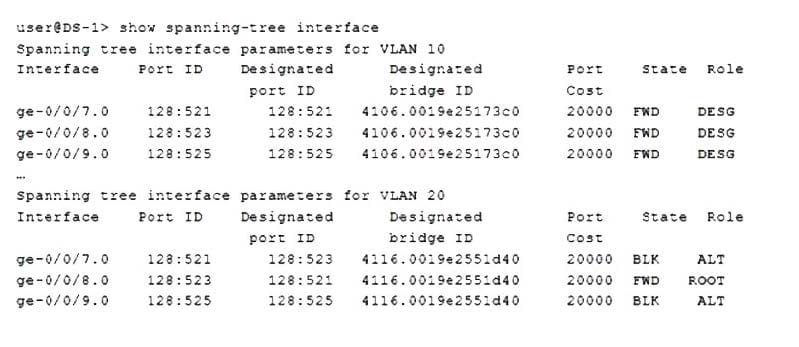
A. BPDUs from the root bridge for VLAN 10 have been received on the ge-0/0/7.0 interface.
B. DS-1 is the root bridge for VLAN 10.
C. BPDUs fromthe root bridge for VLAN 20 have been received on the ge-0/0/7.0 interface.
D. Default VSTP bridge priority values are configured.
Questions 5
Referring to the exhibit, a PIM-SM network is set up to enable communication between multicast devices.
Which two statements are true? (Choose two.)
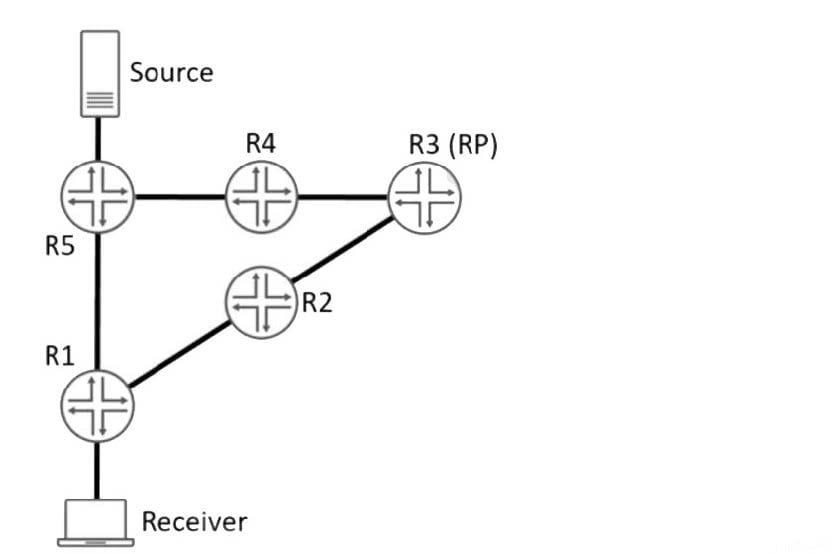
A. Before the formation of the rendezvous-point tree, a join message is sent from R1 to R3.
B. Before theformation of the rendezvous-point tree, an IGMP is sent from the Receiver to R1.
C. Before the formation of the rendezvous-point tree, an IGMP is sent from the Source to R5.
D. Before the formation of the rendezvous-point tree, a join message is sent from R1 to R5.
Questions 6
You are asked to troubleshoot voice quality issues on your newly implement VoIP network. You notice that the voice packets are being dropped. You haveverified that the packets are correctly marked for expedited forwarding queue.
Referring to the exhibit, what must you configure to solve the problem?


A. You must configure a multifield classifier to put the VoIP traffic in the correctqueue.
B. You must configure a rewrite rule to ensure that the traffic is scheduled properly in the device.
C. You must configure a scheduler to allocate bandwidth to the expedited forwarding queue.
D. You must configure a policer to ensure that the queueis not being starved.
Questions 7
You recently committed a change to a router to reject OSPF routes sourced from area 10. However, you are still seeing area 10 routes in the routing table. Referring to the exhibit, which statement is correct?
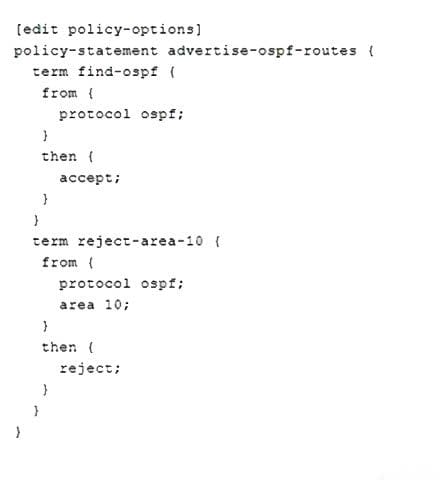
A. The OSPF protocol is first matched by find-ospf and accepted.
B. The routes only timeout after 24 hours.
C. The routes remain in the table until the device is rebooted.
D. The routes remain in the table until the routing daemon is restarted.
Questions 8
You must provide network connectivity to hosts that fail authentication.
In this scenario, what would be used in a network secured with 802.1X to satisfy this requirement?
A. Configure the native-vlan-id parameter on the port.
B. Use the server-reject-vlan command to specify a guest VLAN.
C. Configure a secondary IP address on the port for unauthenticated hosts.
D. Configure the port as a spanning tree edge port.
Questions 9
A user is attempting to watch a high-definition video being streamed from the mediaserver over the network. However, the user complains that the experienced video quality is poor. While logged on to router B, a Juniper Networks device, you notice that video packets are being dropped.
In this scenario, what would solve this problem?
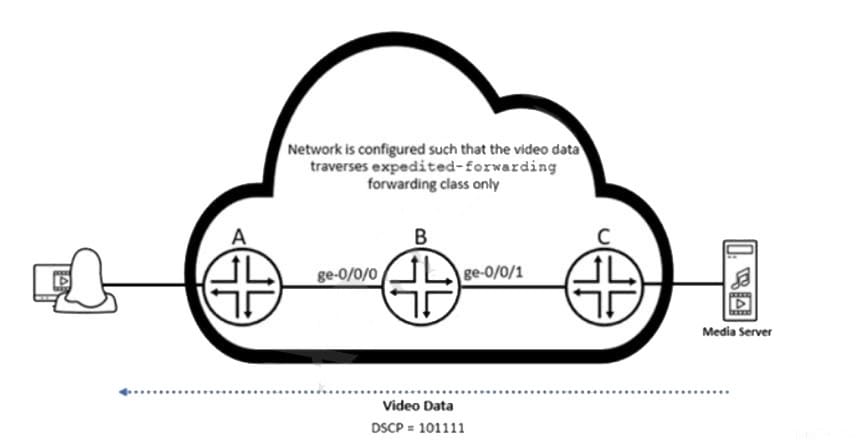
A. Adjust the scheduler for the expedited-forwarding forwarding class to support a higher transmit rate.
B. Adjust the expedited-forwarding BA classifier to router B's ge-0/0/0 interface to support a higher transmit rate.
C. Adjust thescheduler-map to support a higher transmit rate.
D. Adjust the expedited-forwarding BA classifier on router B's ge-0/0/1 interface to support a higher transmit rate.
Questions 10
Referring to the outputs shown in the exhibit, which two statements are correct about the IS-IS adjacency? (Choose two.)
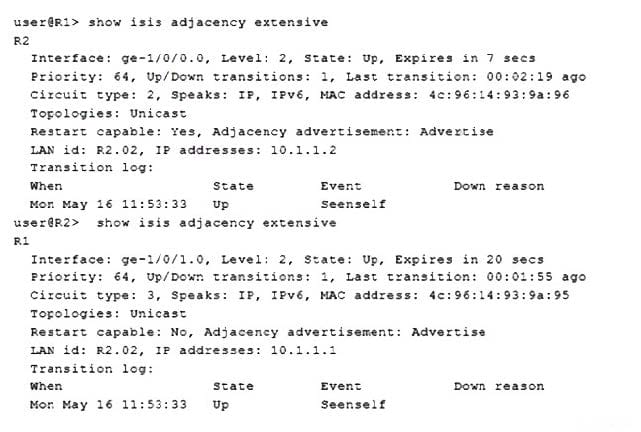
A. R1 is configured to participate in bothLevel 1 and Level 2.
B. R2 is configured to participate in both Level 1 and Level 2.
C. R1 is configured to participate in Level 2 only.
D. R2 is configured to participate in Level 2 only.
Questions 11
You are troubleshooting connectivity between an EVPN spine switch configured as a route reflector and a leaf node with an IP address of 10.30.100.6. Referring to the exhibit, what is the problem?
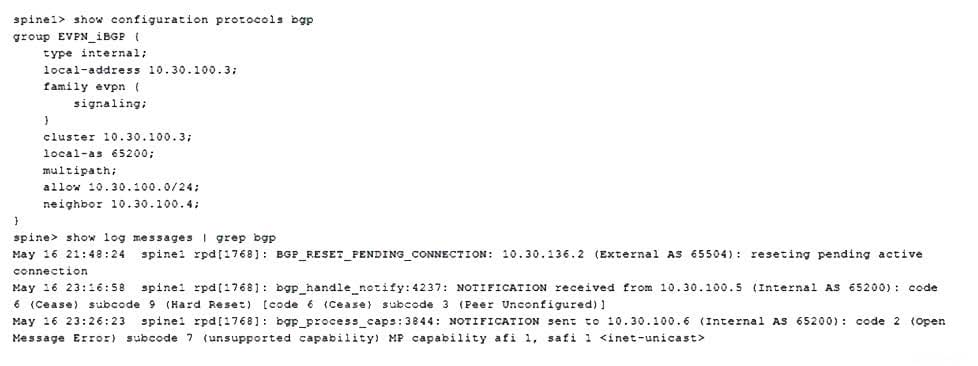
A. The neighbor 10.30.100.3 statement is missing from leaf1's configuration.
B. The spinenode is not configured for the family inet NLRI.
C. The neighbor 10.30.100.6 statement is missing from spine1's configuration.
D. The leaf node is not configured for the family evpn NLRI.
Questions 12
There are two BGP routes to 10.200.200.0/24 received from twoexternal peers. Route 1 comes from a neighbor with a router ID of 10.10.100.1 and a peer IP address of 10.10.30.1, and route 2 comes from a neighbor with a router ID of
10.10.200.1 and a peer IP address of 10.10.50.1. Both routes have the same MED value, origin value, AS path length, and local preference number.
In this scenario, which statement is correct about the active route?
A. Route 1 will be active because of the peer IP address.
B. Route 2 will be active because of the peer IP address.
C. Route 1 will be active because of the router ID.
D. Route 2 will be active because of the router ID.
Questions 13
You are deploying IP phones in your enterprise networks. When plugged in, the IP phones mustbe automatically provided with the correct VLAN ID needed for sending voice traffic to the EX Series switches.
In this scenario, which two solutions are required to accomplish this task? (Choose two.)
A. Enable LLDP-MED on appropriate access interfaces.
B. Create two VLANs and assign them as VLAN members to the appropriate access interfaces.
C. Enable the voice VLAN feature with the appropriate access interfaces and VLAN ID for voice traffic.
D. Use LLDP on appropriate interfaces.


Home | About Us | Contact Us | FAQ | Guarantee Policy | Privacy Policy
Any charges made through this site will appear as Global Simulators Limited. All trademarks are the property of their respective owners.
Copyright © 2004-2026 pass2lead.com, All Rights Reserved.