

JN0-662 Online Practice Questions and Answers
Questions 4
You want to add a new OSPF area to your existing OSPF network, however, this area will not be directly connected to Area 0. Which feature would you use to complete this task?
A. a routing policy
B. not-so stubby area
C. virtual link
D. Type 10 LSA
Questions 5
Click the exhibit button.
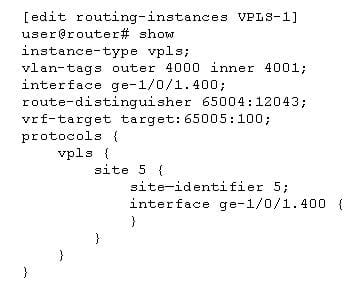
What would be the expected outcome from the configuration shown in the exhibit?
A. The VPLS instance would use a control-word instead of a tunnel-services interface, or no-tunnelservices parameter.
B. The VPLS instance would default to using no-tunnel-services because a tunnel-services interface was not specified.
C. The VPLS instance would cycle through all virtual tunnel interfaces on the router to find one to use.
D. The VPLS instance would cycle through all physical interfaces configured on the router to find one to use.
Questions 6
Click the Exhibit button.
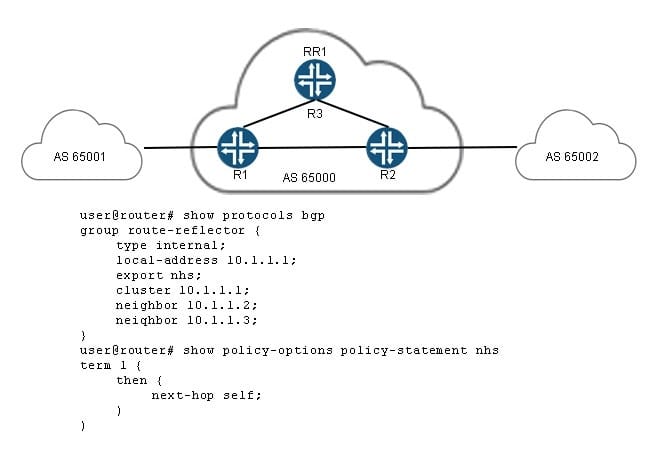
You administer AS 65000, and have deployed a route reflector (RR1) in your network as shown in the exhibit. The traffic between AS 65001 and AS 65002 is going through the route reflector, even though it is not the best path.
What will solve this problem?
A. Change the LOCAL_PREF so that it uses the preferred path.
B. Remove the nhs policy.
C. Change the originator to be the preferred path.
D. Change the IGP metric so it is lower on the preferred path.
Questions 7
Which authentication strategy authenticates IS-IS hello PDUs only?
A. interface authentication
B. area authentication
C. domain authentication
D. level authentication
Questions 8
Click the Exhibit button.
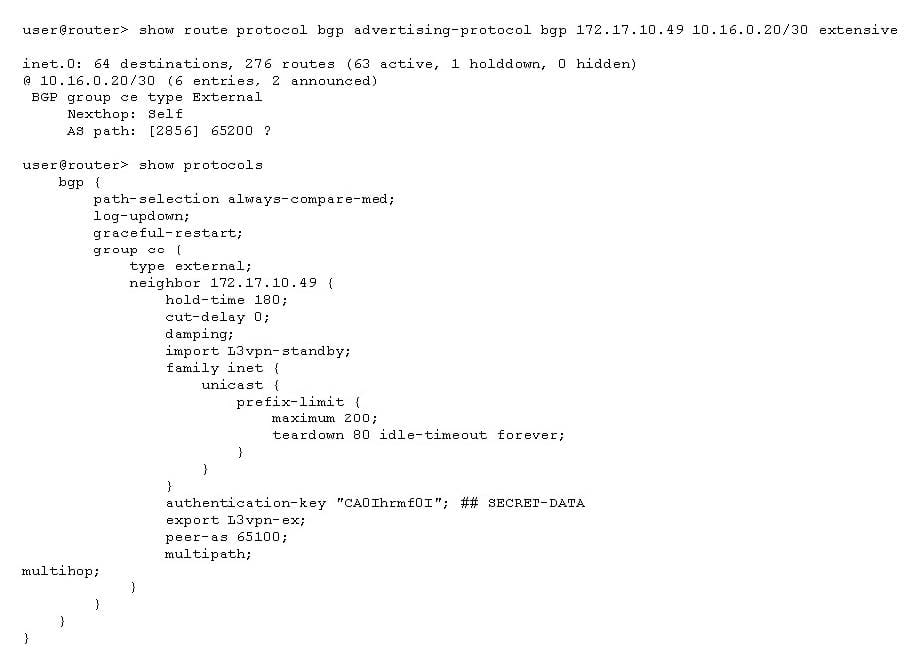
The route shown in the exhibit is being advertised to the EBGP peer and displays a next hop of itself. However, you do not have a next-hop self policy configured. What would cause this behavior?
A. The IBGP peers have a next-hop self policy, which the router is exporting to the EBGP neighbors.
B. The set protocols bgp path-selection as-path-ignore is not set and must be added so the next-hop attribute will propagate from the peer.
C. The set protocols bgp accept-remote-next hop is not set and must be added so the next- hop attribute will propagate from the peer.
D. The next-hop attribute was modified by default when it was advertised to the EBGP peer, without applying a policy.
Questions 9
You want to use IS-IS on a GRE interface where the underlying Layer 3 MTU is 1500.
Which statement is correct in this scenario?
A. IS-IS can be used because every IS-IS interface must be capable of transmitting packets at least as large as 1476 bytes, and the GRE header is 24 bytes.
B. IS IS can be used, but the networking device directly attached to the circuit must be capable of fragmentation.
C. IS-IS cannot be used, but the router can enable a GRE key that serves the same function as IS-IS.
D. IS-IS cannot be used because the IS-IS hello is not allowed to be fragmented and has the DF bit set.
Questions 10
Click the Exhibit button.
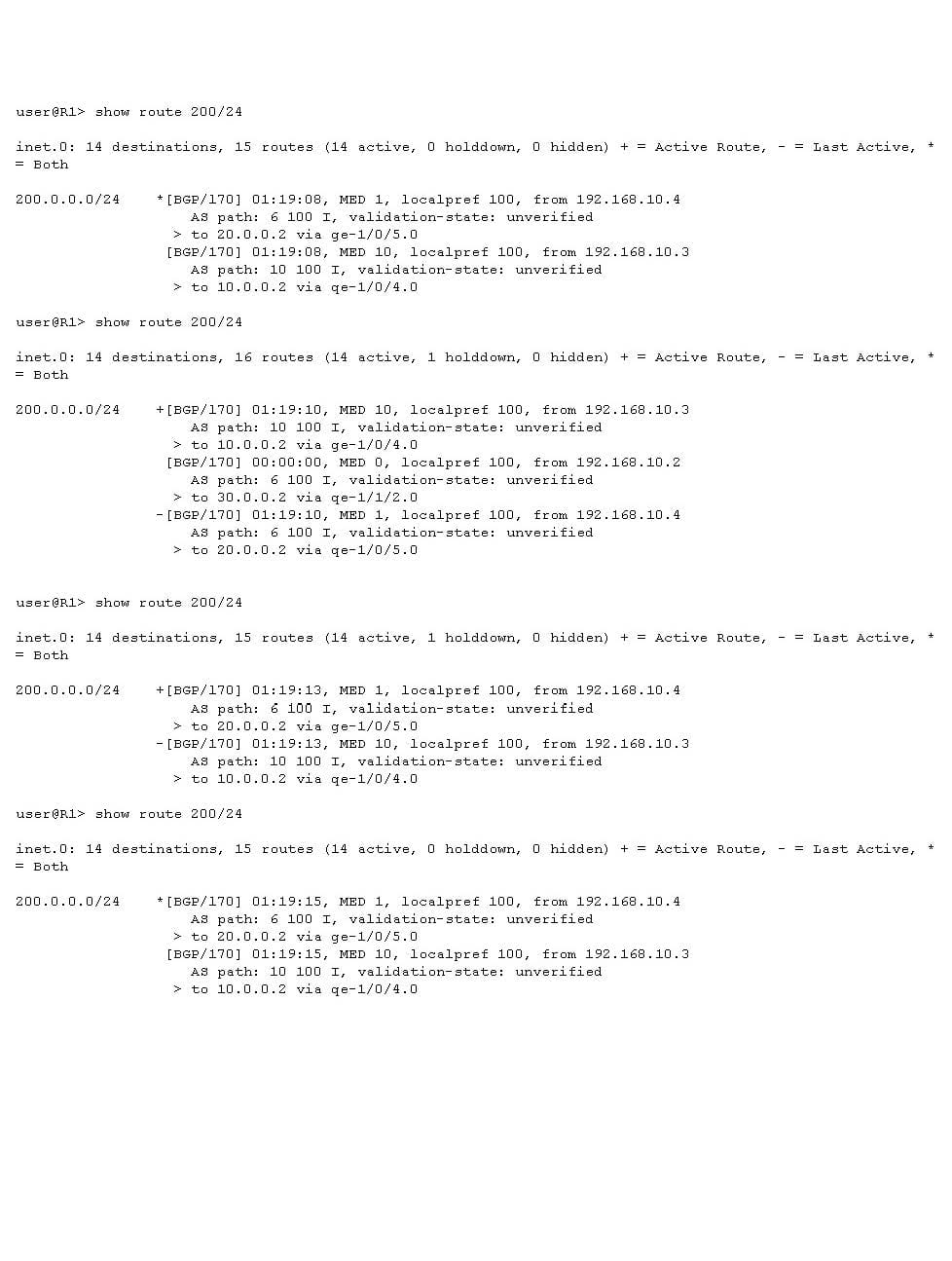
You have deployed route reflectors in your network. You are receiving the route 200.0.0.0/24 from AS10 and AS6 and are seeing the oscillation happening as shown in the exhibit.
What are two ways to solve this issue? (Choose two.)
A. Configure the always-compare-med parameter on both route reflectors.
B. Configure the add-path parameter on both route reflectors.
C. Configure the med-plus-igp parameter on both route reflectors.
D. Configure the as-path-ignore parameter on both route reflectors.
Questions 11
Click the Exhibit button.
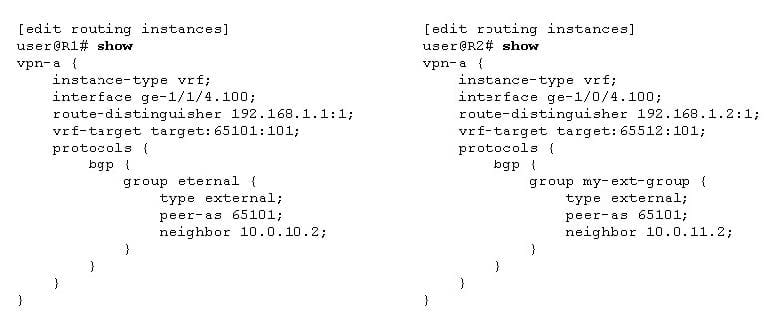
Referring to the exhibit, why are R1 and R2 not exchanging routes between their VPNs?
A. The route targets are not property configured.
B. The IP addresses in the BGP configuration must be in the same subnet.
C. The interfaces unit numbers must be the same on both sides.
D. The route distinguishers are not properly configured.
Questions 12
You are configuring a BGP-signaled Layer 2 VPN service. Which two statements are true in this scenario? (Choose two.)
A. RSVP-signaled LSPs are required.
B. The family 12vpn auto-discovery-only parameter is required for BGP sessions.
C. The family 12vpn signaling parameter is required for BGP sessions.
D. RSVP-signaled or LDP-signaled LSPs may be used.
Questions 13
Click the Exhibit button.
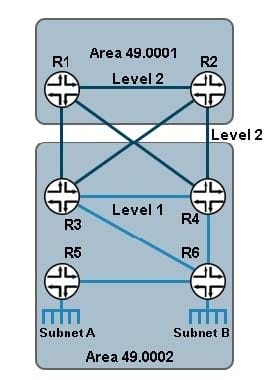
R5 must advertise Subnet A into IS-IS so that Subnet A and Subnet B can communicate. Subnet B must be able to forward traffic to Subnet A and towards Area 49.0001. However, R5 should not be able to route traffic from Subnet A to Area 49.0001.
Referring to the exhibit, how would you solve this problem?
A. Configure Level 2 on all links in Area 49.0002.
B. Configure the set protocols isis ignore-attached-bit parameter on R5.
C. Configure the set protocols isis overload parameter on R6.
D. Configure an export policy on R6 to reject all routes except Subnet B towards R5.


Home | About Us | Contact Us | FAQ | Guarantee Policy | Privacy Policy
Any charges made through this site will appear as Global Simulators Limited. All trademarks are the property of their respective owners.
Copyright © 2004-2026 pass2lead.com, All Rights Reserved.