

JN0-663 Online Practice Questions and Answers
Questions 4
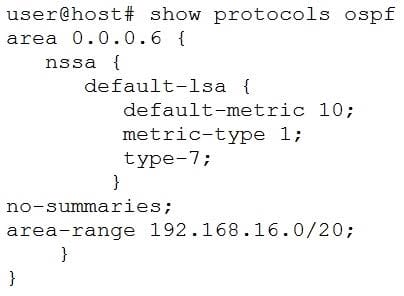
Referring to the ABR configuration shown in the exhibit, which three statements are correct? (Choose three.)
A. The ABR advertises a default route to the NSSA using a Type 7 LSA.
B. The ABR advertises a single Type 3 summary LSA to the backbone area for all Type 1 and Type 2 LSAs in the 192.168.16.0/20 range.
C. The ABR advertises a Type 5 external LSA to the backbone area for each Type 7 LSA in the NSSA.
D. The ABR does not summarize any routes within the 192.168.16.0/20 range.
E. The ABR advertises a single Type 5 external LSA to the backbone area for all Type 7 LSAs in the NSSA.
Questions 5
Which two statements about wide and narrow metrics used in IS-IS are correct? (Choose two.)
A. Wide metrics are enabled with the wide-metrics-only parameter under protocols isis hierarchy.
B. Narrow metrics are enabled by default and use 8 bits in TLVs to send information.
C. Wide metrics are sent by default and use 24 bits in TLVs to send information.
D. Disabling narrow metrics results in external routes being leaked from L1 to L2 areas automatically.
Questions 6

Which three statements are true about the show pim join output shown in the exhibit? (Choose three.)
A. This is a source-specific multicast stream.
B. The multicast receiver is still using the RP to receive the stream.
C. The multicast stream has been configured with a backup path to allow for fast reroute.
D. The multicast stream does not have an RP.
E. The shortest path to the source is through the RP.
Questions 7
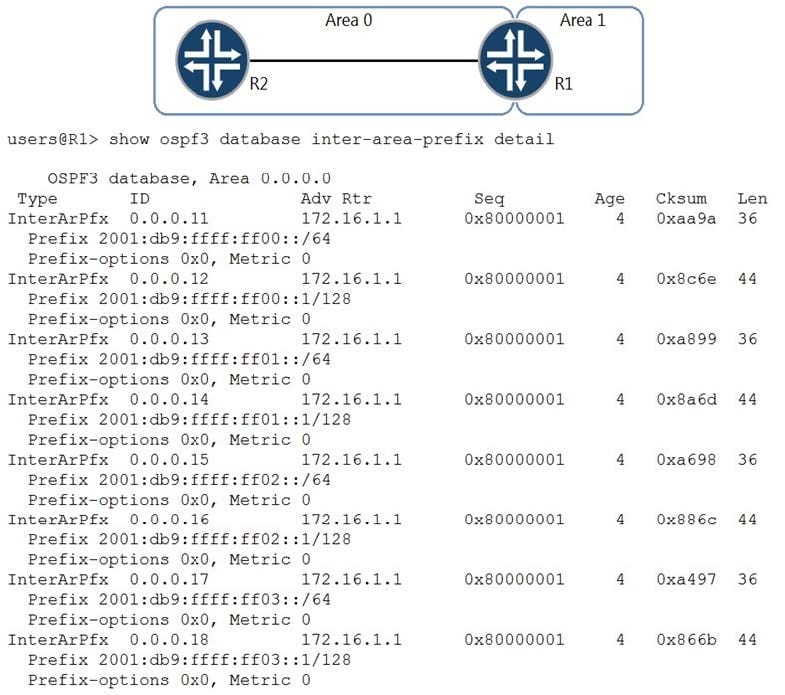
Referring to the exhibit, which command would reduce the size of the OSPF database and corresponding routes?
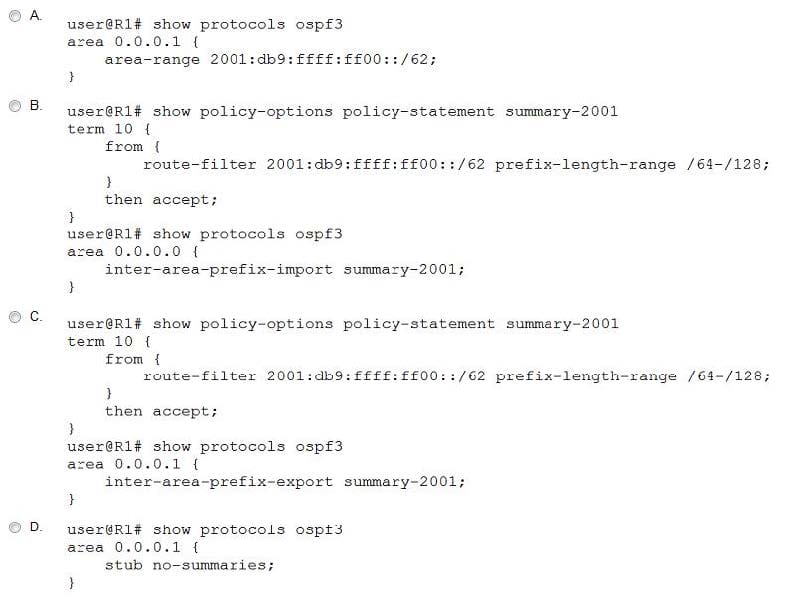
A. Option A
B. Option B
C. Option C
D. Option D
Questions 8
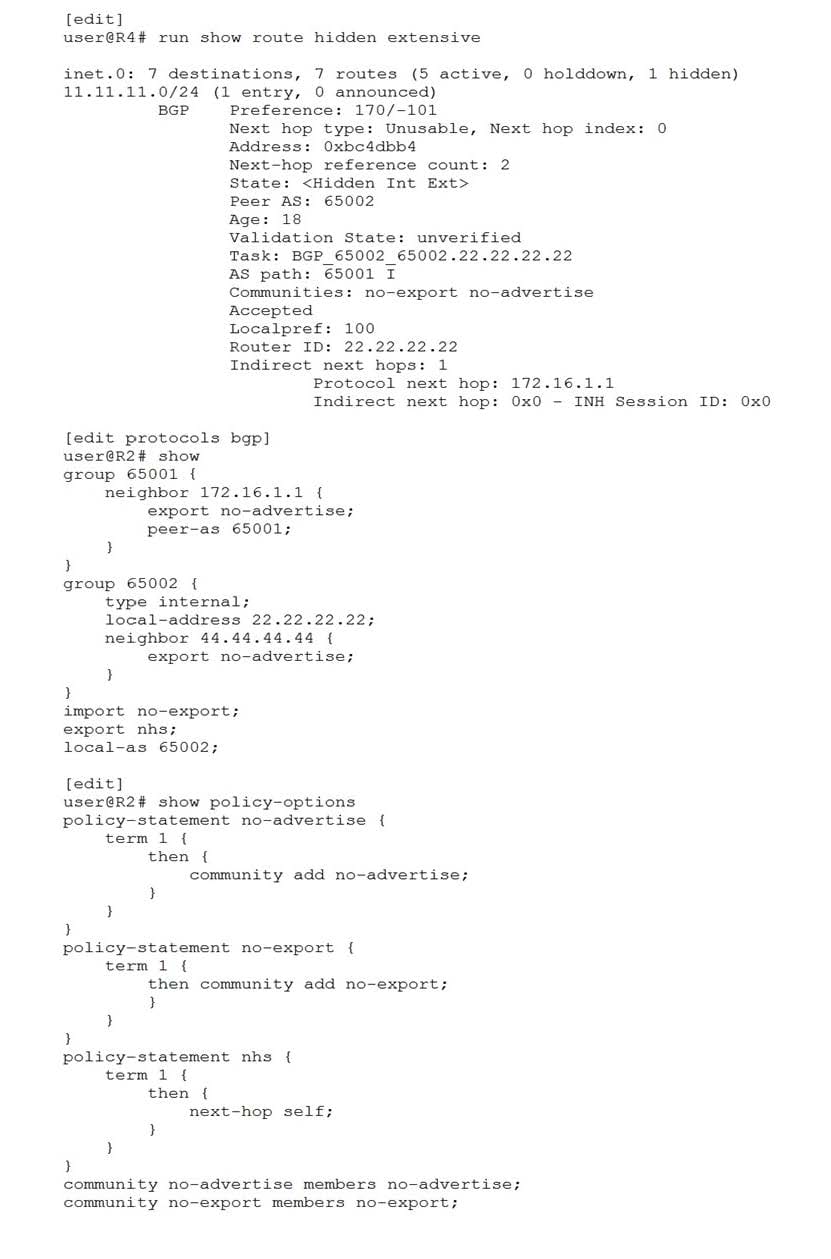
R2 is receiving a route from an EBGP neighbor and is advertising the route to R4.
Referring to the exhibit, which configuration on R2 will solve the issue with the route on R4?
A. Move the no-advertise export policy from group 65002 to a global BGP policy.
B. Move the nhs policy from a global BGP export policy to an export policy under group 65002.
C. Move the no-export policy from a global BGP import policy to an import policy under group 65001.
D. Move the no-advertise export policy from group 65001 to a global BGP policy.
Questions 9

You have a Layer 3 VPN established between PE-1 and PE-2 as well as between PE-1 and PE-3. You are using a route reflector (RR-1) to distribute VPN routes to your IBGP peers. You are asked to ensure that only relevant routes are sent from RR-1 to each of the PE routers.
Referring to the exhibit, which statement is correct?
A. You should use VRF export policies on RR-1 to control which routes are sent to each PE router.
B. You should use route target filtering only on RR-1 to control which routes are sent to each PE router.
C. You should use firewall filtering on RR-1 and all the PE devices to control which routes are sent to each PE router.
D. You should use route target filtering on RR-1 and all the PE devices to control which routes are sent to each PE router.
Questions 10
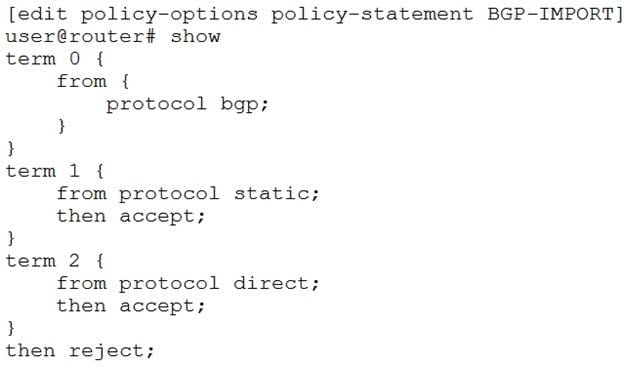
You are troubleshooting a problem with a BGP peer where BGP routes are not being accepted from that peer.
Referring to the exhibit, which two statements are correct? (Choose two.)
A. Term 0 is missing a terminating action that allows BGP routes to be accepted.
B. Term 0 is missing a route-filter that specifies the allowed routes.
C. The reject at the end of the policy is preventing the routes from being accepted.
D. You cannot have terminating actions outside of terms.
Questions 11
You must deploy an interprovider VPN option that ensures that the ASBRs do not need to store any VPN routes.
In this scenario, which interprovider VPN option should you choose?
A. option A
B. option B
C. option D
D. option C
Questions 12
A customer recently migrated to IS-IS and is concerned about resource starvation when the routing protocol daemon (RPD) starts.
To resolve this issue and protect R2 and R3, which feature should you implement?
A. Double the policy-options damping half-life timer to let the network settle.
B. Implement the overload bit and timer to signal service availability.
C. Deploy firewall filters to limit the prefix count in the route table.
D. Use the forwarding-options ip-options-protocol-queue parameter to increase resources.
Questions 13
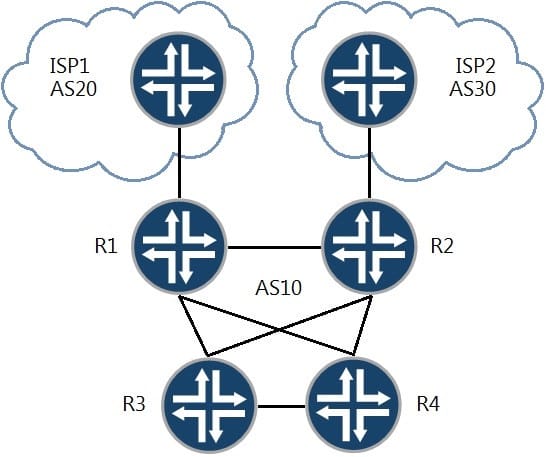
Referring to the exhibit, you want to make ISP1 your preferred connection for inbound and outbound traffic.
Which two steps will accomplish this task? (Choose two.)
A. Create an export policy setting local-preference 200 and next-hop self and apply it to the IBGP peers on R2.
B. Create an export policy to prepend the ASN on advertised routes and apply it to the EBGP peer on R1.
C. Create an export policy to prepend the ASN on advertised routes and apply it to the EBGP peer on R2.
D. Create an export policy setting local-preference 200 and next-hop self and apply it to the IBGP peers on R1.


Home | About Us | Contact Us | FAQ | Guarantee Policy | Privacy Policy
Any charges made through this site will appear as Global Simulators Limited. All trademarks are the property of their respective owners.
Copyright © 2004-2026 pass2lead.com, All Rights Reserved.