

MCAT-TEST Online Practice Questions and Answers
Questions 4
The mind, just like the body, has its needs. The needs of the body are the foundations of society; those of the mind are its amenities. While government and laws provide for the safety and well-being of men when they gather together, the sciences and the arts, which are less despotic but perhaps more powerful, spread garlands of flowers over the iron chains that bind them, stifle in them the sense for that original liberty for which they seem to have been born, cause them to love their own enslavement, and turn them into so-called "civilized people." Necessity raised thrones; the sciences and the arts have strengthened them. O earthly powers: cherish talents and protect those who cultivate them. O civilized people, cultivate them: you happy slaves owe to them that delicate and refined taste of which you are so proud, that gentleness of character and urbanity of manner which make relations among you so amiable and easy -- in other words, that semblance of all the virtues, none of which you actually possess... ...How pleasant it would be to live among us, if our external appearance were always a reflection of what is in our hearts, if decency were virtue, if our maxims served as our rules, and if true philosophy were inseparable from the title of philosopher! But so many qualities are seldom found together, and virtue hardly ever walks in such great pomp. Richness of adornment may be the mark of a man of taste, but a healthy, robust man is known by other signs: it is beneath the rustic clothes of a farmer, and not the gilt of a courtier, that strength and vigor of the body will be found. Ornamentation is just as foreign to virtue, which is the strength and vigor of the soul. The good man is an athlete who prefers to compete in the nude: he disdains all those vile ornaments which would hinder the use of his strength, ornaments which were for the most part invented only to hide some deformity. Before art had molded our manners and taught our passions to speak an affected language, our customs were rustic but natural, and differences in conduct revealed clearly differences in character. Human nature, basically, was no better, but men found security in being able to see through each other easily, and this advantage, which we no longer appreciate, spared them many vices. Now that more subtle refinements and more delicate taste have reduced the art of pleasing to set rules, a base and deceptive uniformity prevails in our behavior, and all minds seem to have been cast in the same mold. Incessantly politeness and propriety make demands on us, and incessantly we follow usage but never our own inclinations. We no longer dare to appear as we are, and under this perpetual constraint, the men who form this herd called society, when placed in the same circumstances, will all act similarly unless stronger motives direct them to do otherwise. Therefore we will never know well those with whom we deal, for to know our friends we will have to wait for some crises to arise -- which is to say that we will have to wait until it is too late, as it is for these very crises that it is essential to know one's friends well. What vice would not accompany this uncertainty? No more sincere friendships, no more genuine esteem, no more well-based confidence. Suspicion, offenses, fears, coldness, reserve, hatred and betrayal will constantly hide under the same false veil of politeness, under that much touted urbanity which we owe to the enlightenment of our times. The name of the Master of the Universe will no longer be profaned by swearing, but insulted by blasphemies that will not offend our scrupulous ears. Men will not boast of their own merits, but belittle those of others. An enemy will not be crudely insulted, but adroitly slandered. National hatreds will die, but so will patriotism. A dangerous skepticism will take the place of the scorning of ignorance. Some excesses will be forbidden, some vices dishonored, but others will be dignified with the name of virtues, and one must either have them or feign them. Let those who want to praise the sobriety of the sages of our time do so; as for me, I see in it only a refinement of intemperance that is as unworthy of my praise as their hypocritical simplicity.
In the context of this passage, the "needs of the body" are to government and laws as:
A. the arts are to the "earthly powers" that "cherish talents."
B. the arts are to the "semblance of all the virtues."
C. the arts are to chains that bind men into slavery.
D. the arts are to man's sense of original liberty.
Questions 5
For the last two decades many earth scientists have supported the notion that the Mediterranean was once a huge, dry desert, lying 3,000 meters below sea level. This "death valley" was thought to have existed at the end of Miocene time, about 6 to 5.5 million years ago.... ...From a geological point of view, the Mediterranean is a tectonically mobile land-enclosed depression -- small (about 3,000,000 square kilometers) in comparison to the major world oceans...Immediately obvious on all charts is the highly variable topography and relief of both the seafloor and adjacent borderland. The coastline is highly irregular and continental shelves, though generally narrow, are well developed off the major river deltas (Nile, Rhone, Po, and Ebro). Moreover, the deep-sea basins and trenches have distinctive relief, with basin plains ranging in depth from less than 1,000 meters to more than 4,000...Observation that rocks dredged offshore are similar to those on land raised a fundamental concept -- the key to understanding Mediterranean history lies in the adjacent emerged land masses, and vice- versa.... ...Early paleographic reconstructions showed that the once-open communication with the Atlantic deteriorated during the upper Miocene. Water-mass exchange continued for a while in the Rif Strait, but then ceased completely prior to the beginning of the Pliocene.... ...High relief near what is now the Strait of Gibraltar served as a barrier to the exchange of waters with the Atlantic. Exposed to a hot and dry climate, water evaporated and the then-dry basin elicited comparison with a gigantic Death Valley... Microfossil studies suggested that the depth of the Mediterranean basin at these times had been "deep." Estimates suggested a dry seafloor as far as 2,000 meters below ocean level... As a response to suddenly lowered sea level, rivers feeding the Mediterranean and canyons on the now-dry seafloor began a geologically dramatic phase of erosion. Deep, Grand Canyon-like gorges of the Nile and Rhone rivers, presently buried on land, were apparently cut during a great drawdown of water -- when the Mediterranean floor lay exposed 1,000 meters or more below its present level...The sudden flooding through a gigantic waterfall at Gibraltar drowned the exposed basin floor. These falls would have been 1,000 times bigger than Niagara Falls...This flooding event is recorded by the Miocene Pliocene boundary, a time when open marine faunal assemblages were suddenly reintroduced from the Atlantic.... ...Geological theories usually fall at a glacial pace into a sea of controversy, and this one is no exception. Today -- charging that proof for the theory is lacking -- many scientists believe that the Med always contained saltwater, with only the depth of the seafloor and the water being in question... Some of the tenets on which the theory was formulated are, if not defective, very seriously in question. To interpret their findings, a respectable number of geologists studying the surrounding emerged borderland as well as subsea sections indicate that alternative, more comprehensive concepts must be envisioned.... ...It is not realistic to envision the Mediterranean seafloor of about 5 million years ago as a desert at 3,000 meters below present ocean level. Several years ago...the Mediterranean [was compared] to a complex picture- puzzle that comprises numerous intricate pieces, many of which are already in place. A general image is emerging, although gaps in some areas of the picture remain fuzzy and indistinct.
In the context of the passage, the term "emerged land masses" (lines 19-20) refers to: A. regions of land that surround the Mediterranean.
B. barriers that develop into waterfalls.
C. saline-concentrated soil that extracts water from surrounding tributaries.
D. continents that have come to touch one another.
Questions 6
Gauguin's attitude toward art marked a break from the past and a beginning to modern art. Like all Post- Impressionist artists, he passed through an Impressionist phase but became quickly dissatisfied with the limitations of the style, and went on to discover a new style that had the directness and universality of a symbol and that concentrated on impressions, ideas and experiences. The beginning of his modern tradition lay in his rejection of Impressionism. He considered naturalism an error to be avoided. He was preoccupied with suggestion rather than description, seeking to portray not the exterior, but the essence of things in their purest, simplest, and most primitive form, which could only be achieved through simplification of the form. He firmly believed throughout his life that "art is an abstraction" and that "this abstraction [must be derived] from nature while dreaming before it." One must think of the creation that will result rather than the model, and not try to render the model exactly as one sees it. This was the birth of "Synthetism" or rather Synthetist-Symbolic, as Gauguin referred to it, using the term "symbolic" to indicate that the forms and patterns in his pictures were meant to suggest mental images or ideas and not simply to record visual experience.
Symbolism flourished around the period of 1885 to 1910 and can be defined as the rejection of direct, literal representation in favor of evocation and suggestion. Painters tried to give a visual expression to emotional experiences, and therefore the movement was a reaction against the naturalistic aims of Impressionism. Satisfying the need for a more spiritual or emotional approach in art, Symbolism is characterized by the desire to seek refuge in a dreamworld of beauty and the belief that color and line in themselves could express ideas. Stylistically, the tendency was towards flattened forms and broad areas of color, and features of the movement were an intense religious feeling and an interest in subjects of death, disease, and sin.
Similarly, "Synthetism" involved the simplification of forms into large-scale patterns and the expressive purification of colors. Form and color had to be simplified for the sake of expression. This style reacted against the "formlessness" of Impressionism and favored painting subjectively and expressing one's ideas rather than relying on external objects as subject matters. It was characterized by areas of pure colors, very defined contours, an emphasis on pattern and decorative qualities, and a relative absence of shadows.
Gauguin's new art form merged these two movements and succeeded in freeing color, form, and line, bringing it to express the artists' emotions, sensibilities, and personal experiences of the world around them. His style created a break with the old tradition of descriptive naturalism and favored the synthesis of observation and imagination. Gauguin sustained that forms are not discovered in nature but in one's wild imagination, and it was in himself that he searched rather than in his surroundings. For this reason, he scorned the Impressionists for their lack of imagination and their mere scientific reasoning. Furthermore, Gauguin used color unnaturalistically for its decorative or emotional effect and reintroduced emphatic outlines. "Synthetism" signified for him that the forms of his pictures were constructed from symbolic patterns of color and linear rhythms and were not mere scientific reproductions of what is seen by the eye.
Dempsey, A., and Dempsey, A. (2010). Styles, Schools and Movements: The Essential Encyclopaedic Guide to Modern Art. London: Thames and Hudson.
According to passage information, what can we infer that Symbolism and Impressionism had in common?
A. Both saw ideas as crucial to the impact of a work.
B. Both focused on representing nature rather than man-made objects.
C. Both considered the artist's subjective experience to be a key element to the work.
D. Both thought art needed to express the idiosyncratic nature of the artist rather than pleasing society.
Questions 7
Hemophilia is a genetically inherited disease that causes the synthesis of an abnormal clotting factor. As a result, hemophiliacs bleed excessively from the slightest injury. The figure below is a partial pedigree for the hemophilia trait in Queen Victoria's descendants. The pedigree indicates no history of hemophilia for either parent prior to the F1 generation.
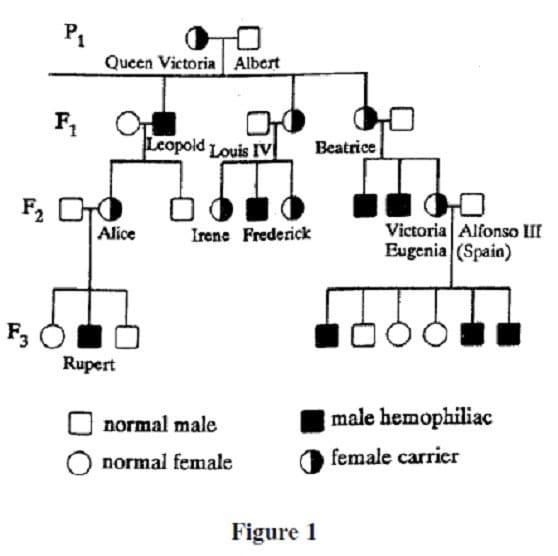
Which of the following best explains why Louis IV was NOT a hemophiliac?
A. His son Frederick was a hemophiliac.
B. He did not inherit the gene for hemophilia from his mother.
C. His father-in-law, Albert, was not a hemophiliac.
D. Only females can be carriers of the gene for hemophilia.
Questions 8
Four major blood types exist in the human ABO blood system: types A, B, AB, and O; and there are three alleles that code for them. The A and B alleles are codominant, and the O allele is recessive. Blood types are derived from the presence of specific polysaccharide antigens that lie on the outer surface of the red blood cell membrane. The A allele codes for the production of the A antigen; the B allele codes for the production of the B antigen; the O allele does not code for any antigen. While there are many other antigens found on red blood cell membranes, the second most important antigen is the Rh antigen. Rh is an autosomally dominant trait coded for by 2 alleles. If this antigen is present, an individual is Rh+; if it is absent, an individual is Rh-. For example, a person with type AB blood with the Rh antigen is said to be AB+.
These antigens become most important when an individual comes into contact with foreign blood. Because of the presence of naturally occurring substances that closely mimic the A and B antigens, individuals who do not have these antigens on their red blood cells will form antibodies against them. This is inconsequential until situations such as blood transfusion, organ transplant, or pregnancy occur.
Erythroblastosis fetalis is a condition in which the red blood cells of an Rh+ fetus are attached by antibodies produced by its Rh- mother. Unlike ABO incompatibility, in which there are naturally occurring antibodies to foreign antigens, the Rh system requires prior sensitization to the Rh antigen before antibodies are produced. This sensitization usually occurs during the delivery of an Rh+ baby. So while the first baby will not be harmed, any further Rh+ fetuses are at risk.
The Coombs tests provide a method for determining whether a mother has mounted an immune response again her baby's blood. The tests are based on whether or not agglutination occurs when Coombs reagent is added to a sample. Coombs reagent contains antibodies against the anti-Rh antibodies produced by the mother. The indirect Coombs test takes the mother's serum, which contains her antibodies but no red blood cells, and mixes it with Rh+ red blood cells. Coombs reagent is then added. If agglutination occurs, the test is positive, and the mother must be producing anti-Rh antibodies. The direct Coombs test mixes the baby's red blood cells with Coombs reagent. If agglutination occurs, the test is positive, and the baby's red blood cells must have been attacked by its mother's anti-Rh antibodies.
If a man with type AB blood needed a transfusion of red blood cells, which of the following individuals could safely donate blood?
A. A man with type A blood
B. A man with the genotype BO
C. A woman with the genotype AB
D. All four blood types are equally safe
Questions 9
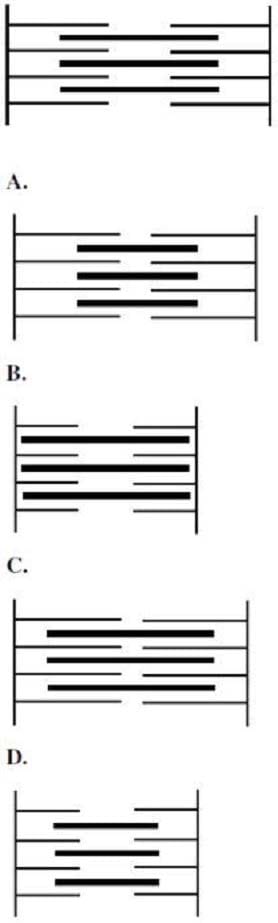
Which of the following best illustrates the contracted state of the sarcomere shown below?
A. Option A
B. Option B
C. Option C
D. Option D
Questions 10
The enzymes in pancreatic juice digest:
A. carbohydrates and proteins only.
B. carbohydrates and proteins only.
C. fats and proteins only.
D. carbohydrates, proteins and fats.
Questions 11
The automobile airbag was designed to inflate upon impact and decrease the risk of injury to drivers and passengers. Among the challenges to its development was the need to find a reliable inflation mechanism that was sufficiently rapid, controllable, and nontoxic. Prototypes employing compressed gases failed to meet these criteria. Researchers thus turned their attention to chemical alternatives.
The ideal inflatant requires a chemical reaction in which the reactants are stable and relatively dense in the condensed phase while the products are mostly or completely gaseous at ambient temperature and pressure. Additionally, the ideal chemical reaction would require a low activation energy and have a high kinetic rate constant, without the large exothermicity characteristic of most such reactions. Traditional explosives such as nitroglycerin, C3H5N3O9(l), were rejected almost immediately because of the extremely exothermic nature of their conversion. Benign solids such as calcium carbonate, CaCO3 , were similarly rejected, because of their large activation requirements. The desired attributes were finally found in sodium azide, NaN3, a stable, dense, ionic solid which rapidly decomposes into elemental sodium and nitrogen gas when ignited by an electrical impulse.

Reaction 1
The gas generating mixture includes excess KNO3 which reacts with the sodium metal from Reaction 1 to produce additional N2 and potassium and sodium oxides (Reactions 2 and 3). These oxides react with SiO2 to produce a non-toxic and stable alkaline silica (glass).

Reaction 2

Reaction 3
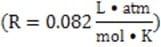
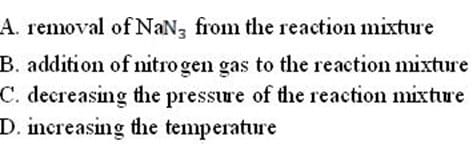
A researcher wishes to make the decomposition of sodium azide (Reaction 1) less favorable. Which of the following adjustments to the reaction would NOT drive it to the left?
A. Option A
B. Option B
C. Option C
D. Option D
Questions 12
Fireworks have been used for centuries in celebrations around the world. One of the primary components of these devices, black powder, was developed by the Chinese over a thousand years ago and is still used today as a propellant and explosive. Black powder is composed of potassium nitrate (KNO3), charcoal (primarily C) and sulfur (S8) in a 75:15:10 ratio by weight. It is very stable if kept dry but can easily be ignited by a spark or burning fuse to undergo the following reaction: Reaction 1 The basic firework is shown in Figure 1. Fireworks rely on a particular kind of combustion in which oxygen is supplied by oxidizing agents included in the pyrotechnic mixture. When ignited, the solid propellant begins to liquefy and vaporize allowing the fuel and oxidizing agents to interact more intimately leading to rapid expansion of gases. Delay fuses time the ignition of the other compartments to occur when the shell is high above ground.

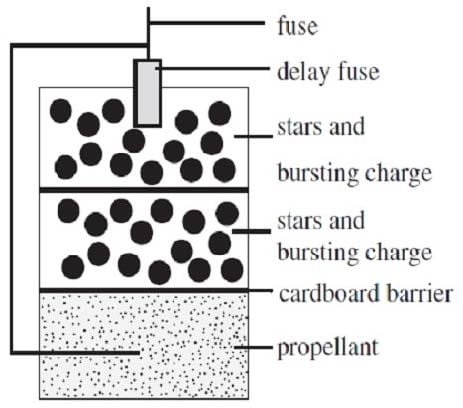
Figure 1
The light generating units of the firework are called stars and are dispersed and ignited by the bursting charge in each compartment. The intense colors of modern fireworks are generated by molecular emitters. For example, barium chloride emits green light (510?30 nm) and strontium chloride emits vibrant red light (605?50 nm). Many of the molecular emitters are unstable at room temperature and so cannot be placed directly into the firework. Instead, they are synthesized in the flame of the pyrotechnic reaction and exist for a short time before decomposing. The flame temperature must be carefully adjusted so that these emitters do not decompose too rapidly.

Flares, a particular kind of pyrotechnic device, can burn underwater. Most materials, like wood, cannot burn underwater. Which of the following provides the best explanation for this difference?
A. The combustion of wood has a lower H.
B. Flares have a lower ignition temperature and can be easily ignited by a spark or fuse.
C. Combustion of wood requires oxygen which is not provided by water.
D. Water is a powerful flame retardant that extinguishes flames by increasing the activation energy of combustion.
Questions 13
Consider the following structure.
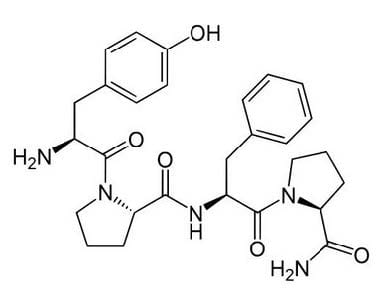
Which of the following is the most accurate description of the structure provided?
A. Dipeptide
B. Tripeptide
C. Tetrapeptide
D. Pentapeptide


Home | About Us | Contact Us | FAQ | Guarantee Policy | Privacy Policy
Any charges made through this site will appear as Global Simulators Limited. All trademarks are the property of their respective owners.
Copyright © 2004-2026 pass2lead.com, All Rights Reserved.