

NSE6_FML-6.0 Online Practice Questions and Answers
Questions 4
Examine the FortiMail antivirus action profile shown in the exhibit; then answer the question below.
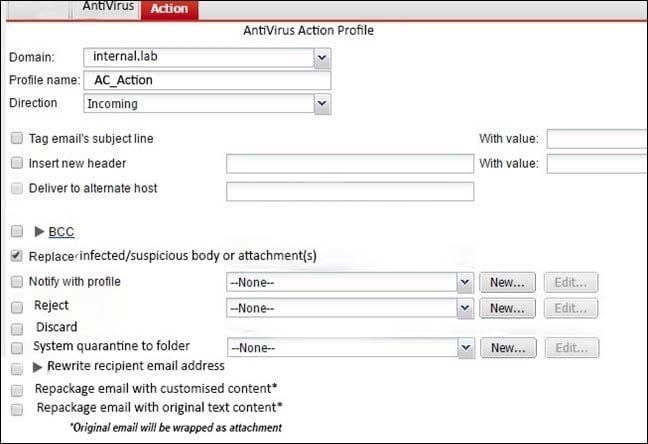
What is the expected outcome if FortiMail applies this action profile to an email? (Choose two.)
A. The sanitized email will be sent to the recipient's personal quarantine
B. A replacement message will be added to the email
C. Virus content will be removed from the email
D. The administrator will be notified of the virus detection
Questions 5
Examine the FortiMail recipient-based policy shown in the exhibit; then answer the question below.
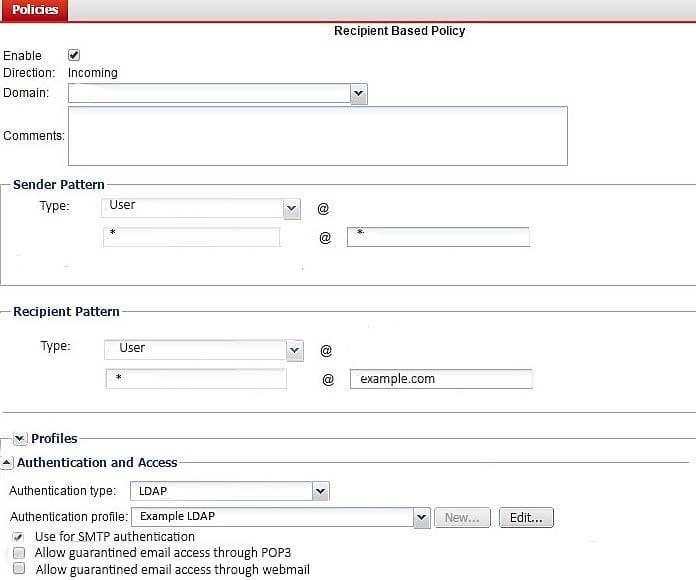
After creating the policy, an administrator discovered that clients are able to send unauthenticated email using SMTP. What must be done to ensure clients cannot send unauthenticated email?
A. Configure a matching IP policy with SMTP authentication and exclusive flag enabled
B. Move the recipient policy to the top of the list
C. Configure an access receive rule to verify authentication status
D. Configure an access delivery rule to enforce authentication
Questions 6
FortiMail is configured with the protected domain "example.com". Identify which of the following envelope addresses will require an access receive rule to relay for unauthenticated senders? (Choose two.)
A. MAIL FROM: mis@hosted.net RCPT TO: noc@example.com
B. MAIL FROM: training@external.org RCPT TO: students@external.org
C. MAIL FROM: accounts@example.com RCPT TO: sales@exernal.org
D. MAIL FROM: support@example.com RCPT TO: marketing@example.com
Questions 7
Examine the access receive rule shown in the exhibit; then answer the question below.
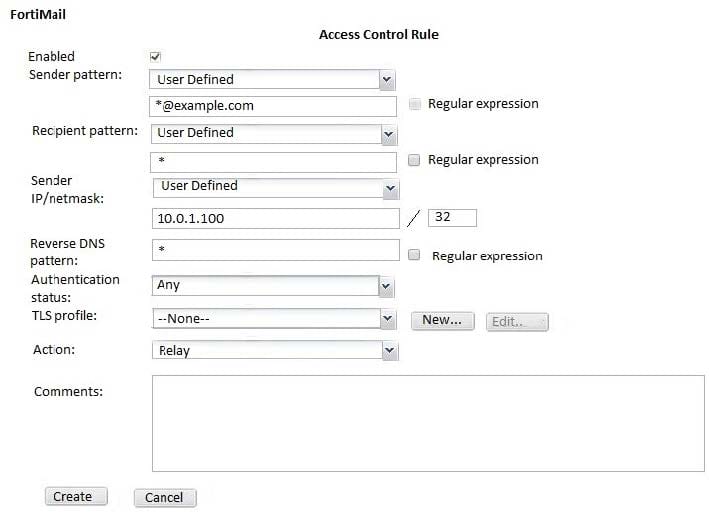
Which of the following statements are true? (Choose two.)
A. Email from any host in the 10.0.1.0/24 subnet can match this rule
B. Senders must be authenticated to match this rule
C. Email matching this rule will be relayed
D. Email must originate from an example.com email address to match this rule
Questions 8
Examine the exhibit; then answer the question below.
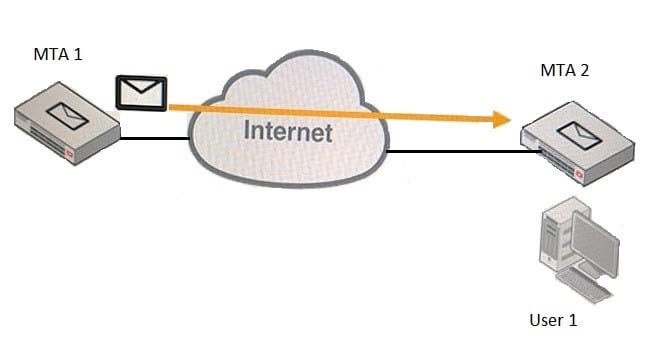
MTA 1 is delivering an email intended for User 1 to MTA 2. Which of the following statements about protocol usage between the devices are true? (Choose two.)
A. MTA 2 will use IMAP to receive the email message from MTA 1
B. MTA 1 will use SMTP to deliver the email message to MTA 2
C. User 1 will use IMAP to download the email message from MTA 2
D. MTA 1 will use POP3 to deliver the email message to User 1 directly
Questions 9
Which of the following statements regarding SMTPS and SMTP over TLS are true? (Choose three.)
A. In an SMTPS session, the identities of both sender and receiver are encrypted
B. SMTPS connections are initiated on port 465
C. SMTP over TLS connections are entirely encrypted and initiated on port 465
D. The STARTTLS command is used to initiate SMTP over TLS
E. SMTPS encrypts the body of the email message, where the most sensitive content exists
Questions 10
Which firmware upgrade method for an active-passive HA cluster ensures service outage is minimal and there are no unnecessary failovers?
A. Upgrade the active unit, which will upgrade the standby unit automatically
B. Upgrade both units at the same time
C. Upgrade the standby unit, and then upgrade the active unit
D. Break the cluster, upgrade the units independently, and then form the cluster again as quickly as possible
Questions 11
Examine the FortiMail topology and IP-based policy shown in the exhibit; then answer the question below.
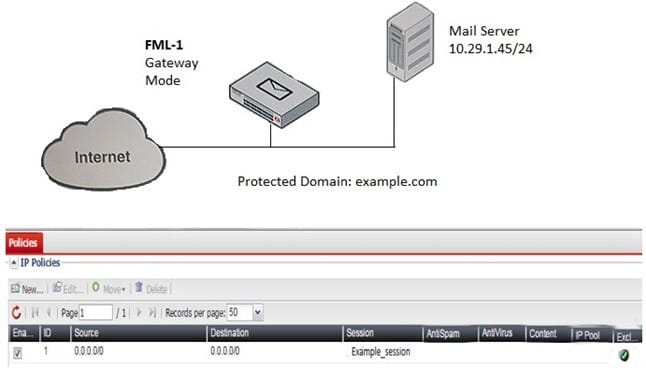
An administrator has enabled the sender reputation feature in the Example_Session profile on FML-1. After a few hours, the deferred queue on the Mail Server started filing up with undeliverable email. What changes should the administrator make to fix this issue? (Choose two.)
A. Clear the sender reputation database using the CLI
B. Create an outbound recipient policy to bypass outbound email from session profile inspections
C. Disable the exclusive flag in IP policy ID 1
D. Apply a session profile with sender reputation disabled on a separate IP policy for outbound sessions
Questions 12
An organization has different groups of users with different needs in email functionality, such as address book access, mobile device access, email retention periods, and disk quotas. Which FortiMail feature specific to server mode can be used to accomplish this?
A. Resource profiles
B. Address book management options
C. Access profiles
D. Domain-level service settings
Questions 13
While reviewing logs, an administrator discovered that an incoming email was processed using policy IDs:
0:4:9.
Which of the following statements are true? (Choose two.)
A.
FortiMail applied the default behavior for relaying inbound email
B.
FortiMail configuration is missing an access delivery rule to process incoming email
C.
Incoming recipient policy ID 9 has the exclusive flag set
D.
Email was processed using IP policy ID 4


Home | About Us | Contact Us | FAQ | Guarantee Policy | Privacy Policy
Any charges made through this site will appear as Global Simulators Limited. All trademarks are the property of their respective owners.
Copyright © 2004-2026 pass2lead.com, All Rights Reserved.