

NSE7_EFW-7.0 Online Practice Questions and Answers
Questions 4
Refer to the exhibit, which contains a TCL script configuration on FortiManager.
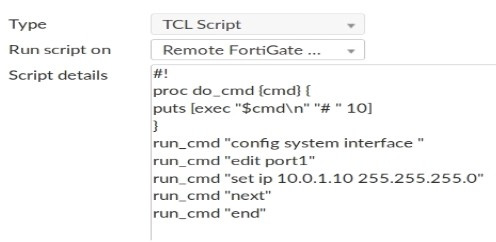
An administrator has configured the TCL script on FortiManager, but failed to apply any changes to the managed device after being executed. Why did the TCL script fail to make any changes to the managed device?
A. Changes in an interface configuration can only be done by CLI script.
B. The TCL script must start with #include <>.
C. Incomplete commands are ignored in TCL scripts.
D. The TCL command run_cmd has not been created.
Questions 5
Refer to the exhibit, which shows the output of a debug command.

What can be concluded from the debug command output?
A. The OSPF router with the ID 0.0.0.69 has its OSPF priority set to 0.
B. The local FortiGate has a different MTU value from the OSPF router with ID 0.0.0.2, based on the state information.
C. There are more than two OSPF routers on the wan2 network.
D. The interface ToRemote is a broadcast OSPF network.
Questions 6
An administrator added the following Ipsec VPN to a FortiGate configuration: configvpn ipsec phasel -interface edit "RemoteSite" set type dynamic set interface "portl" set mode main set psksecret ENC LCVkCiK2E2PhVUzZe next end config vpn ipsec phase2-interface edit "RemoteSite" set phasel name "RemoteSite" set proposal 3des-sha256 next end However, the phase 1 negotiation is failing. The administrator executed the IKF real time debug while attempting the Ipsec connection. The output is shown in the exhibit.
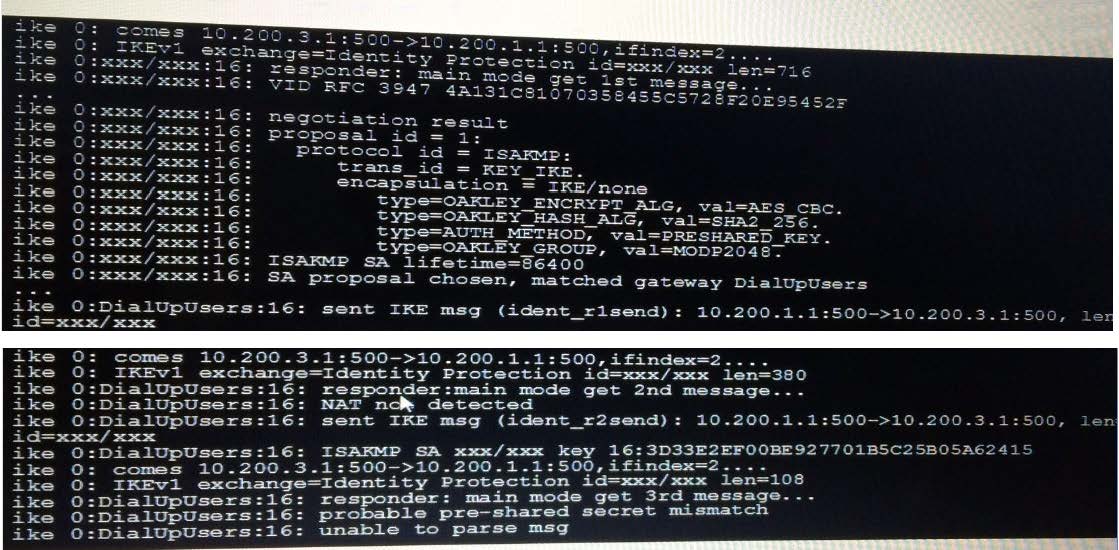
What is causing the IPsec problem in the phase 1 ?
A. The incoming IPsec connection is matching the wrong VPN configuration
B. The phrase-1 mode must be changed to aggressive
C. The pre-shared key is wrong
D. NAT-T settings do not match
Questions 7
View the exhibit, which contains the output of a web diagnose command, and then answer the question below.

Which one of the following statements explains why the cache statistics are all zeros?
A. The administrator has reallocated the cache memory to a separate process.
B. There are no users making web requests.
C. The FortiGuard web filter cache is disabled in the FortiGate's configuration.
D. FortiGate is using a flow-based web filter and the cache applies only to proxy-based inspection.
Questions 8
A FortiGate is rebooting unexpectedly without any apparent reason. What troubleshooting tools could an administrator use to get more information about the problem? (Choose two.)
A. Firewall monitor.
B. Policy monitor.
C. Logs.
D. Crashlogs.
Questions 9
Examine the output of the `get router info bgp summary' command shown in the exhibit; then answer the question below.
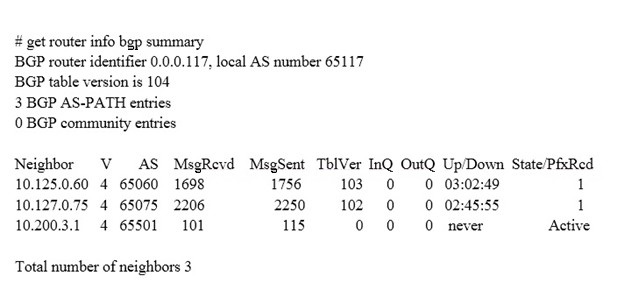
Which statements are true regarding the output in the exhibit? (Choose two.)
A. BGP state of the peer 10.125.0.60 is Established.
B. BGP peer 10.200.3.1 has never been down since the BGP counters were cleared.
C. Local BGP peer has not received an OpenConfirm from 10.200.3.1.
D. The local BGP peer has received a total of 3 BGP prefixes.
Questions 10
Refer to the exhibit, which contains the output of a debug command.
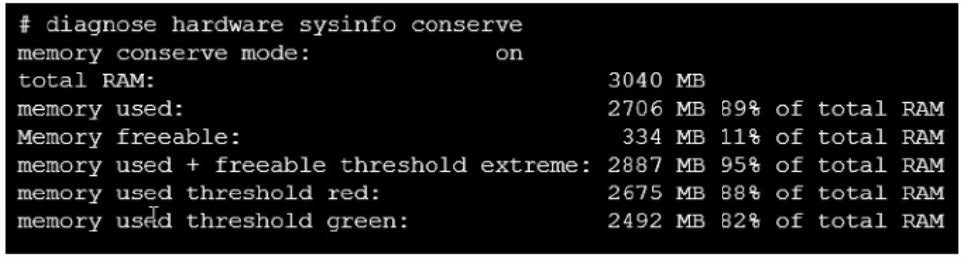
If the default settings are in place, what can be concluded about the conserve mode shown in the exhibit?
A. FortiGate is currently blocking all new sessions regardless of the content inspection requirements or configuration settings due to high memory use.
B. FortiGate is currently allowing new sessions that require flow-based or proxy-based content inspection but is not performing inspection on those sessions.
C. FortiGate is currently blocking new sessions that require flow-based or proxy-based content inspection.
D. FortiGate is currently allowing new sessions that require flow-based content inspection and blocking sessions that require proxy-based content inspection.
Questions 11
Which two conditions must be met for a statistic route to be active in the routing table? (Choose two.)
A. The link health monitor (if configured) is up.
B. There is no other route, to the same destination, with a higher distance.
C. The outgoing interface is up.
D. The next-hop IP address is up.
Questions 12
Which two configuration settings change the behavior for content-inspected traffic while FortiGate is in conserve mode? (Choose two.)
A. IPS failopen
B. mem failopen
C. AV failopen D. UTM failopen
Questions 13
Refer to the exhibit, which contains partial output from an IKE real-time debug.
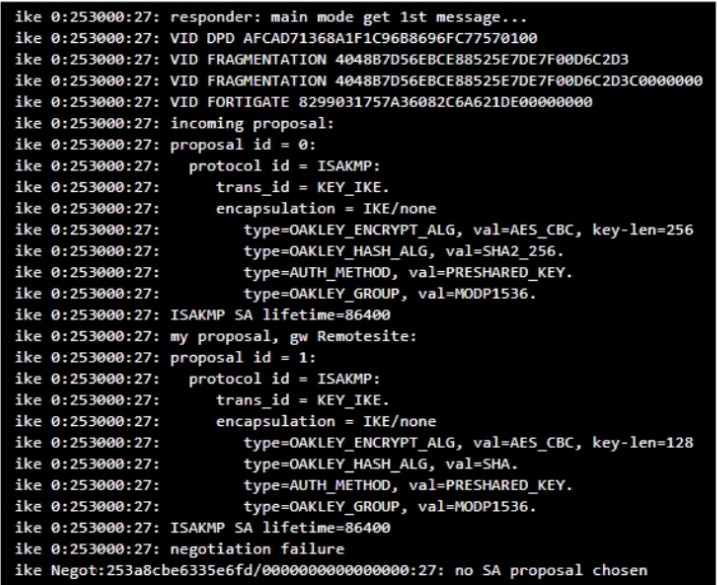
Why did the tunnel not come up?
A. The local gateway has configured less secure encryption and hashing algorithms compared to the remote gateway.
B. The Diffie-Hellman group does not match on the local and remote gateways.
C. The proposal ID does not match between local and remote gateways.
D. The encapsulation method for phase 2 is set to none on local and remote gateways.


Home | About Us | Contact Us | FAQ | Guarantee Policy | Privacy Policy
Any charges made through this site will appear as Global Simulators Limited. All trademarks are the property of their respective owners.
Copyright © 2004-2026 pass2lead.com, All Rights Reserved.