

OAT Online Practice Questions and Answers
Questions 4
It is most likely that you have never had diphtheria. You probably don't even know anyone who has suffered from this disease. In fact, you may not even know what diphtheria is. Similarly, diseases like whooping cough, measles, mumps, and rubella may all be unfamiliar to you. In the nineteenth and early twentieth centuries, these illnesses struck hundreds of thousands of people in the United States each year, mostly children, and tens of thousands of people died. The names of these diseases were frightening household words. Today, they are all but forgotten. That change happened largely because of vaccines.
You probably have been vaccinated against diphtheria. You may even have been exposed to the bacterium that causes it, but the vaccine prepared your body to fight off the disease so quickly that you were unaware of the infection. Vaccines take advantage of your body's natural ability to learn how to combat many disease-causing germs, or microbes. What's more, your body remembers how to protect itself from the microbes it has encountered before. Collectively, the parts of your body that remember and repel microbes are called the immune system. Without the proper functioning of the immune system, the simplest illness ?even the common cold ?could quickly turn deadly.
On average, your immune system needs more than a week to learn how to fight off an unfamiliar microbe. Sometimes, that isn't enough time. Strong microbes can spread through your body faster than the immune system can fend them off. Your body often gains the upper hand after a few weeks, but in the meantime you are sick. Certain microbes are so virulent that they can overwhelm or escape your natural defenses. In those situations, vaccines can make all the difference.
Traditional vaccines contain either parts of microbes or whole microbes that have been altered so that they don't cause disease. When your immune system confronts these harmless versions of the germs, it quickly clears them from your body. In other words, vaccines trick your immune system in order to teach your body important lessons about how to defeat its opponents.
What is the meaning of the word virulent as it is used in the third paragraph?
A. tiny
B. malicious
C. contagious
D. annoying
Questions 5
A lens forms an upright image 19 cm from a lens of an object 49 cm from the lens. The object and image are on the same side of the lens. What is the magnification of the image?
A. 0.39
B. 2.6
C. 13.7
D. 31.2
Questions 6
Which statement best explains why the work done by a gravitational force on an object does not depend on the path the object takes?
A. Work depends on the path when there is friction. The longer the path the more energy is required to overcome friction.
B. Gravitational fields that arise from the interaction between point masses always produce elliptical paths of motion.
C. A falling object experiences a change in potential energy.
D. When an object falls down the work done by gravity is positive and when an object is thrown up the work done by gravity is negative.
Questions 8
A store has a series of sales. In August, all items are reduced to 50%. In September, all items are reduced an additional 30%. If an item was $140 back in July, how much would the item be in September?
A. $49
B. $70
C. $35
D. $30
E. $77
Questions 10
Which of the following hormones is associated with contractions during childbirth?
A. Prolactin
B. Ghrelin
C. Gibberellin
D. Oxytocin
E. Growth Hormone
Questions 11
The separation of two annealed nucleic acid strands (ex. in preparation of DNA replication) can be accomplished by which of the following enzymes?
A. DNA Polymerase I
B. DNA Polymerase III
C. Ligase
D. Helicase
E. Lipase
Questions 12
The structures composed solely of diploid cells:
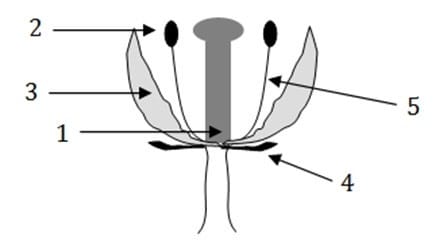
A. 1, 2, and 3
B. 3, 4, and 5
C. 1, 4, and 5
D. 2, 3, and 4
E. 1, 2, and 4
Questions 13
A reaction with a positive S and a positive H is spontaneous when?
A. At all temperatures
B. At high temperatures
C. At low temperatures
D. The reaction is not spontaneous at all.
E. Not enough information is provided to complete this problem.


Home | About Us | Contact Us | FAQ | Guarantee Policy | Privacy Policy
Any charges made through this site will appear as Global Simulators Limited. All trademarks are the property of their respective owners.
Copyright © 2004-2026 pass2lead.com, All Rights Reserved.