

OGB-001 Online Practice Questions and Answers
Questions 4
Which of the following describes how to define a business capability?
A. Identifying and articulating the business problem, enabling the business requirements to be fully documented.
B. Identifying human and computer actors. their roles, and their place in the business.
C. Identifying and documenting a set of statements that outline what the business architecture project must do.
D. Identifying and describing what needs to be done by the business in support of Its overall mission
Questions 5
Compete the sentence. An objective of Phase B is to identify candidate architectureRoadmap components based upon______________________.
A. the Architecture Requirements Impact Assessment
B. the Architecture Vision created in Phase
C. gaps between the Baseline and Target Business Architectures
D. a cross-mapping of Value Stream Stages to Business Capabilities
Questions 6
In which pan of a business scenario are business capabilities and value streams modelled?
A. When identifying and documenting desired outcomes
B. When identifying the business and technology environment
C. When identifying the human actors
D. When identifying, documenting and ranking the problem
Questions 7
Which of the following are two concepts used for structuring a business capability model?
A. Categorizing, Grouping
B. Mapping. Sorting
C. Aligning. Layering
D. Stratification, Leveling
Questions 8
Consider the following business capability model. there cells of a model are given different colors to represent desired maturity levels (Green (G)- level achieved, yellow (Y) =one level away, red (R) -two more more levels away, purple (P) =missing capability):

Which of the following best describes what this model shows?
A. Policy Management. Government Relations Management, and HR Management need immediate attention. Partner Management, Account Management, and Training Management have issues but are of tower priority. Agent Management is o now business capability that Goes not exist.
B. Market Planning. Government Relations Management and HR Management need immediate attention. Partner Management, Customer Management, and Training Management have issues but are of lower priority. Agent Management is a new business capabilitythat does not exist.
C. Customer Management, Training Management and Partner Management need immediate attention. Market Planning. HR Management and Government Relations Management need attention. Agent Management exists as a new Corecapabilitybut has not yet been assessed.
D. The Strategic capabilities need more attention in three areas Market Planning, Government Relations Management, and Partner Management. Agent Management Is missing as a Coro capability. Training Management needs the most attention as a Supporting Capability.
Questions 9
Which of me following is considered a guying principle when creating value streams?
A. Identify the lop-level value streams from components of capabilities
B. Create an Initial set of value streams that map one-to-one to existing capabilities.
C. Avoid going down to operational levels of detail
D. Start with internal value streams within the organization
Questions 10
Consider the following table of techniques used w decompose a business architecture: What is the technique marked W?
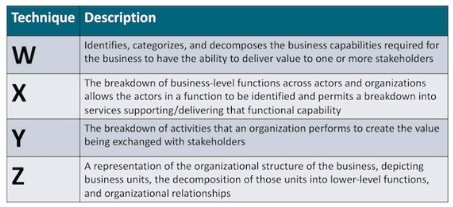
A. Value Stream Mapping
B. Organization Mapping
C. Process Modeling
D. Business Capability Mapping
Questions 11
Complete the sentence. An information map is a____________________________________.
A. target description of information assets needed to support the business
B. collection of Information concepts and their relationships to one another
C. description of the Business units that use capacities and participate in value streams
D. representation of where the business information is held within the enterprise
Questions 12
Whichof the following best describes a TOGAF Business Scenario?
A. A technique for constructing business models in a form enabling reasoning, insight, and clarity.
B. A method forensuring that the business processes deliver the required outcomes.
C. A complete description of a business problem in both business and architectural terms.
D. A specification of the conventions for a particular kindof business architecture view.
Questions 13
Which of the following best describes what a business model is?
A. The rationale for how an organization, creates, deliveries and captures value.
B. The description of the structure and interaction of applications that provide Key business functions.
C. The representation of business assets in use, or planned by the enterprise.
D. A maturity model tor IT process management, continuous improvement and best practices.


Home | About Us | Contact Us | FAQ | Guarantee Policy | Privacy Policy
Any charges made through this site will appear as Global Simulators Limited. All trademarks are the property of their respective owners.
Copyright © 2004-2026 pass2lead.com, All Rights Reserved.