

OGBA-101 Online Practice Questions and Answers
Questions 4
Which of the following is an analysis technique which is used to show a range of different perspectives on the same set of business capabilities?
A. Relationship mapping
B. Capability decomposition
C. Information mapping
D. Heat mapping
Questions 5
Which of the following is a purpose of mapping capabilities to value stream stages?
A. To describe the business in terms of services provided and consumed.
B. To classify, group, and align capabilities into categories for a deeper understanding.
C. To provide a self-contained business description that is independent of the organizational structure.
D. To identify and eliminate business capabilities that do not contribute to the business.
Questions 6
In business capability mapping, when you have documented all of the business capabilities, what should you do next?
A. Draw up a business value assessment for each of the business capabilities.
B. Organize the business capabilities in a logical manner.
C. Identify the human and computer actors associated with each business capability.
D. Map the business capabilities to stakeholder concerns.
Questions 7
Which of the following best describes a business capability?
A. It is an articulation of the relationships between business entities that make up the enterprise.
B. It delineates what a business does without an explanation of how, why, or where the capability is used.
C. It is a detailed description of the architectural approach to realize a particular solution.
D. It is a qualitative statement of intent that should be met by the enterprise architecture capability developing the business architecture.
Questions 8
What can architects present to stakeholders to extract hidden agendas, principles, and requirements that could impact the final Target Architecture?
A. Business Scenarios and Business Models
B. Alternatives and Trade-offs
C. Solutions and Applications
D. Architecture Views and Architecture Viewpoints
Questions 9
In what TOGAF ADM phase should the architect locate existing architecture descriptions to create an information map?
A. Phase A
B. Preliminary Phase
C. Phase B
D. Phase E
Questions 10
What is presented as "striking a balance between positive and negative outcomes resulting from the realization of either opportunities or threats"?
A. Agile development
B. Transition Management
C. Architecture Security
D. Risk Management
Questions 11
In which part of a business scenario are business capabilities and value streams modeled?
A. When identifying the business and technology environment
B. When identifying the human actors
C. When identifying and documenting desired outcomes
D. When identifying, documenting and ranking the problem
Questions 12
Refer to the exhibit.
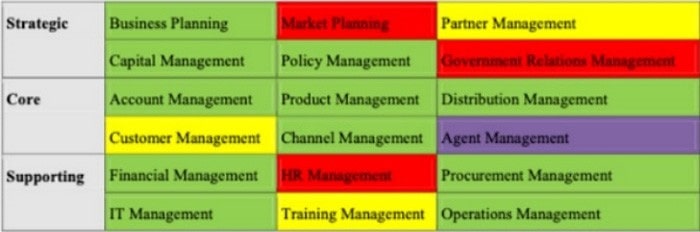
Which of the following best describes this diagram?
A. Business Capability Map
B. Business Capabilities Layer diagram C. Business Capability/Value Stream Mapping
D. Business Relationships diagram
Questions 13
Which approach to model, measure, and analyze business value is primarily concerned with identifying the participants involved in creating and delivering value?
A. Value chains
B. Value networks
C. Lean value streams
D. Value streams


Home | About Us | Contact Us | FAQ | Guarantee Policy | Privacy Policy
Any charges made through this site will appear as Global Simulators Limited. All trademarks are the property of their respective owners.
Copyright © 2004-2026 pass2lead.com, All Rights Reserved.