

OMG-OCUP2-INT200 Online Practice Questions and Answers
Questions 4
What best describes the semantics modeled by the exhibit?
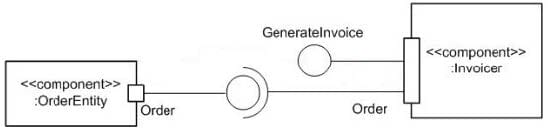
A. The Order Entity component is part of the internals of the Invoicer component.
B. The Invoicer has a complex connector that connects the Generate Invoice interface with the Order interface.
C. This is an illegal diagram.
D. The Invoicer has a complex port that provides the interface Generate Invoice and requires the interface Order.
Questions 5
What types of features may a component possess?
A. attributes and operations
B. operations, but not attributes
C. neither attributes nor operations
D. attributes, but not operations
Questions 6
In the exhibit, if all incoming arrows provide the same value, how many values does the pin have?

A. three.
B. two
C. one
D. none
Questions 7
Refer to the exhibit. Invoicer and Special Order Entity are each preceded by a colon symbol, because they name what type of component?
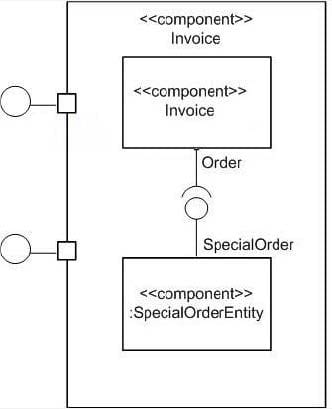
A. parts of an instance level collaboration
B. connection types
C. delegation types
D. assembly connectors
Questions 8
What is true of outgoing transitions from a fork pseudo state?
A. are taken serially in arbitrary order
B. can only exist of the object is declared concurrent
C. are mutually exclusive
D. may have guards
E. must terminate in different regions of a state
Questions 9
What action would destroy all association links for an object in one operation?
A. Clear Structural Feature Action
B. Destroy Object Action
C. Clear Association Action
D. Remove Structural Feature Action
E. Destroy Link Action
Questions 10
What determines whether a loop continues execution?
A. behaviors
B. test nodes
C. guards
D. partitions
E. clauses
Questions 11
What is the meaning of a required extension?
A. An instance of the extending stereotype must always be linked to an instance of the extended metaclass.
B. This extension has a higher priority than the other defined in the same profile.
C. An instance of the extending stereotype must never be linked to an instance of the extended metaclass.
D. The extension must be applied at least once in a model.
Questions 12
Assume component A provides an interface P and requires an interface R. In order for a component B to be substituted for component A, what must be true?
A. The interface that B requires must be type conformant with respect to the interface that A provides.
B. The interface that B requires must be type conformant with respect to the interface that A requires, and the interface that B provides must be type conformant with respect to the interface that A provides.
C. The interface that A requires must be type conformant with respect to the interface that B provides.
D. Components must be related to each other via a dependency.
Questions 13
A component may legally participate in which relationship(s)?
A. associations and generalizations
B. dependencies, associations, and generalizations
C. dependencies and generalizations
D. dependencies


Home | About Us | Contact Us | FAQ | Guarantee Policy | Privacy Policy
Any charges made through this site will appear as Global Simulators Limited. All trademarks are the property of their respective owners.
Copyright © 2004-2026 pass2lead.com, All Rights Reserved.