

P_SAPEA_2023 Online Practice Questions and Answers
Questions 4
Demand and Supply Planning (SAP IBP) implementation has been identified as a quick win, based on feedback from a large cross section of Wanderlust stakeholders. As the Chief Enterprise Architect, you have now been asked to scope and contextualize the architecture project. Architecture principles have already been adopted. Which of the following activities should you to initiate to conclude the Statement of Architecture Work for the intended SAP IBP implementation initiative? Note: There are 3 correct answers to this question.
A. Conduct a Fit Gap Assessment to identify requirements that cannot be met
B. Define the Solution Context for the architecture work.
C. Conduct a high-level Capability Assessment to identify areas of improvement (business and IT).
D. Conduct a technical Proof of Concept to understand features and functionalities of SAP IBP.
E. Outline the aspirational Solution Concept to address the stakeholders' needs and business requirements.
Questions 5
Your company adapts SAP's Integration Solution Advisory Methodology (ISA-M) as an Integration Solution Playbook. In your role as Lead Enterprise Architect, you are asked to decide which integration approach to take for this solution. Which of the following approaches is recommended by SAP ISA-M for identifying an integration solution and strategy?
1.
Document and review the existing integration (architecture)
2.
Scope focus areas, for example future required building blocks
3.
Find suitable integration technology for the required building blocks
4.
Define Integration best practices and governance processes
5.
Roll out the integration solutions in a staged approach
1.
Retrieve the documentation for the solutions that need to be integrated and identify best practices and recommendations for their integration.
2.
Assess existing integration components for re-use
3.
Identify white spots and find suitable integration solutions that can cover them
4.
Define Integration best practices and governance processes
1.
Document and review the existing integration (architecture)
2.
Scope focus areas, for example future required building blocks
3.
Identify architecture-relevant use-cases (technology agnostic/clustered in use-case patterns)
4.
Map these use case patterns to integration technology
5.
Define Integration Best Practices
6.
Enable a Practice of Empowerment
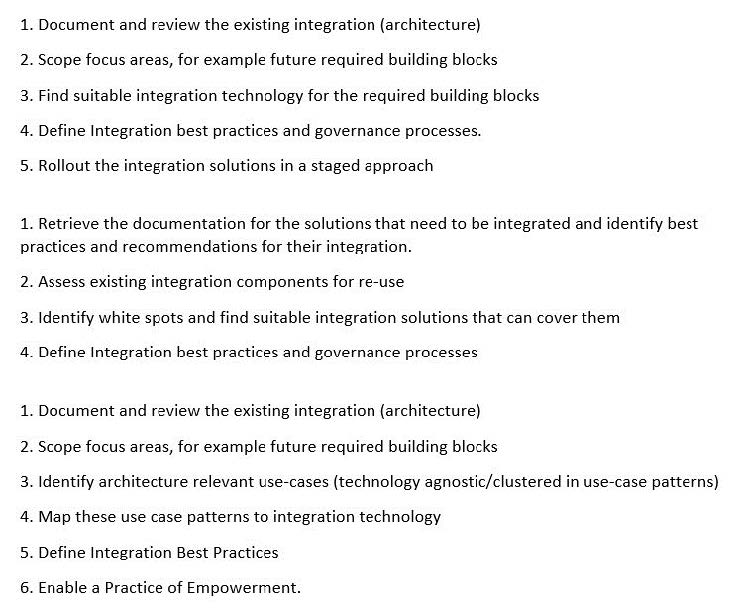
A. 1.Document and review the existing integration (architecture)
2.
Scope focus areas, for example future required building blocks
3.
Find suitable integration technology for the required building blocks
4.
Define Integration best practices and governance processes.
5.
Rollout the integration solutions in a staged approach
B. 1.Retrieve the documentation for the solutions that need to be integrated and identify best practices and recommendations for their integration.
2.
Assess existing integration components for re-use.
3.
Identify white spots and find suitable integration solutions that can cover them.
4.
Define Integration best practices and governance processes.
C. 1.Document and review the existing integration (architecture).
2.
Scope focus areas, for example future required building blocks
3.
Identify architecture relevant use-cases (technology agnostic clustered in use-case patterns)
4.
Map these use case patterns to integration technology.
5.
Define Integration Best Practices.
6.
Enable a Practice of Empowerment.
Questions 6
For the next Architecture Board meeting, you need to determine the next steps required after the business, application/data and technology architecture designs have been created. What do you recommend?
A. Reviewing Business Application/Data and Technology Architecture artifacts with stakeholders and signing off on first versions.Using Transition Architectures to build the Architecture Roadmap. Creating first drafts of the required work packages and the Project/Rollout plan.
B. Finalizing the Business, Application/Data, and Technology Architecture artifacts. Building an Architecture Roadmap. Creating a first draft of the Project/Rollout Project plan.
C. Establishing change management processes for the management of the business application/data and technology artifacts Handing over the artifacts to the implementation partner and rolling out the project
Questions 7
As Chief Enterprise Architect, you want to select an extension option that follows SAP's clean-core strategy. What are your recommendations to implement the clean- core strategy best?
A. To follow the clean-core strategy, the so-called "Developer Extensibility" of S/4HANA isn't allowed. Extensions must use "Side-by-Side Extensibility" on the SAP Business Technology Platform. These extensions use corresponding public remote APIs of the S/4HANA backend system.
B. Follow SAP's Tier 1 to Tier 2 extension model, which enables different extension options: Cloud Extensibility Model and Cloud API Enablement. This allows the development of cloud- ready and upgrade-stable applications and extensions.
C. Use "Key User Extensibility" functions of S/4HANA for simple extensions. "Developer Extensibility must comply with the rules for a Tier-1 or Tier-2 extension.
D. Use of public local APIs or public remote APIs for "Developer Extensibility.
Questions 8
As an Enterprise Architect, you must ensure that future extensions to the Digital Core of the enterprise guarantee stable and reliable operations. The architecture guideline demands to follow the clean-core strategy. What does this demand ensure and entail?
A. Extensions do not break an upgrade, and upgrades do not break an extension. Such extensions can access SAP business objects only through well defined, upgrade-stable interfaces.
B. Extensions may access SAP tables directly and in a well-documented, clean way. Therefore, the code of extensions can be adapted quickly to accommodate future changes.
C. Extensions are kept strictly separate from the SAP application, Extensions are developed in accordance with the SAP Application Extension Methodology. Side-by-side extensibility options are always preferable to on-stack extensibility options.
Questions 9
A custom web application developed with SAPUI5 and running on SAP Business Technology Platform uses large custom data objects deployed in a central data store (SAP HANA Cloud). The solution architect of the application is unsure about which tools to use for integration of this data from different SAP Sources into the central data store and asks you as the Enterprise Architect for guidance. Under which conditions is a data-oriented integration approach (Data Integration) preferable to other integration styles?
A. The data objects are built with data from different SAP and non-SAP sources that change infrequently and are available from REST and Message APIs (event-driven systems).
B. If the data objects are built with data from different SAP and non-SAP sources that can be structured and unstructured, change with high frequency, and need to be cleansed, correlated and partly newly calculated.
C. If the data objects are built with data from different SAP and non-SAP sources that can be structured and unstructured, change with high frequency, and need to be newly calculated.
Questions 10
Which runtime environments does SAP directly support an SAP BTP?
A. SAP BTP, Cloud Foundry environment/SAP Business Technology Platform (BTP), ABAP environment/SAP BTP, Kyma runtime
B. Kubemetes/SAP Business Technology Platform (BTP), ABAP environment C. OpenJDK for Java applications/Openshift for Kubernetes
Questions 11
When creating an application architecture roadmap, the WHAT and WHERE are defined in a rather straightforward way, while the WHOM may differ by context. Multiple roadmap clusters may apply a variety of WHOM dimensions. For example, procurement vs. asset management. Which of the following definitions are correct? Note. There are 3 correct answers to this question.
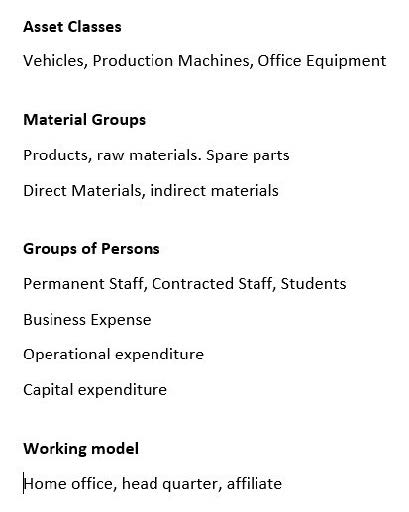
A. Asset Classes/Vehicles, Production Machines, Office Equipment
B. Material Groups/Products, raw materials. Spare parts/Direct Materials, indirect materials
C. Groups of Persons/Permanent Staff, Contracted Staff, Students/Business Expense/Operational expenditure/Capital expenditure
D. Working model/Home office, head quarter, affiliate
Questions 12
Which programming model would you suggest that ABAP developers use when SAP extensions should be built following the clean-core strategy?
A. SAP Cloud Application Programming (CAP)
B. SAP Classic Extensibility model
C. RESTful Application Programming (RAP)
Questions 13
The CIO of Wanderlust strongly feels that the seldom-used legacy Marketing application cannot be the platform to rejuvenate their online marketing business. As Chief Enterprise Architect, the CIO has entrusted you with the responsibility of finding a suitable replacement that can support all current processes and also address the issues plaguing the existing application. Which of the following should you do to conclusively shortlist possible applications to replace the existing one? Note: There are 2 correct answers to this question.
A. Start with current processes, map business capabilities to these processes, and identify which application(s) in the market can deliver such capabilities.
B. Compare the costs of those market leading online marketing applications and rank the top applications in terms of license, implementation, maintenance and subscription cost.
C. Adopt a process centric approach, relate Wanderlust processes to industry standard processes, and identify applications/ solutions which deliver such processes.
D. Understand the features of leading online marketing applications available in the market through product demonstrations and rank the applications in terms of features.


Home | About Us | Contact Us | FAQ | Guarantee Policy | Privacy Policy
Any charges made through this site will appear as Global Simulators Limited. All trademarks are the property of their respective owners.
Copyright © 2004-2026 pass2lead.com, All Rights Reserved.