

QSDA2022 Online Practice Questions and Answers
Questions 4
A data architect needs to upload different data sources. To properly handle null values, the data architect decides to set all of these values to "Missing Value". Which syntax should the data architect use?
A. NullAsValue*; Set NullValues = 'Missing Value';
B. NullasNull *; Set NullValues = 'Missing Value';
C. NullasNull *; Set NullValue = 'Missing Value';
D. NullAsValue*; Set NullValue = 'Missing Value';
Questions 5
A data architect needs to create an app that combines employee data from the Sales system and the Human Resources (HR) system.
These systems identify employees differently Employees in the HR system are identified with an alpha-numeric key Employees in the Sales system are identified using an integer key.
The Human Resources manager creates a table that maps these keys to another, called Associations.
The resultant data model must meet the following requirements:
Associations must be valid The model must be optimized for performance The option must support multiple tables added
Which solution should the data architect use to meet these requirements?
A. APPLYMAP ( 'Associations , EmployeeKey ) as Employeekey;
B. MAPSUBSTRING ( 'Associations' ,EMployeekey) As Employeekey;
C. MAP EmloyeeKey USING Associations;
D. RENAME FIELDS USING Associations;
Questions 6
Refer to the exhibit.
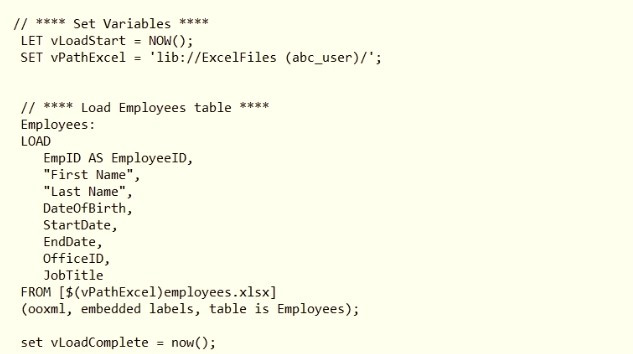
What are the values of the variables vLoadStart and vLoadComplete after the script executes?
A. vLoadStart; 'NOW{)' vLoadComplete: current system date and time when the script ended
B. vLoadStart: system date when the app was opened vLoadComplete 'now()'
C. vLoadStart: system date when the app was opened vLoadComplete: current system date and time when the script ended
D. vLoadStart: current system date and time when the script started vLoadComplete: 'now()'
Questions 7
A data architect needs to write the expression for a measure on a KPI to show the sales person with the highest sales The sort order of the values of the fields is unknown When two or more sales people have sold the same amount, the expression should return all of those sales people
Which expression should the data architect use?
A. FirstSortedValue (Salesperson, -Aggr (Sum(Sales) , Salesperson) )
B. Concat(DISTINCT IF (Aggr (Rank (Sum (Sales) , 4) , Salesperson) =1, Salesperson) , ' ')
C. FirstSortedValue (DISTINCT Salesperson, -Aggr (Sum(Sales) , Salesperson) )
D. Concat (DISTINCT IF (Aggr (Rank (Sum (Sales) , 1) , Salesperson) =1, Salesperson) , ' ')
Questions 8
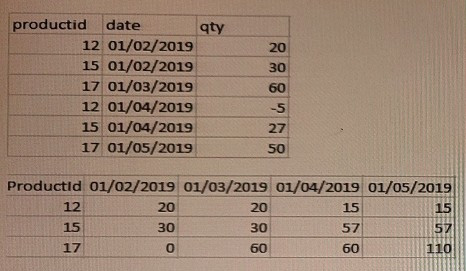
Refer to the exhibits.
The first table shows the source table (Original table).
This data represents the stocks stored every month for each product:
The relevant fields are productid, qty, and date.
The date field represents the calendar months using
The qty field shows the product stock fluctuation from the current month versus the previous month. If there is no fluctuation between months, there are no new entries in the table.
The second table shows a Pivot table visualization the data analyst needs to create in the app displaying per each product the monthly trend of available stock.
For performance reasons, the data analyst requests the data architect to calculate the running stock quantity of each product for every month in the script.
Which approach should the data architect use?
A. 1. Generate a Cartesian JOIN between productid and date in a Combined table
2.
RIGHT JOIN the Combined table with the Original table to populate the missing qty values
3.
Use PREVIOUS() and RANGESUMQ functions to create the running quantity totals for each product for every month
B. 1. Generate a Cartesian JOIN between productid and date in a Combined table
2.
LEFT JOIN the Combined table with the Original table to populate the missing qty values
3.
Use PREVIOUSO and SUM() functions to create the running quantity totals for each product for every month
C. 1. Generate a Calendar table with all dates between the minimum and maximum date values in an Original table
2.
RIGHT JOIN the Calendar table back to the Original table to populate the missing qty values
3.
Use PEEK() and RANGECOUNTO functions to create the running quantity totals for each product for every month
D. 1 Generate a Calendar table with all dates between the minimum and maximum date values in an Original table
2. LEFT JOIN the Calendar table back to the Original table to populate the missing qty values
Questions 9
Users of a published app report incomplete visualizations. The data architect checks the app multiple times and cannot replicate the error. The error affects only one team. What is the most likely cause?
A. An Omit field has been applied
B. Section access restricts too many records
C. A security rule has been applied to the sheet object
D. The affected users were NOT added to the Section table
Questions 10
Refer to the exhibit.
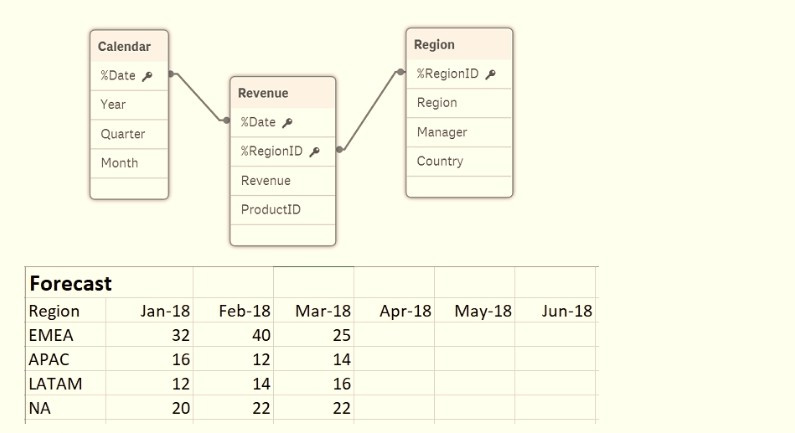
A business department is forecasting revenue within an Excel spreadsheet.
A data architect needs to include this forecast into the existing data model, and without losing any data.
Which two sets of steps will meet these requirements? (Select two.)
A. 1. Load the Excel spreadsheet using the data load editor
2.
Use the Unpivot function
3.
Use the Sum function to group the forecast by date
4.
Connect to the existing data model
B. 1. Load the Excel spreadsheet using the data load editor
2.
Use the Crosstable function to unpivot the table
3.
Create a composite key out of the date and region
4.
Connect the new table to the data model
C. 1 Load the Excel spreadsheet using the data load editor
2.
Change the sort order by date
3.
Create a composite key out of the forecast and region
4.
Connect to the existing data model
D. 1 Load the Excel spreadsheet into the data manager
2.
Use the Unpivot function
3.
Create a composite key from the date and region
4.
Connect the new table to the data model
E. 1. Load the Excel spreadsheet using the data manager
2.
Rename the ForecastDate field to Date
3.
Disable the Region
4.
Connect to the existing data model
Questions 11
ITALY IT001 HR
GERMANY DE002 HR
SPAIN SP03 FINANCE
FRANCE FRO04 SALES
Refer to the exhibit
A company stores the employee data within a key composed of Country UserlD, and Department. These fields are separated by a blank space. The UserlD field is composed of two characters that indicate the country followed by a unique code of two or three digits. A data architect wants to retrieve only that unique code.
A. LTRIM (SUBFIELD (Key, ' ', 2), 2)
B. MID ( SUBFIELD (Key , ' ', 2), 3)
C. RIGHT(SUBFIELD (Key,' ', 2), 3)
D. LEFT(SUBFIELD(Key, ' ', 2), 2)
Questions 12
A company needs to analyze sales data based on the exchange rate of the different countries every day About 30 reports must be produced with an average of 20r000 rows each. This process is estimated to take about three hours. Reports will be in Excel and distributed to business users according to defined security rules
Which two products should the data architect use to build this solution? (Select two.)
A. OQIikGeoAnalytics
B. ODAG
C. QIikDataMarket
D. Qlik Storytelling
E. QIik NPrinting
Questions 13
A data architect needs to load data from two different databases Additional data will be added from a folder that contains QVDs. text files, and Excel files. What is the minimum number of data connections required?
A. Two
B. Five
C. Four
D. Three


Home | About Us | Contact Us | FAQ | Guarantee Policy | Privacy Policy
Any charges made through this site will appear as Global Simulators Limited. All trademarks are the property of their respective owners.
Copyright © 2004-2026 pass2lead.com, All Rights Reserved.