

RPFT Online Practice Questions and Answers
Questions 4
The following results are obtained:
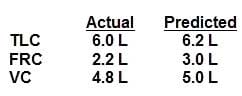
The RV/TLC ratio from these data is consistent with which of the following?
A. Obstructive defect
B. Normal lung volumes
C. Combined obstructive/restrictive defect
D. Restrictive defect
Questions 5
During an exercise study, a pulmonary function technologist notices the systolic blood pressure increased to 270 mm Hg using an automated cuff. Which of the following should the technologist do?
A. Terminate the test and administer oxygen by nasal cannula.
B. Continue the test and recheck blood pressure using manual cuff method.
C. Terminate the test at this time and recheck blood pressure.
D. Continue the test if within 5 minutes of completion.
Questions 6
During the calibration and set-up of the metabolic stress testing system for a patient breathing supplemental oxygen, which of the following gas concentrations will ensure accurate calibration of the system?
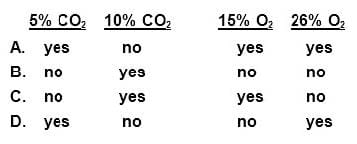
A. Option A
B. Option B
C. Option C
D. Option D
Questions 7
A pulmonary function technologist can calculate which of the following if values for pH, PaO2, SaO2, SvO2 PvO2, VO2, and Hb are obtained?
A. Cardiac output
B. RER
C. VD/VT
D. Stroke volume
Questions 8
While performing duplicate blood gas analyses, a pulmonary function technologist notes that the second instrument gives consistently higher values for PaCO2 and PaO2. Which of the following is the most probable cause of higher readings from the second instrument?
A. The sample chamber temperature is greater than 37?C
B. An excessive delay occurred between running the two samples
C. The PO2 and PCO2 electrode membranes have protein build-up
D. The sample chamber has a bacterial contaminate
Questions 9
At the end of a progressive exercise study of a healthy adult male, RER would be approximately what value?
A. 1.65
B. 0.83
C. 1.00
D. 1.25
Questions 10
While setting up an exercise laboratory in a city with an altitude of 8,600 ft (2,775 m), a pulmonary function technologist notices the fuel cell O2 analyzer is displaying 15.2%. Which of the following is the best explanation for this finding?
A. This exercise system will not work at high altitude.
B. The analyzer is responding to P1O2.
C. F1O2 decreases with increasing altitude.
D. The fuel cell needs to be changed.
Questions 11
A 54-year-old male with a normal ECG at rest develops dyspnea during an exercise (stress) test, and the following ECG pattern is noted at 25 watts:
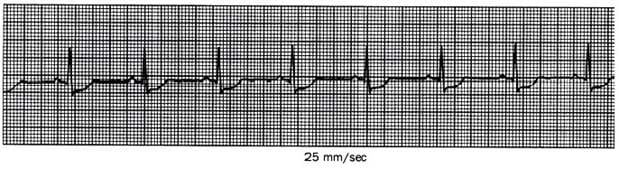
25 mm/sec A pulmonary function technologist should
A. Continue the test until the subject reaches target heart rate.
B. Stop the test immediately; there is evidence of heart block.
C. Continue the test and obtain an arterial blood sample.
D. Stop the test immediately; there is evidence of ischemia.
Questions 12
A patient with severe airflow limitation pants too rapidly (> 3 breaths/second) against a closed shutter in a body plethysmograph. Which of the following will occur?
A. VTG underestimation
B. VTG overestimation
C. RAW underestimation
D. RAW overestimation
Questions 13
A smoking cessation program using a nicotine patch is started for all smokers in a factory. Results revealed that smokers who reported they had quit had exhaled carbon monoxide levels less than 6 ppm. A pulmonary function technologist should conclude that
A. The program was effective in accomplishing smoking cessation.
B. The smokers had refrained from smoking for the previous 6 hours.
C. The smokers were not being truthful about smoking cessation.
D. A different method of smoking cessation should be offered to improve outcomes.


Home | About Us | Contact Us | FAQ | Guarantee Policy | Privacy Policy
Any charges made through this site will appear as Global Simulators Limited. All trademarks are the property of their respective owners.
Copyright © 2004-2026 pass2lead.com, All Rights Reserved.