

USMLE-STEP-1 Online Practice Questions and Answers
Questions 4
During development, the notochord grows in a cranial direction until it reaches the prechordal plate. This plate is the primordium of the oropharyngeal (or buccopharyngeal) membrane, which, in the embryo, will separate the stomodeum from the foregut. At 26 days of gestation, the oropharyngeal membrane will break down, allowing communication of the foregut with the oral cavity. Of the following structures in the adult, which one lies at the same location as the embryonic oropharyngeal membrane?
A. buccinators
B. palatoglossus
C. palatopharyngeus
D. stylopharyngeus
E. superior constrictor
Questions 5
A premature female infant is born about 24 weeks after fertilization and develops rapid, labored breathing shortly after birth. She is immediately transferred to intensive care where she is diagnosed with hyaline membrane disease (HMD). Which of the following is most likely deficient in the infant?
A. alveolar ducts
B. lung surfactant
C. terminal saccules
D. type I alveolar cells
E. type II alveolar cells
Questions 6
Your patient presents in your office complaining of hoarseness. During your examination, you find that one vocal fold has deviated toward the midline and does not abduct during deep inspiration or vocalization. You also observe that touch sensation in the vestibule of the larynx appears to be intact.
You suspect that a nerve has been damaged, but which nerve is most likely involved?
A. external laryngeal
B. glossopharyngeal
C. inferior laryngeal
D. internal laryngeal
E. superior laryngeal
Questions 7
A 9-month-old child is presented to the emergency room by his parents who report that he has been vomiting and has severe diarrhea. The episodes of vomiting began when the parents started feeding their child cow's milk. The infant exhibits signs of failing to thrive. Laboratory tests show elevated blood galactose, hypergalactosuria, metabolic acidosis, albuminuria, and hyperaminoaciduria. These clinical and laboratory findings are most consistent with which of the following disorders?
A. alkaptonuria
B. essential fructosuria
C. hereditary galactosemia
D. Menkes disease
E. von Gierke disease
Questions 8
Hemochromatosis, a disorder that is the result of excess iron accumulation, is caused by deficiencies in which of the following proteins?
A. divalent metal transporter-1 (DMT1)
B. human leukcocyte antigen (HLA) complex iron protein (HFE)
C. ferritin
D. ferroportin
E. transferrin
Questions 9
Asmall gram-negative pleomorphic organism was isolated from the nasal secretion of a toddler who later had paroxysms of coughing and post-tussive vomiting lasting at least 2 weeks. Which of the following culture media should be used to culture the suspected organism?
A. blood agar
B. Bordet Gengou agar
C. MacConkey agar
D. Thayer Martin agar
E. Tryptic soy agar
Questions 10
A 57-year-old man seeks medical attention for the recent appearance of numerous, large, fluid-filled, cutaneous blisters. These involve the face, scalp, neck, and axillae. Manual pressure to the skin results in epidermal separation. These changes are most likely the result of which of the following?
A. autoimmune disorder
B. bacterial infection
C. dietary deficiency
D. exposure to a chemical toxin
E. local ischemia
Questions 11
A 26-year-old woman complains of the acute onset of anuria, purpura, and mental confusion. Her peripheral blood film displays marked thrombocytopenia and abundant schistocytes. Laboratory studies reveal elevations of bilirubin, creatinine, and lactose dehydrogenase. A skin biopsy shows numerous intravascular thrombi within the dermal microvasculature. What is the most likely diagnosis?
A. acute idiopathic thrombocytopenia purpura
B. BernardSoulier syndrome
C. Glanzmann thrombasthenia
D. MayHegglin anomaly
E. thrombotic thrombocytopenic purpura
Questions 12
A 15-month-old baby girl is brought to the emergency room by her parents for a 1-week history of malaise, poor feeding, mild fever, and diarrhea. Physical examination is unremarkable. This is the sixth such occasion for which the parents have brought their daughter to a physician. Past visits have revealed repeated infections, including Candida, cytomegalovirus, and M. avium-intracellulare. A complete blood count (CBC) is remarkable only for a low total lymphocyte count. Immunoglobulin levels are normal. Alymph node biopsy is remarkable for paracortical cell depletion, but is otherwise normal. Which of the following is the most likely diagnosis?
A. Bruton congenital agammaglobulinemia
B. chronic granulomatous disease of childhood
C. severe combined immunodeficiency disease
D. thymic hypoplasia
E. Wiskott-Aldrich syndrome
Questions 13
In following figure, arrow 2 points to which of the following specific structures A. central vein
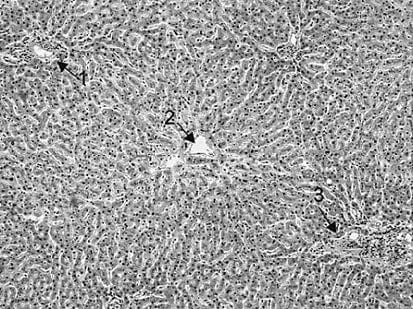
B. hepatic lobule
C. portal tract
D. sinusoid
E. Space of Disse


Home | About Us | Contact Us | FAQ | Guarantee Policy | Privacy Policy
Any charges made through this site will appear as Global Simulators Limited. All trademarks are the property of their respective owners.
Copyright © 2004-2026 pass2lead.com, All Rights Reserved.