

1Z0-1058 Online Practice Questions and Answers
Questions 4
Your client has configured separate roles for control assessor and control assessment reviewer. The control assessor has submitted his or her assessment. The control assessor realizes later that he or she has forgotten to attach a critical test evidence document to the assessment and needs to attach it now. How can this be accomplished?
A. The assessor can request the reviewer to attach the document during the review.
B. On the Assessment tab in the Control definition, the assessor can select the assessment and click the Complete Assessment button. He or she can attach the document and resubmit the assessment.
C. The assessor can request the reviewer to reject the assessment. After the assessment is rejected, the assessor can then attach the document and resubmit the assessment.
D. On the Manage Assessments page, the assessor can select the assessment and click the Reopen button. He or she can then attach the document and resubmit the assessment.
Questions 5
You have five business units in our company, BU1 through BU5. You want to build a transaction model to identify suppliers who have been paid more than $100,000 USD across all business units except BU5. Which two filters must be combined? (Choose two.)
A. Add a standard filter where the "Payment" object's "Organization ID" equals BU1, BU2, BU3, BU4.
B. Add a function filter grouping by "Supplier ID" where the sum of "Payment Amount" is greater than 100,000.
C. Add a function filter grouping by "Organization ID" where the sum of "Payment Amount" is greater than 100,000.
D. Add a standard filter where the "Payment" object's "Organization ID" equals BU5, and advanced option "Exclude" is checked.
E. Add a standard filter where the "Payment" object's "Organization ID" is equal to itself.
Questions 6
An organization has a list of companies with which they no longer wish to do business. The list is not
stored in their ERP Could but is stored in a file.
Which transaction model will identify payments made to these companies?
A. Create an Imported business object that can be used in conjunction with Oracle's pre-built "Payment" object. One both objects are in your model, add this standard filter: the "Payment" object's "Remit to Supplier Name" is similar to the custom object's "Company Name" by 95%.
B. Add a configurable attribute "Company Name" to Oracle's pre-built "Payment" object. Then add this standard filter: "Remit to Supplier Name" equals "Company Name".
C. You cannot define this model because imported objects from a file cannot be used with delivered objects.
D. Create an Imported business object that can be used in conjunction with Oracle's pre-built "Payables Invoice" object. Once both objects are in your model, add this standard filter: the "Payables Invoice" object's "Supplier Name" equals the custom object's "Company Name".
Questions 7
You are designing data for data import. The customer decided that they want to secure controls based on
their company organization.
Which three worksheets of the import template are required to accomplish this requirement? (Choose
three.)
A. Perspective Items
B. Controls
C. Control Test Plans
D. Perspective-Control
Questions 8
You build an access model with two entitlements. Each entitlement has four access points. The entitlements do not have any access points in common. How many access point combinations will be analyzed?
A. 20
B. 16
C. 8
D. 4
E. 25
Questions 9
During implementation, you created a risk object and successfully mapped it to a control object. The
client's Risk Owner is able to access the risk but not the control.
Why did this happen?
A. The Risk Administrator needs to run the synchronize jobs to populate the mapping.
B. The Risk Owner account is inactive.
C. The Risk Owner role does not have the right privileges.
D. The risk and control objects are inactive and need to be made active.
Questions 10
When validating imported data, the control manager at your client has identified an incorrect Risk- Control mapping; that is, Control A was mapped incorrectly to Risk B instead of Risk.
What needs to be done to fix the mapping?
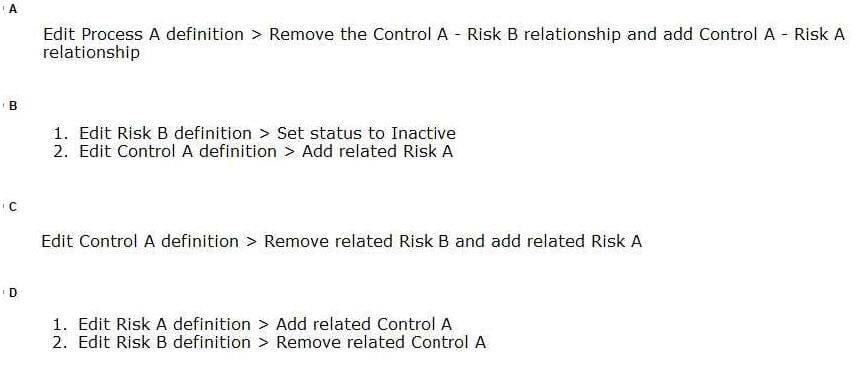
A. Option A
B. Option B
C. Option C
D. Option D
Questions 11
How do you identify Financial Reporting Compliance Cloud's key stakeholders?
A. Identify users who need to create and submit expense reports easily.
B. Identify users who will create customer invoices, and receive and apply customer payments.
C. Identify executives who need to certify internal controls for SOX or similar mandates.
D. Identify executives who will manage customer balances and recognize revenue.
Questions 12
You completed the data migration successfully. You created 100 controls, an Organization Perspective,
and relationship of controls to the Organization Perspective. All controls are related to one perspective
item. The Control Manager logs in to the application to view the new controls, yet there are none available
for his or her review.
Identify three reasons for this. (Choose three.)
A. The Control Manager was not given the correct data security policy to access the controls.
B. The Perspective Hierarchy was not associated to the Control Object.
C. There was no Control Type associated with the controls.
D. The Perspective Hierarchy is not in the Approved state.
E. No risks were mapped to the imported controls.
Questions 13
The control manager needs to associate an existing test plan to an additional assessment type, Audit Test.
The existing test plan is associated only with the Design Review assessment type.
How can this be accomplished?
A. The control manager should create a new test plan with Audit Test and Design Review as assessment types.
B. The control's test plan should be updated to include both Audit Test and Design Review as assessment types.
C. The control manager does not need to update the control because any initiated assessment will include all control test plans.
D. The control's test plan should be updated to Audit Test as the assessment type.


Home | About Us | Contact Us | FAQ | Guarantee Policy | Privacy Policy
Any charges made through this site will appear as Global Simulators Limited. All trademarks are the property of their respective owners.
Copyright © 2004-2026 pass2lead.com, All Rights Reserved.