

1Z0-970 Online Practice Questions and Answers
Questions 4
Which two options should you check for before importing product groups by using File-Based Import? (Choose two.)
A. whether all the required data values are configured and imported in the production instance
B. whether all the products related to the products groups to be imported already exist in the production instance
C. whether the Sales Cloud was customized to capture additional attributes and whether the customization has already been migrated
D. whether all the product groups that are to be imported already exist in the production instance
Questions 5
Which action must be performed when a Sales Catalog is imported with errors because it was assigned to an incorrect product group?
A. Inactivate the Sales Catalog version and create a new one.
B. Delete the Sales Catalog from the production environment.
C. Log out from the application and log in again.
D. Request a rollback from the application support team.
E. Access the Sales Catalog options and erase it.
Questions 6
Which three options would you configure to validate geography in the Manage Geographies task? (Choose three.)
A. Configure rules to determine that an address is a legitimate address.
B. Use Geography Validation Control to avoid or allow recording an incorrect address.
C. Enable Geography Validation for every geography type that you plan to validate.
D. Standardize the address.
E. Enable a list of values in the geography type to allow users to select a value from the list.
Questions 7
Which four key attributes can you configure to reference customers in Oracle Sales Cloud? (Choose four.)
A. Reference association with Lead: In the references UI, the Lead tab displays all Leads where the reference customer was used.
B. Reference association with Opportunity: In the references UI, the Opportunity tab displays all Opportunities where the reference customer was used.
C. Collateral: Associates collateral with reference customers to give salespeople materials to help them make sales.
D. References profile: Stores and maintains the reference customer profile, which also displays some underlying party-specific attributes and lists the deals the reference has already participated in.
E. Status: Indicates whether or not the customer is an active reference.
F. Rank: Designates the internal ranking of the customer, such as 1, 2, or 3.
Questions 8
Consider the following:
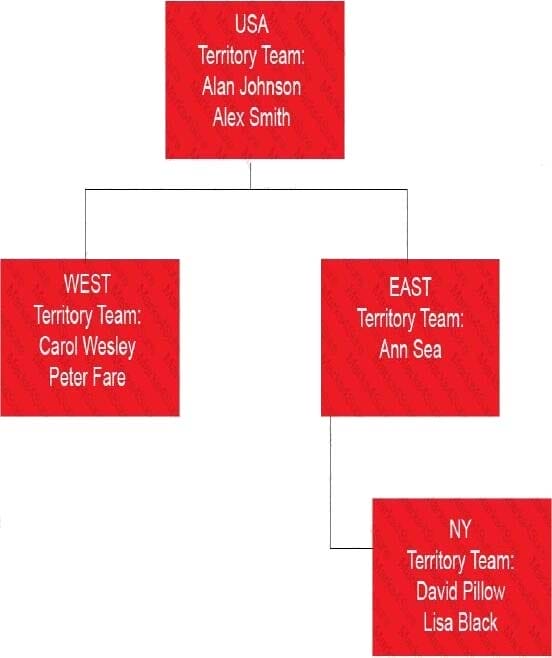
An opportunity is associated with the NY Territory.
Mike Lee and Susan Brown are members of the opportunity sales team.
Mark Lake is Susan Brown's manager.
Which option shows the members of the sales team who can view the opportunity record?
A. Mike, Susan, Mark, David, Lisa, Ann, Alan, and Alex
B. Mike, Susan, David, and Lisa
C. Mike, Susan, Mark, David, Lisa, and Ann
D. Mike, Susan, David, Lisa, Ann, Carol, and Peter
E. Mike, Susan, David, Lisa, Ann, Alan, and Alex
Questions 9
You have created your product group hierarchy, either directly in the UI or through file-based import. Now you want to publish, enable, and validate it.
Which three statements are correct? (Choose three.)
A. When you publish, the application will attempt to publish all product groups that are unlocked. If you don't want some groups to be published, then you must lock them.
B. Enable the catalog by assigning the root node to the "Base" usage.
C. You must publish the root node of the hierarchy in order for it to be available in the Manage Product Group Usage.
D. After you publish your product groups, if they are not published properly, you can delete them and republish.
E. Validate that the catalog appears in the consuming applications.
Questions 10
You were asked to define an object trigger to extend the standard processing logic of the opportunity record creation.
Identify two recommendations to prevent performance degradation. (Choose two.)
A. Do not exceed 10 triggers per object.
B. Use validation logic inside triggers whenever possible.
C. When querying objects programmatically within a Groovy trigger, select efficient view criteria to avoid limiting the underlying query.
D. Minimize the number of triggers on an object by combining logically-related fields inside a single trigger.
E. Always use newView() API inside triggers. The usage of newView() API will always kept your performance optimal.
Questions 11
Your customer sells cars across the United States. The customer now wants to split the East region to measure quota and manage closed opportunities in order to specialize its sales team in a Public Sector Territory and a Financial Sector.
The customer wants to add two territories to the Public Sector Territory, for example, Treasure Department and Citizen Services, and dedicate specialized sales personnel to service them. Other institutions are not to be assigned to these territories.
How would you set this up?
A. You must use a geographic dimension to the US East region, a Car product dimension, and an included customer coverage type to define Treasure Department, and then assign sales people to this territory. Use the same steps for Citizen Services, but use an included customer coverage type to include Citizen Services.
B. You must use a geographic dimension to the US East region, a Car product dimension, and an excluded customer coverage type to define Citizen Services and exclude Treasure Department. Then you assign sales people to this territory. Use the same steps for Treasure Department, but use an excluded coverage type to exclude Citizen Services.
C. You must use a geographic dimension to the US East region, a Car product dimension, and an included
D. customer coverage type to define Citizen Services, and then assign sales people to this territory. Use the same steps for Treasure Department, but use an excluded customer coverage type to exclude Citizen Services.
E. You must use a geographic dimension to the US East region, a Car product dimension, and an included customer coverage type to define Treasure Department, and then assign sales people to this territory. Use the same steps for Citizen Services, but use an excluded customer coverage type to exclude Treasure Department.
F. You must use a geographic dimension to the US East region, a Car product dimension, and a Treasure Department customer name dimension, and then assign sales people to this territory. Use the same steps for the Citizen Services territory.
Questions 12
You are importing users through File Based Loader. After import you realized that few of the users are not appearing in Oracle Identity Management.
What is the first step you should do in order to fix this issue so that the remaining users appear in OIM?
A. Re-import the same import file for the remaining users.
B. Correct the employee work number if it has an extension.
C. Go to Manage Users and save the user record.
D. Manually create the remaining users that are missed out during the file based load.
E. Run the process ?Send pending LDAP request
Questions 13
You have created recurring revenue schedules for your opportunity products to manage your subscription sales.
Which four statements are correct with respect to recurring opportunities? (Choose four.)
A. Create recurring schedules to occur at the frequency of your choice (such as weekly, monthly, quarterly, or annually) for product amounts and quantities.
B. You can't adjust quantity or amounts for transactions in the schedule, or modify the schedule.
C. Enable additional sets of standard fields of configure pre-defined extension fields for recurring transactions.
D. Import or update recurring transactions using import or Web services.
E. Add one-time setup or installation fees.


Home | About Us | Contact Us | FAQ | Guarantee Policy | Privacy Policy
Any charges made through this site will appear as Global Simulators Limited. All trademarks are the property of their respective owners.
Copyright © 2004-2026 pass2lead.com, All Rights Reserved.