

3V0-21.21 Online Practice Questions and Answers
Questions 4
An architect is finalizing the design for a new vCenter Server High Availability deployment.
What is one thing the architect must document in the design?
A. The load balancing algorithm used by the Management Distributed Virtual Switches (DVS)
B. The SSH configuration settings for the vCenter Server's active node
C. The vCenter Management Network IPv4 addresses for the witness node vCenter Server
D. The details of each of the vCenter Server licenses for active, passive and witness nodes
Questions 5
An architect is finalizing the design for a new vSphere platform based on the following information:
All Windows virtual machines will be hosted on a dedicated cluster for licensing purposes.
All Linux virtual machines will be hosted on a dedicated cluster for licensing purposes.
All management virtual machines will be hosted on a dedicated cluster.
A total of ten physical sites will be used to host virtual machines.
In the event of one physical datacenter becoming unavailable, the manageability of the virtual
infrastructure in the remaining data centers should not be impacted.
Access to configure the management virtual machines via vCenter Server must be controlled through the
management Active Directory domain.
Access to configure the Windows and Linux virtual machines must be controlled through the resource
Active Directory domain.
The management and resource Active Directory domains are part of separate Active Directory forests and
do not have any trusts between them.
The design will use Active Directory with Integrated Windows Authentication.
How should the architect document the vCenter Server configuration for this design?
A. Deploy a vCenter server for the management cluster. Deploy a vCenter Server for all remaining clusters. Create a shared SSO domain for each physical site.
B. Deploy a vCenter Server for the management cluster. Deploy a vCenter Server for all remaining clusters. Create a shared SSO domain across all physical sites.
C. Deploy a vCenter Server for the management cluster with a dedicated SSO domain. Deploy a vCenter Server for all remaining clusters and use a dedicated SSO domain for each physical site.
D. Deploy a vCenter Server for the management cluster with a dedicated SSO domain. Deploy a vCenter Server for all remaining clusters and use a dedicated SSO domain into a single physical site.
Questions 6
During a transformation project kick-off meeting, an architect highlights specific areas on which to focus while developing the new conceptual design.
Which two of the listed statements are business requirements? (Choose two.)
A. The project should use the existing storage devices within the data center
B. Sites must support a network latency of less than 12 ms round-trip time (RTT)
C. The solution must allow data replication between sites
D. There is no budget specifically assigned for disaster recovery
E. There must not be a single point of failure for the virtual infrastructure
Questions 7
An architect is tasked with designing a greenfield VMware software-defined data center (SDDC) solution
that will be used to deliver a private cloud service for a customer.
During the initial meeting with the service owner and business sponsor, the customer has provided the
following information to help inform the design:
The solution must initially support the concurrent running of 300 production and 600 development virtual
machines.
The production environment should be delivered across two geographically dispersed data centers.
The development environment must be vSphere-based but does not have to be deployed on-premises.
The two data centers are connected to each other through multiple diversely routed, high bandwidth and
low latency links.
The customer's server hardware standard document states that all virtual infrastructure hosts must be
based on blade architecture only.
The service owner has said that is important to ensure that neither the availability target of 99.5% nor the
resource capacity is affected when the operations team completes maintenance activities, such as the
monthly software patching and ad-hoc hardware break/fix.
All virtual machine backups must be completed using the existing backup service.
The recovery time objective (RTO) for the service is four hours.
The recovery point objective (RPO) of the service is 24 hours.
Given the information from the customer, which two would be classified as assumptions within the design? (Choose two.)
A. The backup service will store data in a secure facility
B. The backup service has sufficient capacity for the new requirements
C. The customer will update their hardware standard to support rack mount servers
D. All virtual machines will be deployed with the same resource profile for production and development
E. The clusters will have a minimum redundancy of N+1
Questions 8
There is a request for approved virtual machine applications through a new vSphere platform's integrated
automation portal. The platform was built following all provided company security guidelines and has been
assessed against Sarbanes-Oxley Act of 2002 (SOX) regulations.
The platform has the following characteristics:
vRealize Operations is being used to monitor all clusters.
There is a dedicated ESXi cluster, supporting all management services.
-All network traffic is via distributed virtual switches (DVS).
There is a dedicated ESXi cluster for all line-of-business applications.
-
Network traffic is serviced by NSX-T.
There is a dedicated ESXi cluster for virtual desktop infrastructure (VDI).
-
Network traffic is serviced by NSX-T.
The application owner is requesting approval to install a new service that must be protected as per the Payment Card Industry (PCI) Data Security Standard.
Which additional non-functional requirement should the architect include in the design to support the new service?
A. The vSphere hosting platform and all PCI application virtual machines must be assessed against Payment Card Industry (PCI) Data Security Standard compliance.
B. The vSphere hosting platform and all PCI application virtual machines must be assessed for SOX compliance.
C. The vSphere hosting platform and all PCI application virtual machine network traffic must be routed via NSX-T.
D. The vSphere hosting platform and all PCI application virtual machines must be monitored using the vRealize Operations Compliance Pack for Payment Card Industry.
Questions 9
Refer to the exhibit.
During a requirements gathering workshop, a customer shares the following diagram regarding their availability service-level agreements (SLAs):
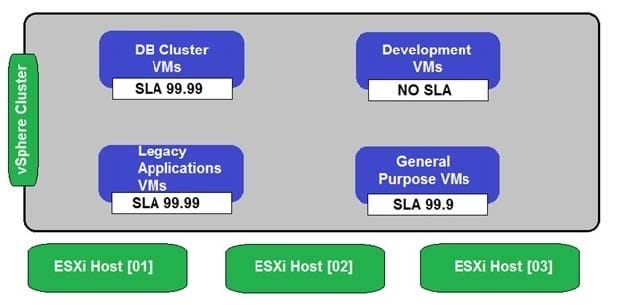
The customer states that there is no application level availability for legacy applications.
Which recommendation could the architect make to meet the customer's high availability requirements for the legacy applications virtual machines?
A. Enable vSphere HA and add a VM Override with VM Restart Priority set to Disabled
B. Enable Fault Tolerance
C. Achieve application availability with snapshots
D. Enable vSphere HA and add a VM Override with VM Restart Priority set to Lowest
Questions 10
An organization's existing vSphere environments are configured for Enhanced Linked Mode. The DevOps
team automates the creation of hardened virtual machine images for various operating systems. Their
continuous integration/continuous delivery (CI/CD) pipeline runs a task at the end of a successful build,
which uploads the Open Virtualization Format (OV) image to a sandbox content library, deploys a virtual
machine from the image, and then destroys these objects after quality checks are complete.
The following requirements have been noted:
All content libraries and images must be centrally created and managed.
All images must be capable of being updated.
All images must be refreshed and available to subscribed libraries within 24 hours.
All images must provide details of the image contents and versions.
All images must be capable of being reverted to a previous version.
All images must be capable of having the hardware and guest operating system customized during
deployment.
Which three recommendations should the architect make to design a content library solution that will meet
these requirements? (Choose three.)
A. Create a local content library in the primary vSphere environment and enable publishing.
B. Create and publish a new subscription to a new subscriber library for each target vSphere environment.
C. Deploy the OVF images to vSphere and clone as an OVF template to a local content library.
D. Deploy the OVF images to vSphere and clone as a VM template to a local content library.
E. Edit the Auto Sync Refresh Interval advanced setting for each subscribed library.
F. Add a new subscriber library from each vSphere environment.
Questions 11
An architect is tasked with designing a new VMware software-defined data center (SDDC) solution for an
online retail customer who has a primary and secondary data center as well as 10 distribution hubs.
The customer has provided the following business requirements to help inform the design:
The solution must support the running of up to 1,000 concurrent virtual machines across the primary and
secondary data center.
The solution must support the running of up to 20 concurrent virtual machines in each distribution hub.
The solution must support the separation of management and lines-of-business application virtual
machines.
All management components (including directory services, backup, automation, operations and logging)
must be deployed to the primary data center.
All virtual infrastructure components must have redundancy of N+1.
All sites are connected to each other using a wide area network that has multiple diversely routed links.
The solution should support a monthly uptime target of 99.9%.
The recovery time objective (RTO) for the solution must be four hours.
The recovery point objective (RPO) for the solution must be 24 hours.
Given the information from the customer, which assumption should the architect include in the design?
A. All business application virtual machines can be deployed into a single cluster within the primary data center.
B. Each distribution hub should be configured with a backup device.
C. The wide area network has sufficient bandwidth to support centralized management.
D. Each cluster will have a minimum of four hosts.
Questions 12
An architect is designing a VMware solution for a customer to meet the following requirements:
The solution must use investments in existing storage array that supports both block and file storage.
The solution must support the ability to migrate workloads between hosts within a cluster.
The solution must support resource management priorities.
The solution must support the ability to connect virtual machines directly to LUNs.
The solution should use existing 32G fabric infrastructure.
There is no budget for additional physical hardware.
Which design decision should the architect make to meet these requirements?
A. The ESXi hosts will leverage Fibre Channel (FC).
B. The ESXi hosts will leverage iSCSI.
C. The ESXi hosts will leverage Fibre Channel over Ethernet (FCoE).
D. The ESXi hosts will leverage NFS.
Questions 13
A new real-time financial service application is being developed by the engineering team at a financial firm and will be released as a public Software-as-a-Service (SaaS) offering. The solutions architect has designed and deployed a new vSphere environment and the supporting network infrastructure for hosting all public services. ESXi hosts are configured to use Precision Time Protocol (PTP) and a local stratum-1 network time server. Application provisioning and scaling will be managed by VMware vRealize Automation and can be run on Microsoft Windows or multiple distributions of Linux.
Which three recommendations should the architect include in the design to ensure that the service maintain timekeeping within an accuracy of one second? (Choose three.)
A. Use Microsoft Windows Server as the guest operating system.
B. Configure the chrony time-sync agent on each virtual machine guest operating system.
C. Set the virtual hardware device to use Host System Time (NTP) for each virtual machine running the application.
D. Add a precision clock virtual device to each virtual machine running the application.
E. Use a Linux distribution as the guest operating system.
F. Add a virtual watchdog timer (VWDT) device to each virtual machine running the application.


Home | About Us | Contact Us | FAQ | Guarantee Policy | Privacy Policy
Any charges made through this site will appear as Global Simulators Limited. All trademarks are the property of their respective owners.
Copyright © 2004-2026 pass2lead.com, All Rights Reserved.