


 Printable PDF

Advanced Design VMware vSphere 7.x: 3V0-21.21
Want to pass your Advanced Design VMware vSphere 7.x 3V0-21.21 exam in the very first attempt? Try Pass2lead! It is equally effective for both starters and IT professionals.
- Vendor: VMware
- Exam Code: 3V0-21.21
- Exam Name: Advanced Design VMware vSphere 7.x
- Certifications: VMware Certifications
- Total Questions: 89 Q&As( View Details)
- Updated on: Jul 07, 2026
- Note: Product instant download. Please sign in and click My account to download your product.




- Q&As Identical to the VCE Product
- Windows, Mac, Linux, Mobile Phone
- Printable PDF without Watermark
- Instant Download Access
- Download Free PDF Demo
- Includes 365 Days of Free Updates
VCE
- Q&As Identical to the PDF Product
- Windows Only
- Simulates a Real Exam Environment
- Review Test History and Performance
- Instant Download Access
- Includes 365 Days of Free Updates
Passing Certification Exams Made Easy
Everything you need prepare and quickly pass the tough certification exams the first time
- 99.5% pass rate
- 7 Years experience
- 7000+ IT Exam Q&As
- 70000+ satisfied customers
- 365 days Free Update
- 3 days of preparation before your test
- 100% Safe shopping experience
- 24/7 Support
VMware 3V0-21.21 Last Month Results
Free 3V0-21.21 Exam Questions in PDF Format
Related VMware Certifications Exams
3V0-21.21 Online Practice Questions and Answers
Questions 1
Refer to the exhibit.
During a requirements gathering workshop, the architect shares the following diagram:
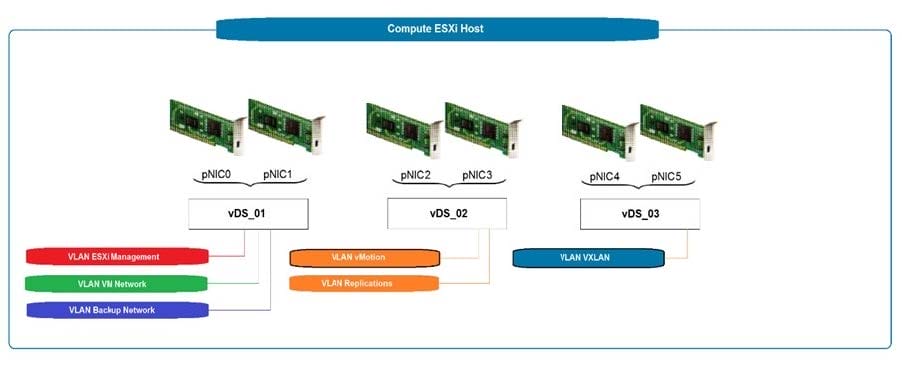
What should the architect recommend for guaranteed throughput for each service?
A. Use explicit failover order with pNIC0 as Active for ESXi Management and VM Network Use explicit failover order with pNIC1 as Active for backup network Use explicit failover order with pNIC2 as Active for vMotion Use explicit failover order with pNIC3 as Active for replication
B. Use the Route Based on IP Hash for ESXi management and VM network Use the Route Based on IP Hash for backup network Use the Route Based on the Originating Virtual Port for vMotion Use failover with pNIC3 as Active for replication
C. Create a link aggregation group (LAG) for vDS_01 Use the Route Based on Physical NIC Load for vMotion Use the Route Based on Physical NIC Load for replication
D. Use the Route Based on IP Hash for ESXi management and VM network Use failover with pNIC1 as Active for backup network Create a link aggregation group (LAG) for vDS_02
Questions 2
Refer to the exhibit.
During a requirements gathering workshop, the customer shares the following diagram regarding their availability service-level agreements (SLAs):
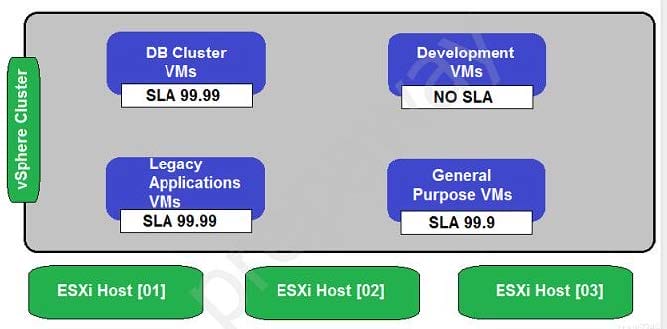
The customer wants database application level availability to always take precedence. What should the architect recommend to meet the customer's requirement?
A. Enable vSphere HA and add a VM Override with VM Restart Priority set to Highest.
B. Enable Fault Tolerance.
C. Enable Sphere HA and maintain the default settings.
D. Enable vSphere HA and add a VM Override with VM Restart Priority set to Lowest.
Questions 3
Following a recent acquisition, the architect learns that both companies use vSphere on-premise and will need to combine the data centers into one. The acquired company's licenses will not be renewed for cost-savings related to the acquisition. All consumed vSphere licenses must have active support to support lineof-business operations. The merged environment must maintain 25% spare capacity. The architect has a small budget remaining unallocated for hardware.
The architect has calculated that the current vSphere environment can absorb the acquired company's virtual machines but the cluster will run at 90% memory utilization and at 50% CPU utilization.
Which design decision can the architect make to incorporate the new company's virtual machines into the combined vSphere environment?
A. Migrate the acquired company's virtual machines into the vSphere environment as it will currently fit.
B. Use the current budget to add memory to the cluster to increase each ESXi host's capacity and add the new virtual machines.
C. Purchase extra hosts to add to the cluster in anticipation of adding the acquired company's virtual machines.
D. Purchase new licenses for some of the acquired company's ESXi hosts and add them to the cluster to hold the acquired company's virtual machines.
Reviews
-
Quick
 PhilippinesValid dumps. I hope all my friend will pass the exam, so I will introduce this dumps to them.Good luck to them and you.
 -
Mercer
 United Statespassed 9xx , I had met many same questions with this dumps. Thanks very much.
 -
Zuzi
 IsraelHi All,i took the exam this week, many of the questions were from this dumps and I swear I'm not lying.Recommend to all.
 -
ZHLEE
 MalaysiaI want to say thank you to you guys. This is the first time I buy dumps from you while I think I will be a regular customer.
 -
Marlin Erick
 KazakhstanI studied this dumps, took some online trainings. At last I pass my exam today.
 -
Sunny
 ChinaVery good study material, I just passed my exam with the help of it. Good luck to you.
 -
Rossie
 Russian Federationvery good study material.
 -
Wyatt
 South AfricaThis is the valid dumps. I passed mine yesterday. All the questions are from this dumps. Thanks.
 -
Jack
United StatesThis dumps is still valid. Just took my CCNA today and passed it. Every question i got on the test was in the dumps. -
Baines
 Turkeydumps is valid.



Home | About Us | Contact Us | FAQ | Guarantee Policy | Privacy Policy
Any charges made through this site will appear as Global Simulators Limited. All trademarks are the property of their respective owners.
Copyright © 2004-2026 pass2lead.com, All Rights Reserved.