

5V0-41.20 Online Practice Questions and Answers
Questions 4
Scenario 3: After resolving numerous connectivity issues throughout the various branch sites, connectivity between applications and users is finally present. The network administrator is informed that during certain tests, applications are not performing as they are expected to. Users report that call quality has not fully improved and that some of their calls either drop or have poor voice quality where the conversation is breaking up. Other users are noticing that file transfers are slower than expect. A group of users from a few sites have reported slowness in accessing internal and external applications.
Users at multiple branches complain that a highly performant SQL Database cluster residing at the New York Data Center is not responding to database queries or inserts as expected. It is affecting the order management site. A network administrator investigates and finds that traffic from the branches are going through Seattle to reach the SQL Cluster in New York. The design for this SD-WAN network does not call for routing security.
The SQL Cluster is reachable through either Data Center, but for performance reasons, must flow through the New York DC. The network administrator has verified that the routes are not present in the OFC and the BGP neighborship is down in Network Services.
Refer to the Exhibit(s).
Exhibit.
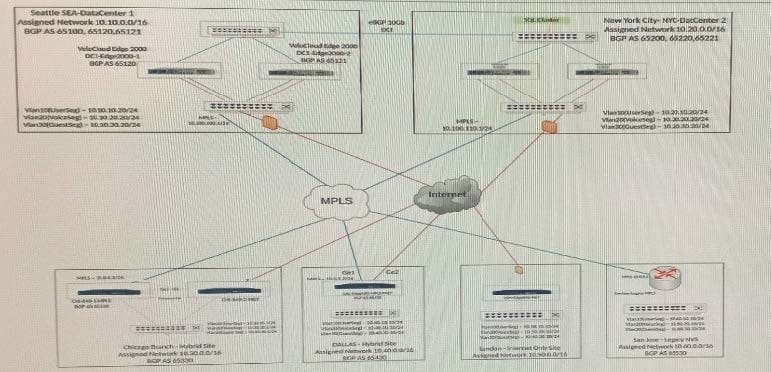
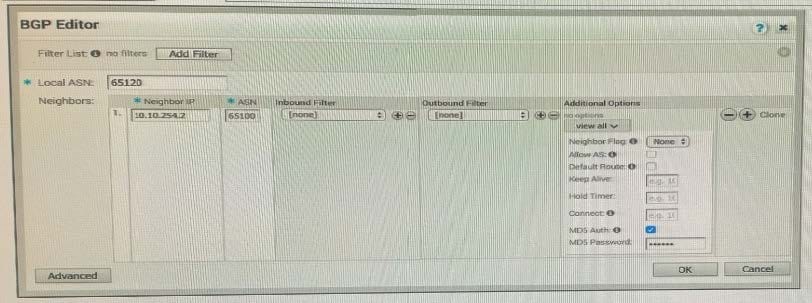
What should the administrator verify?
A. The BGP configuration has a filter in place to deny the prefix in New York.
B. The BGP Authentication matches on both sides.
C. The BGP configuration has a filter in place to deny the prefix in Seattle.
D. Backhauling through the Seattle DC is disabled.
Questions 5
Scenario 2:
After completing the branch activation activities for ail required branches, the network administrator attempts to test connectivity between the various branches and between the hubs and branches. The administrator notices a lack of connectivity despite being cert configurations have been complete. The administrator also observed that several reporting intermittent connectivity to some of the applications they are accessing. Other users are reporting no access to these applications. Other users at some of the branches claim they cannot get to certain public resources. The administrator wants to ensure that all sites can talk to each other and all resources are accessible.
Exhibit.
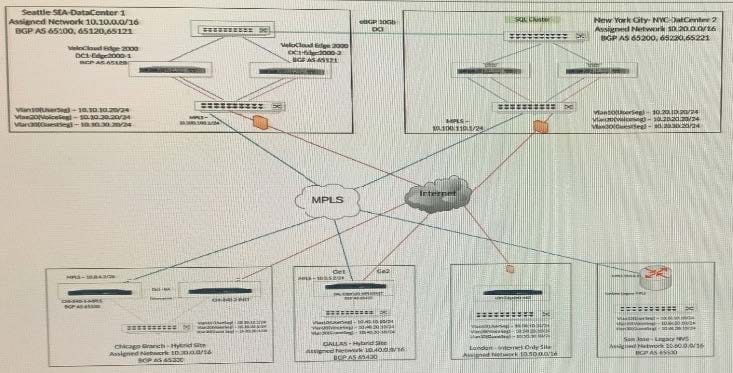
A network administrator has been told that Dallas needs some high-availability in the event that the SDWAINJ Edge goes offline for whatever reason. There is limited budget so the administrator must use the other available CE router as a fallback mechanism. The administrator will use VRRP to provide HA. When configuring VRRP, the SD-WAN Edge service restarted.
What caused this behavior?
A. The administrator failed to specify the Edge Type as a VeloCloud Cluster.
B. This is an expected behavior.
C. The device is faulty and will need a replacement.
D. The administrator failed to specify the Edge Type as a VeloCloud Active Standby Pair.
Questions 6
Scenario 3:
After resolving numerous connectivity issues throughout the various branch sites, connectivity between applications and users is finally present. The network administrator is informed that during certain tests, applications are not performing as they are expected to. Users report that call quality has not fully improved and that some of their calls either drop or have poor voice quality where the conversation is breaking up. Other users are noticing that file transfers are slower than expect. A group of users from a few sites have reported slowness in accessing internal and external applications.
Exhibit.

Users at a remote office are complaining about poor performance with certain applications. The network administrator has already configured Business Policies based on these requirements.
What is the sequence of parameters that the administrator can check to troubleshoot this problem? (Choose two.)
A. Change the bandwidth measurement under WAN Overlay Advanced Settings.
B. Check underlay network (bandwidth, latency, jitter, packet loss).
C. Under Monitor, check Routing tab.
D. Review Business Policies configuration and match them against the business requirements.
Questions 7
Scenario 2:
After completing the branch activation activities for all required branches, the network administrator attempts to test connectivity between the various branches and between the hubs and branches. The administrator notices a lack of connectivity despite being certain that configurations have been complete. The administrator also observed that several users are reporting intermittent connectivity to some of the applications they are accessing. Other users are reporting no access to these applications. Other users at some of the branches claim they cannot get to certain public resources. The administrator wants to ensure that all sites can talk to each other and all resources are accessible.
Exhibit.
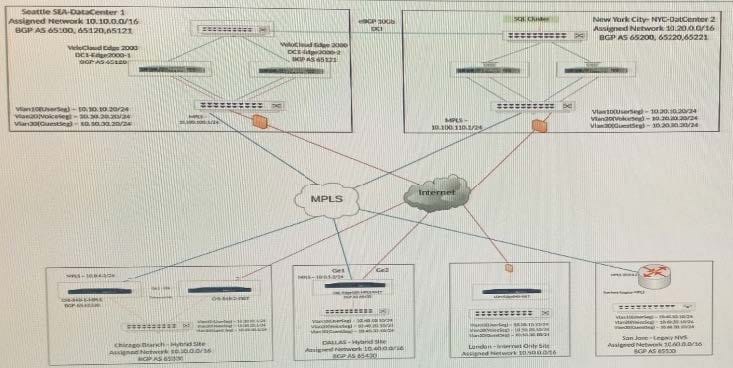
When checking connectivity from the San Jose branch, all users report that they can reach certain resources at the main data center. They are unable to reach locations elsewhere. The network administrator investigates and first looks at the Overlay Flow Control (OFC) Table.
What should the network administrator look for next to determine what the issue might be?
A. Check with the local network administrator to see if the routes for the SD-WAN sites are present in San Jose's branch router.
B. Check Test and Troubleshoot and review a route table dump of the NY hub site.
C. Check the Global Segment Configuration to see if it has the Routing Flag enabled.
D. Determine if OSPF has been configured on the MPLS Routers at the hub.
Questions 8
Scenario 2:
After completing the branch activation for all required branches, the network administrator attempts to test connectivity between the various branches and between hubs and branches. The administrator notices a lack of connectivity despite being certain that configurations have been complete. The administrator also observed that several users are reporting intermittent connectivity to some of the some applications they are accessing. Other users are reporting no access to these applications. Other users at some of the branches claim they cannot get to certain public resources. The administrator wants to ensure that all sites can talk to each other and all resources are accessible.
Exhibit.

A technician has added Edges to an East Coast Profile. These Edges are not able to communicate via dynamic tunnels to Edges in the West_Coast profile. The technician has noticed that some Edges are able to establish dynamic tunnels.
What could be preventing Edges from being able to establish dynamic tunnels?
A. The profiles are not configured to allow dynamic branch to branch VPNs.
B. The profiles are configured to only allow dynamic branch to branch for Edges within the same profile.
C. None of the existing profiles have Cloud VPN enabled thus preventing dynamic tunnels.
D. Neither profile has been configured to utilize cloud gateways.
Questions 9
Scenario 3:
After resolving numerous connectivity issues throughout the various branch sites, connectivity between applications and users is finally present. The network administrator is informed that during certain tests, applications are not performing as they are expected to. Users report that call quality has not fully improved and that some of their calls either drop or have poor voice quality where the conversation is breaking up. Other users are noticing that file transfers are slower than expect. A group of users from a few sites have reported slowness in accessing internal and external applications.
Exhibit.

A network administrator decides to deploy a local Checkpoint VNF appliance on the Edge in London to cut back on unnecessary traffic towards the NY hub location.
The Checkpoint VNF and associated security services were successfully deployed at the London Branch. Users are now are complaining that Webpages are extremely slow to load, just like before.
What should the administrator do?
A. Reboot the Edge, as this is a requirement in the deployment of a Security VNF.
B. Disable and redeploy the VNF with lower memory requirements.
C. Verify to see if a firewall rule in the Edge is set to allow traffic to the Checkpoint VNF.
D. Check the flow records in Remote Diagnostics.
Questions 10
Scenario 3:
After completing the branch activation activities for all required branches, the network administrator attempts to test connectivity between the various branches and between the hubs and branches. The administrator notices a lack of connectivity despite being certain that configurations have been complete. The administrator also observed that several users are reporting intermittent connectivity to some of the applications they are accessing. Other users are reporting no access to these applications. Other users at some of the branches claim they cannot get to certain public resources. The administrator wants to ensure that all sites can talk to each other and all resources are accessible.
Exhibit.
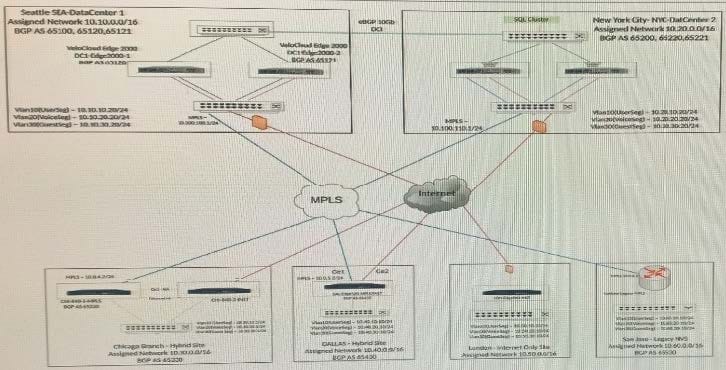
The network administrator determines that dynamic routes to SD-WAN sites are missing at the San Jose branch router. The network administrator decides to look into the configurations of hub Edges. All SD-WAN branch sites must use a hub to communicate with the San Jose site. Best practices have been implemented at these SD-WAN sites.
Where should the administrator check first to verify if the configuration is correct?
A. Verify that the NVS feature is enabled in Cloud VPN.
B. Verify that redistribution between the primary hub site and San Jose is enabled.
C. Verify the static routes to San Jose from all Branches are configured.
D. Verify that redistribution at the Dallas Hybrid Site is enabled for San Jose to use as a peering point.
Questions 11
Scenario 2:
After completing the branch activation activities for all required branches, the network administrator attempts to test connectivity between the various branches and between the hubs and branches. The administrator notices a lack of connectivity despite being certain that configurations have been complete. The administrator also observed that several users are reporting intermittent connectivity to some of the applications they are accessing. Other users are reporting no access to these applications. Other users at some of the branches claim they cannot get to certain public resources. The administrator wants to ensure that all sites can talk to each other and all resources are accessible.
Exhibit.

Several reports have come in from branch locations indicating customers cannot reach applications being served by the hub location. The hub location has a single LAN-side port from which it should be learning dynamic routes for the subnets serving the applications.
How should the technician verify if the ports on the Edge are up and working?
A. Look under Administration and System Settings to verify if the interfaces are configured and enabled.
B. Look in Test and Troubleshoot under the Remote Diagnostics and run Interface status.
C. Look in Test and Troubleshoot under the Remote Actions and run System Health.
D. Look in Test and Troubleshoot under the Remote Diagnostics and run System Health.
Questions 12
Scenario 2:
After completing the branch activation activities for all required branches, the network administrator attempts to test connectivity between the various branches and between the hubs and branches. The administrator notices a lack of connectivity despite being certain that configurations have been complete. The administrator also observed that several users are reporting intermittent connectivity to some of the applications they are accessing. Other users are reporting no access to these applications. Other users at some of the branches claim they cannot get to certain public resources. The administrator wants to ensure that all sites can talk to each other and all resources are accessible.
Exhibit.
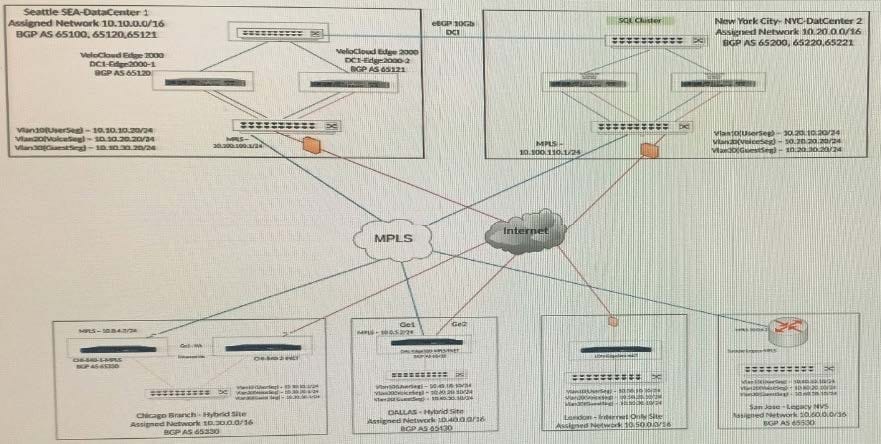
One branch location is not able to communicate with another branch location via dynamic branch-tobranch tunnels. While troubleshooting at the Edge configuration level, the network administrator notices Cloud VPN is not enabled and is grayed out, preventing them from enabling that feature.
A. Where is the next location to check for and enable the necessary feature?
B. Within the Configuration section under Profiles. Within the Monitor section under Network Services.
C. Within the Test and Troubleshooting section under Remote Diagnostics.
D. Within the Configuration section under Customer VPN enablement.
Questions 13
Scenario 2:
After completing the branch activation activities for all required branches, the network administrator attempts to test connectivity between the various branches and between the hubs and branches. The administrator notices a lack of connectivity despite being certain that configurations have been complete. The administrator also observed that several users are reporting intermittent connectivity to some of the applications they are accessing. Other users are reporting no access to these applications. Other users at some of the branches claim they cannot get to certain public resources. The administrator wants to ensure that all sites can talk to each other and all resources are accessible.
Exhibit.
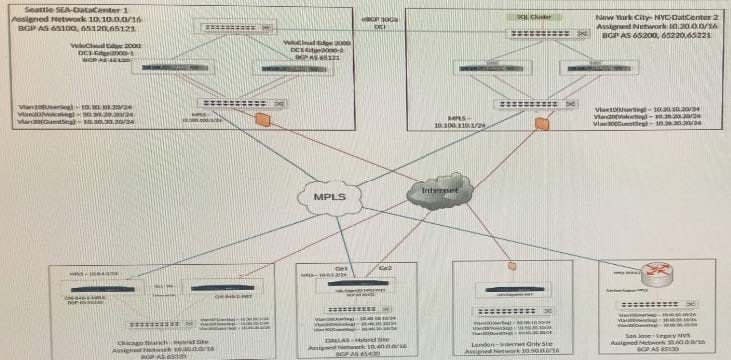
Where can the network administrator check to see what routes are present on the London- site Edge?
A. Log into the VCO > Configuration > Overlay Flow Control
B. Log into the VCO > Test and Troubleshoot > Remote Diagnostics > Run "List Paths"
C. Log into the VCO > Test and Troubleshoot > Remote Diagnostics > Run "Route Table Dump"
D. Log into the VCO > Monitoring > Overlay Flow Control


Home | About Us | Contact Us | FAQ | Guarantee Policy | Privacy Policy
Any charges made through this site will appear as Global Simulators Limited. All trademarks are the property of their respective owners.
Copyright © 2004-2026 pass2lead.com, All Rights Reserved.