

DATABRICKS-CERTIFIED-PROFESSIONAL-DATA-ENGINEER Online Practice Questions and Answers
Questions 4
A junior data engineer is working to implement logic for a Lakehouse table named silver_device_recordings. The source data contains 100 unique fields in a highly nested JSON structure.
The silver_device_recordings table will be used downstream to power several production monitoring dashboards and a production model. At present, 45 of the 100 fields are being used in at least one of these applications.
The data engineer is trying to determine the best approach for dealing with schema declaration given the highly-nested structure of the data and the numerous fields.
Which of the following accurately presents information about Delta Lake and Databricks that may impact their decision-making process?
A. The Tungsten encoding used by Databricks is optimized for storing string data; newly-added native support for querying JSON strings means that string types are always most efficient.
B. Because Delta Lake uses Parquet for data storage, data types can be easily evolved by just modifying file footer information in place.
C. Human labor in writing code is the largest cost associated with data engineering workloads; as such, automating table declaration logic should be a priority in all migration workloads.
D. Because Databricks will infer schema using types that allow all observed data to be processed, setting types manually provides greater assurance of data quality enforcement.
E. Schema inference and evolution on .Databricks ensure that inferred types will always accurately match the data types used by downstream systems.
Questions 5
To reduce storage and compute costs, the data engineering team has been tasked with curating a series of aggregate tables leveraged by business intelligence dashboards, customer-facing applications, production machine learning models, and ad hoc analytical queries.
The data engineering team has been made aware of new requirements from a customer-facing application, which is the only downstream workload they manage entirely. As a result, an aggregate table used by numerous teams across the organization will need to have a number of fields renamed, and additional fields will also be added.
Which of the solutions addresses the situation while minimally interrupting other teams in the organization without increasing the number of tables that need to be managed?
A. Send all users notice that the schema for the table will be changing; include in the communication the logic necessary to revert the new table schema to match historic queries.
B. Configure a new table with all the requisite fields and new names and use this as the source for the customer-facing application; create a view that maintains the original data schema and table name by aliasing select fields from the new table.
C. Create a new table with the required schema and new fields and use Delta Lake's deep clone functionality to sync up changes committed to one table to the corresponding table.
D. Replace the current table definition with a logical view defined with the query logic currently writing the aggregate table; create a new table to power the customer-facing application.
E. Add a table comment warning all users that the table schema and field names will be changing on a given date; overwrite the table in place to the specifications of the customer-facing application.
Questions 6
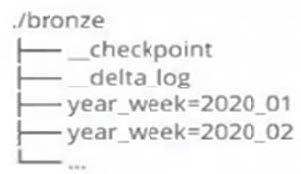
A data architect has designed a system in which two Structured Streaming jobs will concurrently write to a single bronze Delta table. Each job is subscribing to a different topic from an Apache Kafka source, but they will write data with the same schema. To keep the directory structure simple, a data engineer has decided to nest a checkpoint directory to be shared by both streams.
The proposed directory structure is displayed below: Which statement describes whether this checkpoint directory structure is valid for the given scenario and why?
A. No; Delta Lake manages streaming checkpoints in the transaction log.
B. Yes; both of the streams can share a single checkpoint directory.
C. No; only one stream can write to a Delta Lake table.
D. Yes; Delta Lake supports infinite concurrent writers.
E. No; each of the streams needs to have its own checkpoint directory.
Questions 7
A table named user_ltv is being used to create a view that will be used by data analysis on various teams. Users in the workspace are configured into groups, which are used for setting up data access using ACLs. The user_ltv table has the following schema:
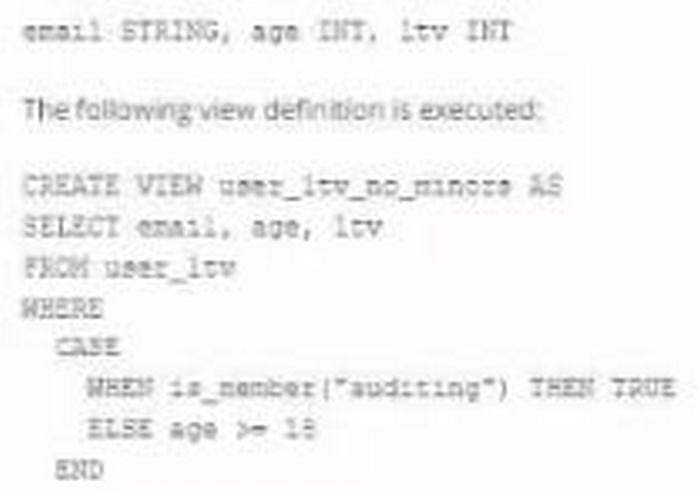
An analyze who is not a member of the auditing group executing the following query:

Which result will be returned by this query?
A. All columns will be displayed normally for those records that have an age greater than 18; records not meeting this condition will be omitted.
B. All columns will be displayed normally for those records that have an age greater than 17; records not meeting this condition will be omitted.
C. All age values less than 18 will be returned as null values all other columns will be returned with the values in user_ltv.
D. All records from all columns will be displayed with the values in user_ltv.
Questions 8
A data team's Structured Streaming job is configured to calculate running aggregates for item sales to update a downstream marketing dashboard. The marketing team has introduced a new field to track the number of times this promotion code is used for each item. A junior data engineer suggests updating the existing query as follows: Note that proposed changes are in bold.
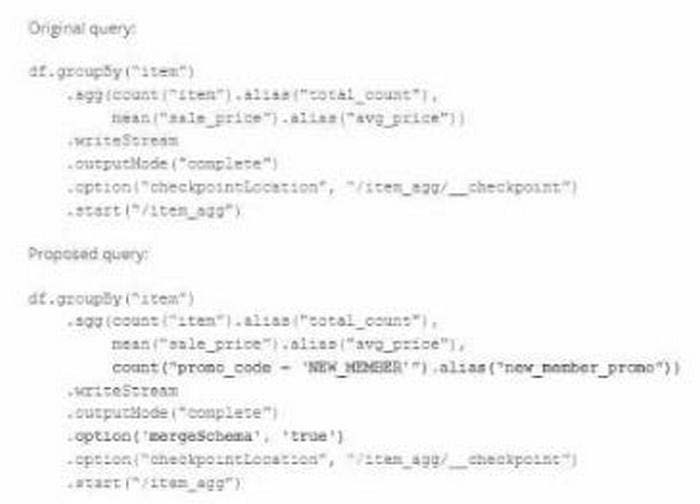
Which step must also be completed to put the proposed query into production?
A. Increase the shuffle partitions to account for additional aggregates
B. Specify a new checkpointlocation
C. Run REFRESH TABLE delta, /item_agg'
D. Remove .option (mergeSchema', true') from the streaming write
Questions 9
A data engineer wants to join a stream of advertisement impressions (when an ad was shown) with another stream of user clicks on advertisements to correlate when impression led to monitizable clicks.

Which solution would improve the performance?

A. Option A
B. Option B
C. Option C
D. Option D
Questions 10
A table named user_ltv is being used to create a view that will be used by data analysts on various teams. Users in the workspace are configured into groups, which are used for setting up data access using ACLs.
The user_ltv table has the following schema: email STRING, age INT, ltv INT
The following view definition is executed:
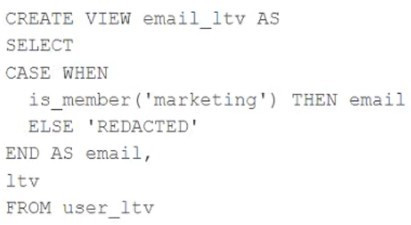
An analyst who is not a member of the marketing group executes the following query:
SELECT * FROM email_ltv
Which statement describes the results returned by this query?
A. Three columns will be returned, but one column will be named "redacted" and contain only null values.
B. Only the email and itv columns will be returned; the email column will contain all null values.
C. The email and ltv columns will be returned with the values in user itv.
D. The email, age. and ltv columns will be returned with the values in user ltv.
E. Only the email and ltv columns will be returned; the email column will contain the string "REDACTED" in each row.
Questions 11
What is the first of a Databricks Python notebook when viewed in a text editor?
A. %python
B. % Databricks notebook source
C. --Databricks notebook source
D. //Databricks notebook source
Questions 12
An external object storage container has been mounted to the location /mnt/finance_eda_bucket.
The following logic was executed to create a database for the finance team:

After the database was successfully created and permissions configured, a member of the finance team runs the following code:
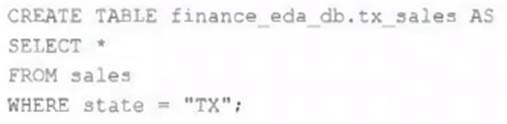
If all users on the finance team are members of the finance group, which statement describes how the tx_sales table will be created?
A. A logical table will persist the query plan to the Hive Metastore in the Databricks control plane.
B. An external table will be created in the storage container mounted to /mnt/finance eda bucket.
C. A logical table will persist the physical plan to the Hive Metastore in the Databricks control plane.
D. An managed table will be created in the storage container mounted to /mnt/finance eda bucket.
E. A managed table will be created in the DBFS root storage container.
Questions 13
Which statement describes Delta Lake Auto Compaction?
A. An asynchronous job runs after the write completes to detect if files could be further compacted; if yes, an optimize job is executed toward a default of 1 GB.
B. Before a Jobs cluster terminates, optimize is executed on all tables modified during the most recent job.
C. Optimized writes use logical partitions instead of directory partitions; because partition boundaries are only represented in metadata, fewer small files are written.
D. Data is queued in a messaging bus instead of committing data directly to memory; all data is committed from the messaging bus in one batch once the job is complete.
E. An asynchronous job runs after the write completes to detect if files could be further compacted; if yes, an optimize job is executed toward a default of 128 MB.


Home | About Us | Contact Us | FAQ | Guarantee Policy | Privacy Policy
Any charges made through this site will appear as Global Simulators Limited. All trademarks are the property of their respective owners.
Copyright © 2004-2026 pass2lead.com, All Rights Reserved.