

HPE6-A41 Online Practice Questions and Answers
Questions 4
How does a switch treat a link aggregation?
A. The switch treats the link aggregation as one logical link for spanning tree, but it learns MAC addresses separately on each individual interface within the aggregation.
B. The switch treats the link aggregation as one logical link. It assigns one spanning tree port role to the link aggregation, and it learns MAC addresses on the aggregation.
C. The switch treats the link aggregation as one logical link for MAC learning, but it assigns an individual spanning tree port role to each interface within the aggregation.
D. The switch treats each interface within the interface as a separate entity for MAC address learning; it also assigns an individual spanning tree port role to each interface.
Questions 5
Refer to the exhibit.
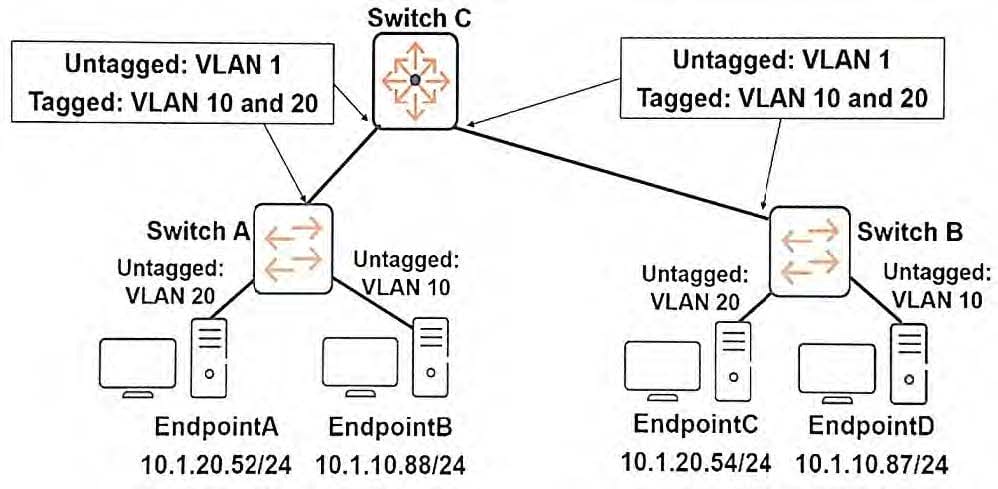
Endpoint A sends broadcast ARP requests.
Where are these requests received?
A. at EndpointC
B. at EndpointB
C. at EndpointB, at EndpointC, and at EndpointD
D. at EndpointB and at EndpointC
Questions 6
Refer to the exhibit.
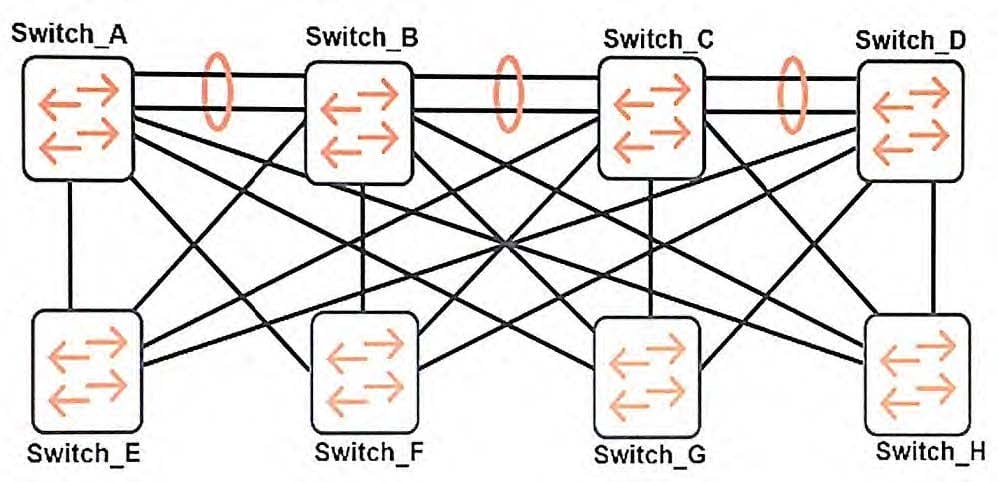
MSTP is implemented in the topology shown in the exhibit, and all the switches are in the same region. The network administrator does not want to use the Internal Spanning Tree (IST) or instance 0 for production traffic.
How many non-IST spanning tree instances does this network need in order to have effective load sharing on the uplinks from the access switches?
A. two
B. three
C. four
D. five
Questions 7
An ArubaOS switch operates at factory default settings. A network administrator enters this command: Switch (config)# password operator plaintext mysecret
How does the switch now control access to the CLI through the console port?
A. It forces users to enter no username and password operator to gain access to basic mode. Users must then enter password mysecret to reach enable mode.
B. It forces users du enter username operator and password mysecret to gain access to basic mode. Users can then reach enable mode without authenticating.
C. It allows users to access basic mode without logging in, but forces them to enter password mysecret to reach enable mode.
D. It forces users to enter no username and password mysecret to gain access to basic mode. Users can then reach enable mode without authenticating.
Questions 8
Refer to the exhibit.
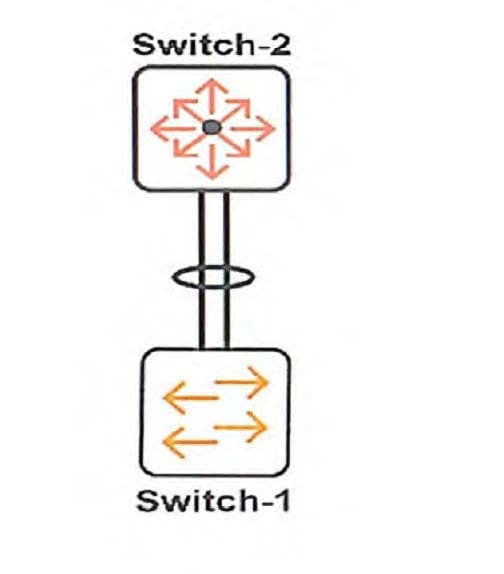
A network administrator wants to set up a link aggregation between two switches, as shown in the exhibit. The link aggregation must meet these requirements:
Protects against misconfiguration Can be configured with VLANs and other settings Which type of link aggregation should the administrator create?
A. dynamic LACP
B. static LACP
C. manual (trunk)
D. distributed (trunk)
Questions 9
Refer to the exhibit.
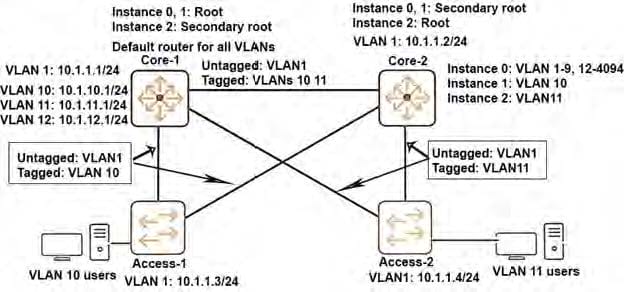
The link between Core-1 and Core-2 shown in the exhibit fails, and some users lose connectivity. What should the network administrator do to prevent this issue in a situation such as this?
A. Configure BPDU protection on all Core-2 ports.
B. Enable IP routing on Core-2.
C. Create routes to 10.1.10.0/24 and 10.1.11.0/24 through 10.1.1.3 on Core-2.
D. Extend VLANs 10 and 11 on all switch-to-switch links.
Questions 10
Refer to the exhibits.
Exhibit 1 Exhibit 2
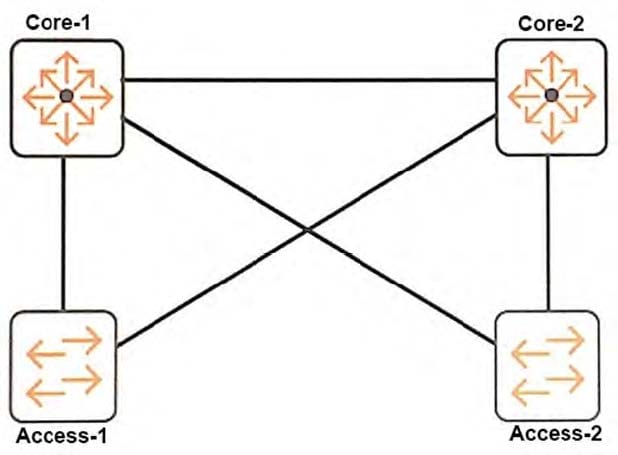
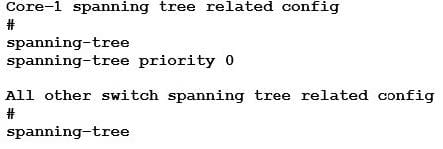
A network uses RSTP, as shown in the exhibits. The network administrator wants switches to use the link that connects to Core-2 to forward some of the traffic. The administrator enters these commands on every switch shown in the exhibit:

The administrator then discovers that the links to Core-2 still did not forward any traffic. What should the administrator do to enable these links to carry traffic?
A. Activate the MSTP region configuration on all switches.
B. Lower the port cost on the links that connect to Core-2 on the access layer switches.
C. Configure Core-2 with spanning tree priority 0 in instance 2.
D. Change the spanning tree mode to MSTP on all switches.
Questions 11
Refer to the exhibit.
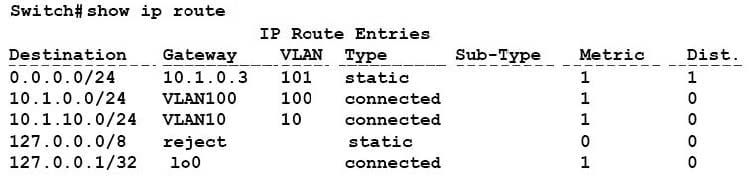
Prior to implementing OSPF on the network, an ArubaOS switch had the IP routing table shown in the exhibit. The network administrator then sets up OSPF in the network. The switch calculates these OSPF routes to 10.1.20.0/24:
Through 10.1.0.1 with cost 3 and administrative distance 110 Through 10.1.0.2 with cost 3 and administrative distance 110
How does the way the switch handles traffic destined to 10.1.20.0/24 change with the introduction of OSPF?
A. The switch stops sending the traffic to 10.1.0.3 and instead load balances it to 10.1.0.1 and 10.1.0.2.
B. The switch no longer drops this traffic and instead load balances it to 10.1.0.1 and 10.1.0.2.
C. The switch continues to send the traffic to 10.1.0.3, but it now has backup routes for the traffic in case the connection to 10.1.0.3 fails.
D. The switch no longer drops this traffic and instead sends it to 10.1.0.1.
Questions 12
Refer to the exhibit.
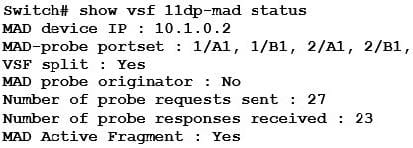
A network administrator logs in to the CLI of a Virtual Switching Framework (VSF) fabric and enters the command shown in the exhibit.
What does the output reveal?
A. MAD assistant at 10.1.0.2 failed to respond to probe requests.
B. The VSF link failed, and MAD shut down the links on the other member.
C. MAD is configured incorrectly and causes a split brain situation to occur.
D. The VSF link failed, and MAD shut down the links on this switch.
Questions 13
A network administrator wants to see how much power an Aruba AP has dynamically requested from an ArubaOS switch port. Which information should the administrator look at?
A. LLDP with the use of the show lldp info remote-device command
B. interface with the use of the show interface command
C. device class with the use of show system power-supply command
D. device profile with the use of the show device-profile status command


Home | About Us | Contact Us | FAQ | Guarantee Policy | Privacy Policy
Any charges made through this site will appear as Global Simulators Limited. All trademarks are the property of their respective owners.
Copyright © 2004-2026 pass2lead.com, All Rights Reserved.