

 Printable PDF

Applying Aruba Switching Fundamentals for Mobility: HPE6-A41
Want to pass your Applying Aruba Switching Fundamentals for Mobility HPE6-A41 exam in the very first attempt? Try Pass2lead! It is equally effective for both starters and IT professionals.
- Vendor: HP
- Exam Code: HPE6-A41
- Exam Name: Applying Aruba Switching Fundamentals for Mobility
- Certifications: HP Certifications
- Total Questions: 125 Q&As( View Details)
- Updated on: Jul 08, 2026
- Note: Product instant download. Please sign in and click My account to download your product.




- Q&As Identical to the VCE Product
- Windows, Mac, Linux, Mobile Phone
- Printable PDF without Watermark
- Instant Download Access
- Download Free PDF Demo
- Includes 365 Days of Free Updates
VCE
- Q&As Identical to the PDF Product
- Windows Only
- Simulates a Real Exam Environment
- Review Test History and Performance
- Instant Download Access
- Includes 365 Days of Free Updates
Passing Certification Exams Made Easy
Everything you need prepare and quickly pass the tough certification exams the first time
- 99.5% pass rate
- 7 Years experience
- 7000+ IT Exam Q&As
- 70000+ satisfied customers
- 365 days Free Update
- 3 days of preparation before your test
- 100% Safe shopping experience
- 24/7 Support
HP HPE6-A41 Last Month Results
Free HPE6-A41 Exam Questions in PDF Format
Related HP Certifications Exams
HPE6-A41 Online Practice Questions and Answers
Questions 1
Refer to the exhibit. Exhibit 1.
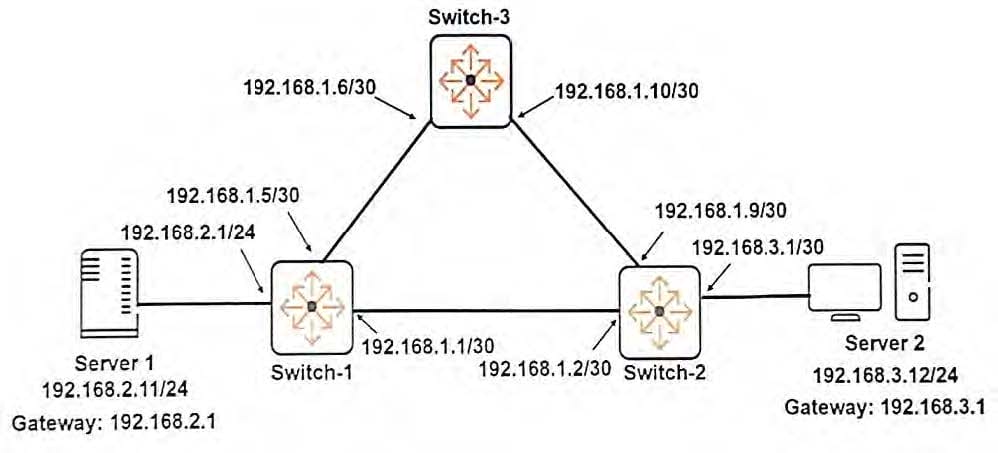
Exhibit 2.
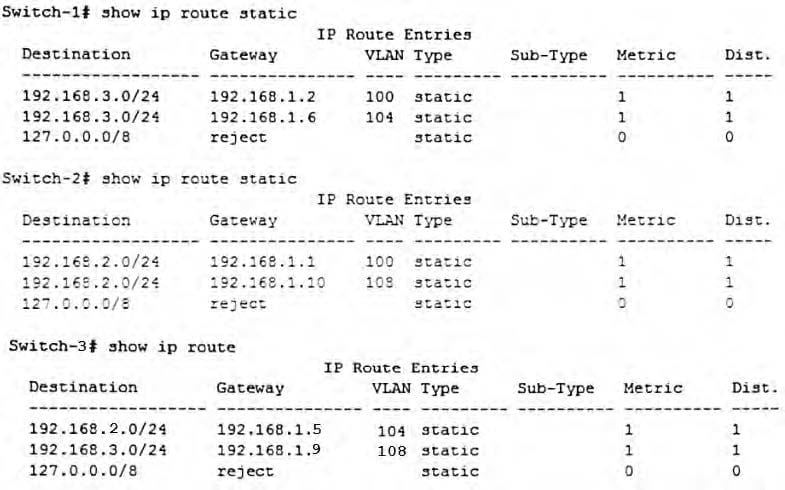
The routing configuration must support this behavior:
Server 1 and Server 2 communicate over Link 1 when Link 1 is up.
If Link 1 fails, Server 1 and Server 2 can continue to communicate over the path through Switch-3.
What must the network administrator change to meet these criteria?
A. On Switch 3, add a route to 192.168.2.0/24 through 192.168.1.9 and a route to 192.168.3.0/24 through
192.168.1.5.
B. On Switch-1, Switch-2, and Switch-3, change the next hop in each static route to specify an IP address that exists on that switch.
C. On Switch-1, raise the administrative distance for the second route to 192.168.3.0/24; on Switch-2, raise the administrative distance for the second route to 192.168.2.0/24
D. On Switch-1, add a route to 192.168.1.8/30 through 192.168.0.3; on Switch-2, add a route to 192.168.1.4/30 through 192.168.1.1; on Switch-3, add a route to 192.168.1.0/30 through 192.169.1.4.
E. On Switch-1, add a route to 192.168.1.8/30 through 192.168.1.2; on Switch-2, add a route to 192.168.1.4/30 through 192.168.1.1; on Switch-3, add a route to 192.168.1.0/30 through 192.168.1.4.
Questions 2
A network administrator needs to set up a static LACP link aggregation. How should the administrator configure the VLAN settings for the link aggregation?
A. Configure the VLANs on the physical interface with the lowest port ID before link aggregation setup.
B. Configure the VLANs on both physical interfaces after link aggregation setup.
C. Configure the VLANs on the link aggregation interface after the link aggregation setup.
D. Configure the VLANs on both physical interfaces before link aggregation setup.
Questions 3
A network administrator wants to form a cluster with several Aruba Instant APs. What is required to achieve this goal?
A. All APs must be pre-configured with WLANs with the same SSID.
B. All APs must be in the same regulatory domain.
C. All APs must operate on the same radio channel.
D. All APs must be the same model.
Reviews
-
souam
 MoroccoThere are many new questions in the dumps and the answers are accurate and correct. I finished my exam with high score this morning, thanks very much.
 -
Roosevelt
 VietnamI passed the exam today with 9xx. Dump is valid.
 -
yeah
 EgyptValid today. Pass with this dumps. very good thanks a lot.
 -
PassIT
 United Statesi cannot image that i would pass the exam with so high score, thanks for this dumps. Recommend.
 -
Hillary
 HungaryI studied this material carefully and took every question seriously. At last, I passed the exam with high score. Prepare well and study much more.
 -
Zhao
 United Arab EmiratesJust passed my exam. 4 new questions in my exam. You need to be careful. Do not just learn the answers by heart. Better to get understanding about why the correct answer is this one not that one. Recommend.
 -
Roger
United StatesAs for me , this dumps is very useful and convenient, I can find my disadvantages easily and know how to correct them. I also can learn new skills and knowledge by using this dumps. I think you also can do it. I have test it so you can trust on it. -
Wyatt
 South AfricaThis is the valid dumps. I passed mine yesterday. All the questions are from this dumps. Thanks.
 -
Lisa
 Jordanthanks god and thank you all. 100% valid. you can trust on it.
 -
_q_
United StatesDo not reply on a dumps to pass the exam.
Utilize GNS3 or real equipment to learn the technology.
Please do not degrade the value of this Cisco Cert.



Home | About Us | Contact Us | FAQ | Guarantee Policy | Privacy Policy
Any charges made through this site will appear as Global Simulators Limited. All trademarks are the property of their respective owners.
Copyright © 2004-2026 pass2lead.com, All Rights Reserved.