

HPE6-A47 Online Practice Questions and Answers
Questions 4
Refer to the exhibit.
Exhibit 1 shows the logical plan, and Exhibit 2 shows the BOM created with IRIS. An architect plans to propose two 5406Rzl switches as a VSF fabric for a campus network core. Which issue with the plan should the architect correct?
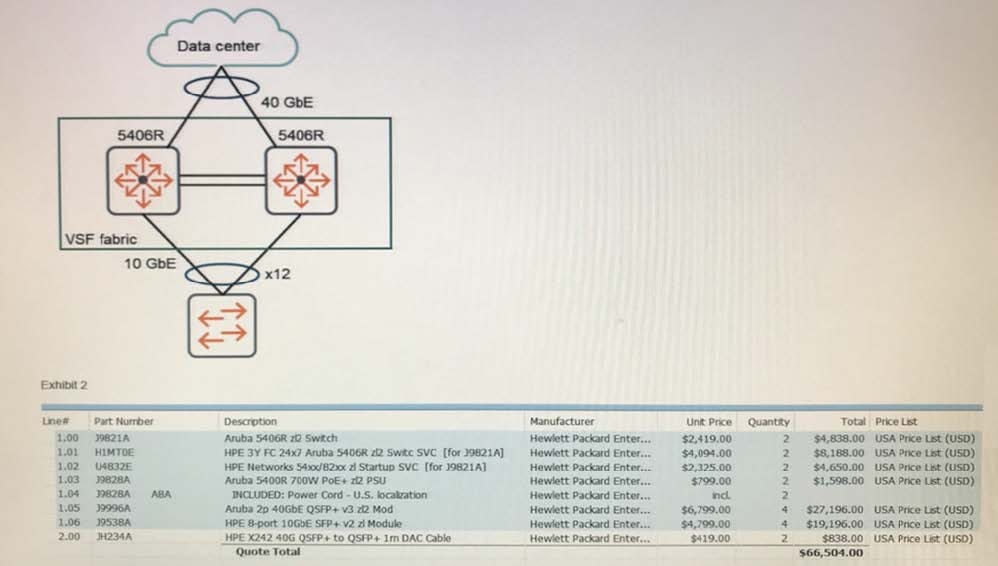
A. Add two QSPF+ MP0 SR4 transceivers.
B. Change the v2 modules to v3 modules.
C. Add stacking modules and cables.
D. Change the power supply type.
Questions 5
An architect needs to plan the bandwidth for two Aruba 7240 Mobility Controllers (MCs) which will connect to the network core. The customer indicates that four 10 GbE links between the network core and the data center will be adequate. The customer expects almost all traffic in the network will be wireless. The customer expects up to 25 Gbps upstream traffic from wireless clients and up to 35 Gbps downstream to wireless clients. The customer requires the MCs to be able to continue to forward traffic if up to one link fails, but lower performance during the failover situation is permissible.
What are the minimal links to meet these requirements?
A. two 10 GbE links on each of the MC
B. two 40 GbE links in each of the MCs
C. three 10 GbE links on each of the MCs
D. four 10 GbE links on each of the MCs.
Questions 6
A customer needs a solution to terminate VPN tunnels for Aruba RAPs. The customer has a single site and a single public IP address for this purpose. Network address translation (NAT) will forward the IPsec traffic to the correct device to terminate the VPN tunnel. The customer also requires N+1 redundancy for the solution.
Which solution meets the customer requirements?
A. two Aruba MCs on the same subnet that use VRRP without clustering
B. two Aruba MCs deployed as a Layer 3 cluster
C. two Aruba MCs on different subnets that use VRRP without clustering
D. two Aruba MCs deployed as a Layer 2 cluster
Questions 7
An architect proposes an Aruba solution with a hardware Mobility Master (MM) to a customer. The customer has a disaster recovery site which is connected to the main site at Layer 3. The customer requires the MM to remain available in case of a total site failure.
Which plan meets the customer requirements?
A. Deploy a hardware MM to the disaster recovery site and set up VRRP between them.
B. Deploy a hardware MM to the disaster recovery site and set its IP address as the standby master for MCs.
C. Deploy the virtual MM (VMM) to the disaster recovery site and set the VMM IP address to the same address as the hardware MM.
D. Deploy the virtual MM (VMM) to the disaster recovery site and configure clustering on the hardware and software appliances.
Questions 8
A customer has very high availability requirements for wireless services. The architect plans to implement clustering on several Aruba Mobility Controllers (MCs).
Which benefit of this feature should the architect explain?
A. Clustering provides wireless client load balancing and seamless failover for client sessions.
B. Clustering provides high stability because one MC is active for all sessions and one is standby for all sessions.
C. Clustering enables an AP with a failed MC to operate on its own briefly to ensure seamless connectivity.
D. Clustering enables an AP with a failed MC to reconnect to a new AP after a short bootstrap.
Questions 9
An architect needs to plan a wireless deployment. The architect conducts a physical walkthrough, but still needs more information.
Which significant RF obstacle can be difficult to see visually and might require access to blueprints?
A. fiberglass
B. metal firewall
C. ceiling tiles
D. drywall
Questions 10
An architect needs to plan 802.11ac wireless deployment for an office environment with a mix of closed offices and cubicles. The coverage area is approximately 4,645 square meters (approximately 50,000 square feet) and has 350 users. The employees use the wireless network for typical office applications, such as email, Web, printing, and accessing shared files and datacenter services.
The architect plans to do a predictive site survey and use VisualRF to plan the coverage.
What is a general estimate for the AP count that the architect should have in mind?
A. 5-10
B. 10-15
C. 20-25
D. 40-45
Questions 11
An architect needs to plan an 802.11ac wireless upgrade for a university building. What is one reason that it is important for the architect to identify auditoriums?
A. Auditoriums typically require a high-density AP design for RF coverage.
B. Users in Auditoriums often have Bluetooth devices, which can be a source of interface in the 5 GHz band.
C. Auditoriums typically require the use of 80 MHz channels to meet bandwidth requirements.
D. Auditoriums often require the use of DFS channels for sufficient 20 MHz channels.
Questions 12
For which scenario does the Aruba backplane stacking technology meet the needs?
A. The customer needs to deploy a pair of aggregation switches in the same closet, and wants to simplify the architecture and redundancy design.
B. The customer needs to simplify the deployment of core switches which are located in different closets for redundancy purposes.
C. The customer needs to expand the network and make it possible for the current core switches to support more MAC forwarding and ARP entries.
D. The customer needs to deploy a switch at a branch office and have the switch automatically discover and join the network stack at the main office.
Questions 13
Refer to the exhibit.
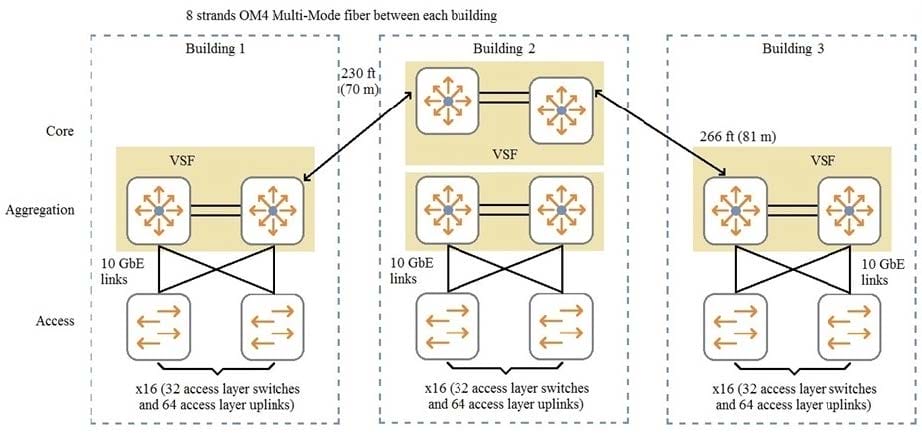
An architect selects 5406R switches for the aggregation layer.
What is the maximum bandwidth possible between the aggregation and core layers using 8 strands of OM4 MM fiber at the distances indicated in the diagram?
A. 60 Gbps
B. 160 Gbps
C. 200 Gbps
D. 320 Gbps


Home | About Us | Contact Us | FAQ | Guarantee Policy | Privacy Policy
Any charges made through this site will appear as Global Simulators Limited. All trademarks are the property of their respective owners.
Copyright © 2004-2026 pass2lead.com, All Rights Reserved.