

PMI-ACP Online Practice Questions and Answers
Questions 4
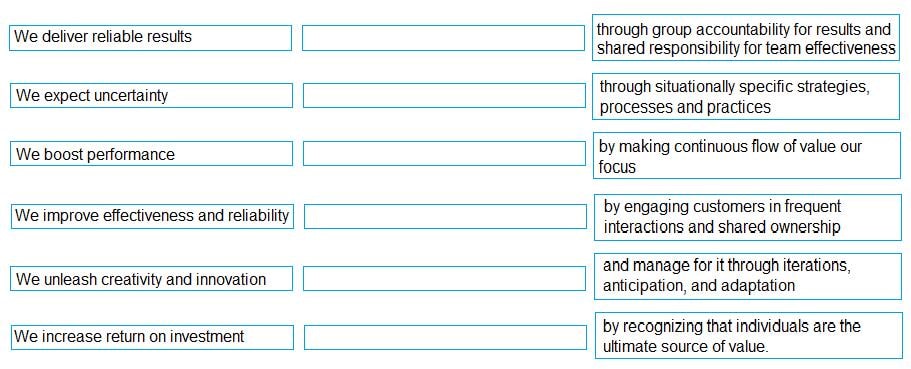
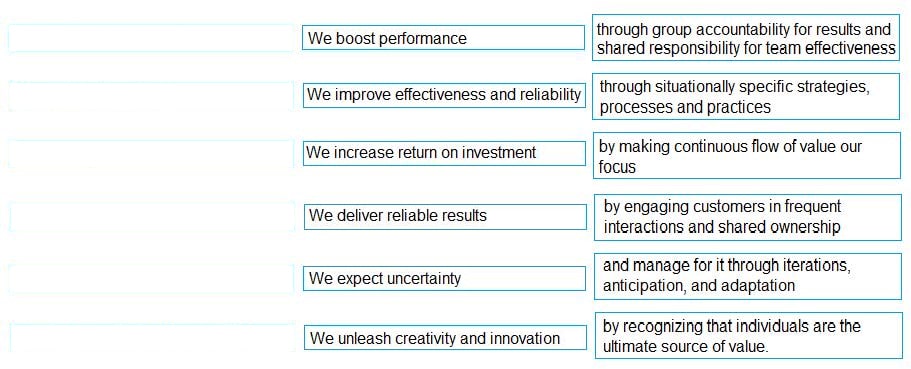
The PM Declaration of Interdependence is a set of six management principle initially intended for project managers of Agile software development projects. Match the items below to identify the principles.
Select and Place:
Questions 5
At a strategic level, what is the most appropriate way for an Agile team to estimate a project?
A. Creating a strategic plan by estimating hours and days required
B. Using an abstract measurement to estimate Product Backlog items
C. Estimating source lines of code needed to implement the features
D. Taking an initial set of estimates and adding an appropriate risk factor
Questions 6
_____________ an estimate refers to estimating a story based on its relationship to one or more other stories.
A. Triangulating
B. Triaging
C. Aggregating
D. Disaggregating
Questions 7
Which of these statements is NOT correct about Ideal time and Calendar time?
A. Ideal time is the time that is actually required to complete the work
B. Both of them convey the same meaning
C. Calendar time is the amount of time that passes on clock (calendar days)
D. Normally calendar days are not equal to ideal days
Questions 8
In the first part of the Sprint Planning meeting, what is NOT accomplished?
A. Items are selected from the Product Backlog
B. The Development Team decides how much work can be accomplished
C. The Scrum Team defines the Sprint Goal
D. The Tasks are defined
Questions 9
Who is NOT part of the Scrum Team?
A. Product Owner
B. Scrum Master
C. Customer
D. Development Team
Questions 10
The purpose of a Sprint retrospective is for the Scrum team to:
A. Review stories planned for the next sprint and provide estimates,
B. Demonstrate completed user stories to the Product Owner.
C. Determine what to stop doing, start doing, and continue doing.
D. Individually provide status updates on user stories in progress.
Questions 11
During the iteration planning of a newly on boarded agile team, the product owner adds a set of high priority user stories into the iteration backlog. What should the team do first to define the tasks need to implement the user stories?
A. Self-organize
B. Assign tasks to each team
C. Meet with the customer
D. Identify the Scrum Master
Questions 12
The risk profile of a project has increased beyond the upper threshold of tolerance. The product owner and project leader meet to discuss an approach for dealing with this.
What should the team do next?
A. Add risk mitigation tasks to the backlog, then prioritize in current and upcoming sprints
B. Add risk mitigation time to each requirement
C. Apply the 80/20 rule, reserving 20 percent of each sprint's capacity for risk mitigation
D. Hold a risks until they become issues, then add issue resolution tasks to the product backlog
Questions 13
A new product owner needs to manage the backlog of a high-visibility, fast-moving project that is consuming a considerable amount of time.
What should the product owner do?
A. Schedule regular meetings with the scrum team to write, groom, and size user stories
B. Focus on stories based on the highest number of story points to first address those items with the highest value
C. Seek regular input from project stakeholders, and reflect this input in the backlog's priorities
D. Schedule in-person, monthly meetings with key stakeholders to review the project's progress


Home | About Us | Contact Us | FAQ | Guarantee Policy | Privacy Policy
Any charges made through this site will appear as Global Simulators Limited. All trademarks are the property of their respective owners.
Copyright © 2004-2026 pass2lead.com, All Rights Reserved.