

SCS-C02 Online Practice Questions and Answers
Questions 4
A Software Engineer wrote a customized reporting service that will run on a fleet of Amazon EC2 instances. The company security policy states that application logs for the reporting service must be centrally collected. What is the MOST efficient way to meet these requirements?
A. Write an IAM Lambda function that logs into the EC2 instance to pull the application logs from the EC2 instance and persists them into an Amazon S3 bucket.
B. Enable IAM CloudTrail logging for the IAM account, create a new Amazon S3 bucket, and then configure Amazon CloudWatch Logs to receive the application logs from CloudTrail.
C. Create a simple cron job on the EC2 instances that synchronizes the application logs to an Amazon S3 bucket by using rsync.
D. Install the Amazon CloudWatch Logs Agent on the EC2 instances, and configure it to send the application logs to CloudWatch Logs.
Questions 5
You have a vendor that needs access to an IAM resource. You create an IAM user account. You want to restrict access to the resource using a policy for just that user over a brief period. Which of the following would be an ideal policy to use?
A. An IAM Managed Policy
B. An Inline Policy
C. A Bucket Policy
D. A bucket ACL
Questions 6
You want to get a list of vulnerabilities for an EC2 Instance as per the guidelines set by the Center of Internet Security. How can you go about doing this?
A. Enable IAM Guard Duty for the Instance
B. Use IAM Trusted Advisor
C. Use IAM inspector
D. UseIAMMacie
Questions 7
You are planning on using the IAM KMS service for managing keys for your application. For which of the following can the KMS CMK keys be used for encrypting? Choose 2 answers from the options given below
A. Image Objects
B. Large files
C. Password
D. RSA Keys
Questions 8
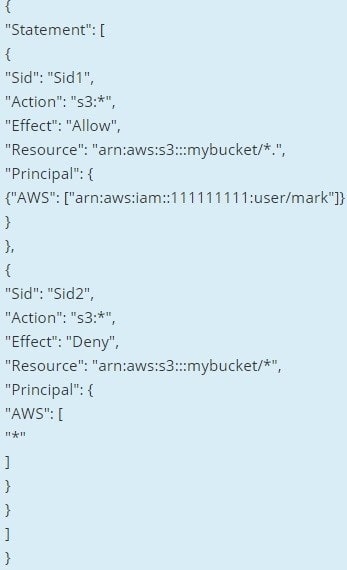
What is the result of the following bucket policy?
Choose the correct answer:
A. It will allow all access to the bucket mybucket
B. It will allow the user mark from IAM account number 111111111 all access to the bucket but deny everyone else all access to the bucket
C. It will deny all access to the bucket mybucket
D. None of these
Questions 9
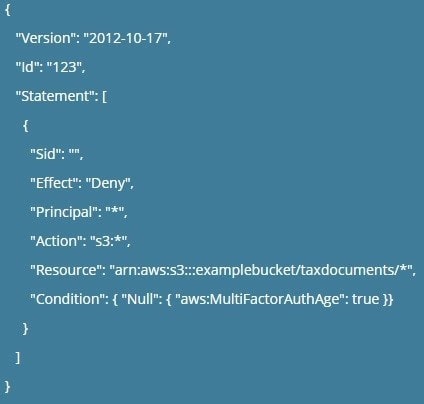
A company stores critical data in an S3 bucket. There is a requirement to ensure that an extra level of security is added to the S3 bucket. In addition , it should be ensured that objects are available in a secondary region if the primary one goes down. Which of the following can help fulfil these requirements? Choose 2 answers from the options given below
A. Enable bucket versioning and also enable CRR
B. Enable bucket versioning and enable Master Pays
C. For the Bucket policy add a condition for {"Null": {"IAM:MultiFactorAuthAge": true}} i
D. Enable the Bucket ACL and add a condition for {"Null": {"IAM:MultiFactorAuthAge": true}}
Questions 10
A company is operating a website using Amazon CloudFornt. CloudFront servers some content from Amazon S3 and other from web servers running EC2 instances behind an Application. Load Balancer (ALB). Amazon DynamoDB is used as the data store. The company already uses IAM Certificate Manager (ACM) to store a public TLS certificate that can optionally secure connections between the website users and CloudFront. The company has a new requirement to enforce end-to-end encryption in transit. Which combination of steps should the company take to meet this requirement? (Select THREE.)
A. Update the CloudFront distribution. configuring it to optionally use HTTPS when connecting to origins on Amazon S3
B. Update the web application configuration on the web servers to use HTTPS instead of HTTP when connecting to DynamoDB
C. Update the CloudFront distribution to redirect HTTP corrections to HTTPS
D. Configure the web servers on the EC2 instances to listen using HTTPS using the public ACM TLS certificate Update the ALB to connect to the target group using HTTPS
E. Update the ALB listen to listen using HTTPS using the public ACM TLS certificate. Update the CloudFront distribution to connect to the HTTPS listener.
F. Create a TLS certificate Configure the web servers on the EC2 instances to use HTTPS only with that certificate. Update the ALB to connect to the target group using HTTPS.
Questions 11
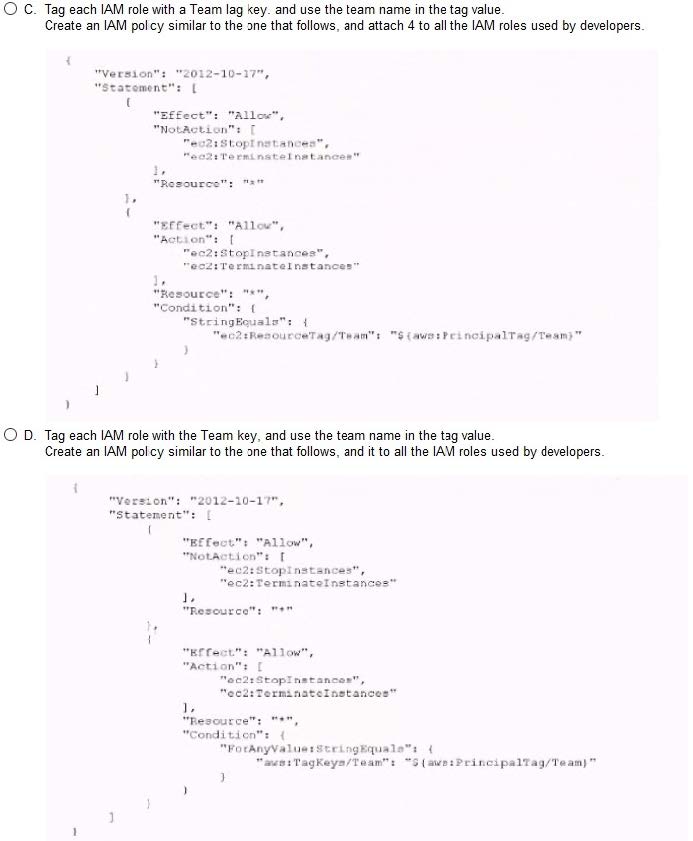
A company created an IAM account for its developers to use for testing and learning purposes Because MM account will be shared among multiple teams of developers, the company wants to restrict the ability to stop and terminate Amazon EC2 instances so that a team can perform these actions only on the instances it owns.
Developers were Instructed to tag al their instances with a Team tag key and use the team name in the tag value One of the first teams to use this account is Business Intelligence A security engineer needs to develop a highly scalable solution for providing developers with access to the appropriate resources within the account The security engineer has already created individual IAM roles for each team.
Which additional configuration steps should the security engineer take to complete the task?
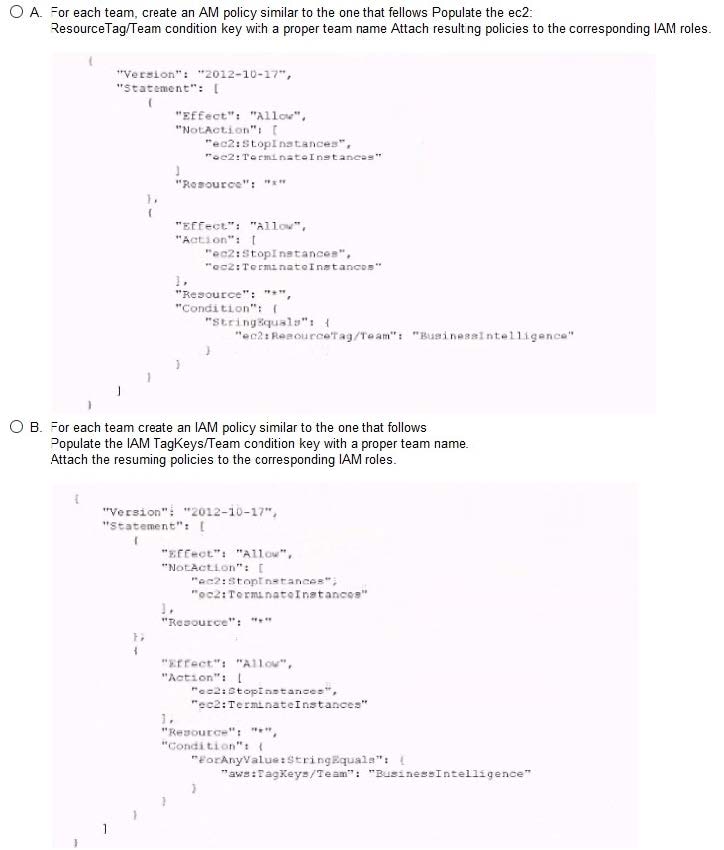
A. Option A
B. Option B
C. Option C
D. Option D
Questions 12
A team is using AWS Secrets Manager to store an application database password. Only a limited number of IAM principals within the account can have access to the secret. The principals who require access to the secret change frequently. A security engineer must create a solution that maximizes flexibility and scalability.
Which solution will meet these requirements?
A. Use a role-based approach by creating an IAM role with an inline permissions policy that allows access to the secret. Update the IAM principals in the role trust policy as required.
B. Deploy a VPC endpoint for Secrets Manager. Create and attach an endpoint policy that specifies the IAM principals that are allowed to access the secret. Update the list of IAM principals as required.
C. Use a tag-based approach by attaching a resource policy to the secret. Apply tags to the secret and the IAM principals. Use the aws:PrincipalTag and aws:ResourceTag IAM condition keys to control access.
D. Use a deny-by-default approach by using IAM policies to deny access to the secret explicitly. Attach the policies to an IAM group. Add all IAM principals to the IAM group. Remove principals from the group when they need access. Add the principals to the group again when access is no longer allowed.
Questions 13
A security engineer is checking an AWS CloudFormation template for vulnerabilities. The security engineer finds a parameter that has a default value that exposes an application's API key in plaintext. The parameter is referenced several times throughout the template.
The security engineer must replace the parameter while maintaining the ability to reference the value in the template.
Which solution will meet these requirements in the MOST secure way? {resolve:s3:MyBucketName:MyObjectName}}.
A. Store the API key value as a SecureString parameter in AWS Systems Manager Parameter Store. In the template, replace all references to the value with {{resolve:ssm:MySSMParameterName:I}}.
B. Store the API key value in AWS Secrets Manager. In the template, replace all references to the value with { {resolve:secretsmanager:MySecretId:SecretString}}.
C. Store the API key value in Amazon DynamoDB. In the template, replace all references to the value with {{resolve:dynamodb:MyTableName:MyPrimaryKey}}.
D. Store the API key value in a new Amazon S3 bucket. In the template, replace all references to the value with {


Home | About Us | Contact Us | FAQ | Guarantee Policy | Privacy Policy
Any charges made through this site will appear as Global Simulators Limited. All trademarks are the property of their respective owners.
Copyright © 2004-2026 pass2lead.com, All Rights Reserved.