

 Printable PDF

Security, Specialist (JNCIS-SEC): JN0-333
Want to pass your Security, Specialist (JNCIS-SEC) JN0-333 exam in the very first attempt? Try Pass2lead! It is equally effective for both starters and IT professionals.
- Vendor: Juniper
- Exam Code: JN0-333
- Exam Name: Security, Specialist (JNCIS-SEC)
- Certifications: Juniper Certifications
- Total Questions: 75 Q&As( View Details)
- Updated on: Jul 05, 2026
- Note: Product instant download. Please sign in and click My account to download your product.




- Q&As Identical to the VCE Product
- Windows, Mac, Linux, Mobile Phone
- Printable PDF without Watermark
- Instant Download Access
- Download Free PDF Demo
- Includes 365 Days of Free Updates
VCE
- Q&As Identical to the PDF Product
- Windows Only
- Simulates a Real Exam Environment
- Review Test History and Performance
- Instant Download Access
- Includes 365 Days of Free Updates
Passing Certification Exams Made Easy
Everything you need prepare and quickly pass the tough certification exams the first time
- 99.5% pass rate
- 7 Years experience
- 7000+ IT Exam Q&As
- 70000+ satisfied customers
- 365 days Free Update
- 3 days of preparation before your test
- 100% Safe shopping experience
- 24/7 Support
Juniper JN0-333 Last Month Results
Free JN0-333 Exam Questions in PDF Format
Related Juniper Certifications Exams
JN0-333 Online Practice Questions and Answers
Questions 1
You have recently configured an IPsec tunnel between two SRX Series devices. One of the devices is assigned an IP address using DHCP with an IP address that changes frequently. Initial testing indicates that the IPsec tunnel is not working. Troubleshooting has revealed that Phase 1 negotiations are failing.
Which two actions would solve the problem? (Choose two.)
A. Verify that the device with the IP address assigned by DHCP is the traffic initiator.
B. Verify that VPN monitoring is enabled.
C. Verify that the IKE policy is configured for aggressive mode.
D. Verify that PKI is properly configured.
Questions 2
Click the Exhibit button.
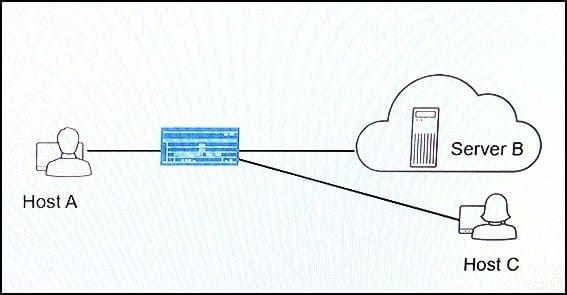
You have configured NAT on your network so that Host A can communicate with Server B. You want to ensure that Host C can initiate communication with Host A using Host A's reflexive address.
Referring to the exhibit, which parameter should you configure on the SRX Series device to satisfy this requirement?
A. Configure persistent NAT with the target-host parameter.
B. Configure persistent NAT with the target-host-port parameter.
C. Configure persistent NAT with the any-remote-host parameter.
D. Configure persistent NAT with the port-overloading parameter.
Questions 3
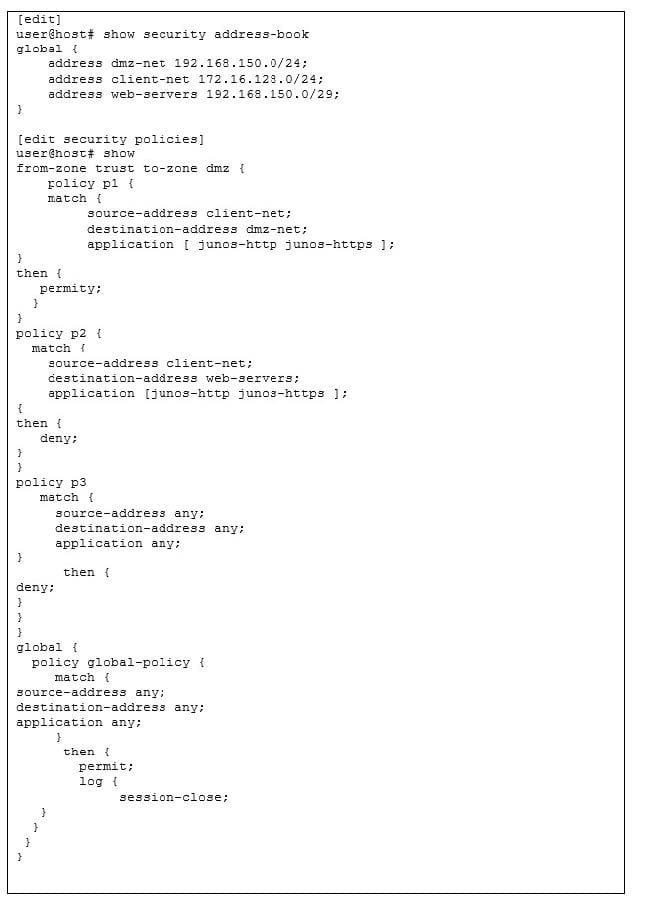
Click the Exhibit button. Referring to the exhibit, what will happen if client 172.16.128.50 tries to connect to destination 192.168.150.3 using HTTP?
A. The client will be permitted by policy p1.
B. The client will be denied by policy p3.
C. The client will be denied by policy p2.
D. The client will be permitted by the global policy.
Reviews
-
zel
 Sri LankaI'm so happy that I passed exam this week. Thanks for this study material and my friend's recommendation.
 -
Zhivotnikov
 Russian FederationExam Passed. Valid dumps. Recommend strongly.
 -
Linda
 GreeceThanks for my friend's introduction, I passed the exam by using this study material luckily. Good lucky to you!
 -
Vic
Sri LankaGreat job, you guys. I passed my exam with your help! Thanks for everything! -
Kim
 CambodiaI appreciated this dumps not only because it helped me pass the exam, but also because I learned much knowledge and skills. Thanks very much.
 -
Kevin
 GhanaThe Dumb is valid 100%.
 -
Dale
 United StatesThanks for your help I pass my exam yesterday. Although I did not get a very high score but never mind. Thanks.
 -
Osman
 FranceI have tested yet. I prepared my exam only with their materials. Recommend.
 -
Ziaul huque
 New ZealandThis study material is very useful and effective, if you have not much time to prepare for your exam, this study material is your best choice.
 -
Talon
United StatesStill valid!! 97%



Home | About Us | Contact Us | FAQ | Guarantee Policy | Privacy Policy
Any charges made through this site will appear as Global Simulators Limited. All trademarks are the property of their respective owners.
Copyright © 2004-2026 pass2lead.com, All Rights Reserved.